



UNIST Solves Electric Vehicle Battery Fire Problem
 Published2023.10.17 08:18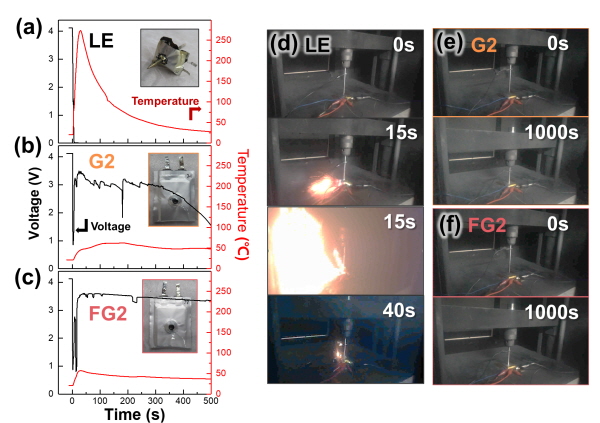
▲ Nail penetration test results. Liquid electrolytes experience a rapid temperature rise and voltage drop within seconds of a nail penetrating, potentially leading to an explosion. Semi-solid electrolytes, on the other hand, maintain a stable temperature and avoid explosion.
Fire suppression and high lithium-ion conductivity confirmed
A non-flammable, semi-solid electrolyte has been developed. This promises to solve the problem of electric vehicle battery fires threatening underground parking lots.
UNIST (President Yong-Hoon Lee) announced on the 17th that a joint research team consisting of Professor Hyun-Gon Song of the Department of Energy and Chemical Engineering at UNIST, Dr. Seo-Hyeon Jeong of the Fine Chemical Research Center at the Korea Research Institute of Chemical Technology, and Dr. Tae-Hee Kim of the Ulsan Next-Generation Battery Research and Development Center at the Korea Institute of Energy Research have developed a “non-flammable polymer semi-solid electrolyte” capable of molecular bonding within a battery.
Until now, non-flammable electrolytes have used excessive amounts of flame-retardant additives or solvents with extremely high boiling points. This has led to several drawbacks, including a sharp decrease in the ionic conductivity of the electrolyte.
The research team created a "semi-solid electrolyte" by adding a small amount of polymer (2 wt.%) to the electrolyte. The resulting polymer semi-solid electrolyte exhibited a lithium ion conductivity (4.8 mS/cm), 33% higher than that of conventional liquid electrolytes. The pouch-type battery utilizing this showed a 110% improved lifespan by forming an SEI layer to prevent unnecessary reactions in the electrolyte that occur during operation.
The reason it possesses both excellent electrolyte performance and non-flammability is because it can suppress radical chain reactions between fuel and the combustion process. Radicals are atoms or molecules with a single electron and exhibit highly unstable properties. The research team once again demonstrated the excellence of the developed polymer by quantitatively analyzing the values that can stabilize radicals and suppress them.
“We were able to suppress the radical chain reaction by utilizing the interaction between the polymerized polymer and the volatile solvent within the battery,” said first author Jeong Ji-hong, a researcher in the Department of Energy and Chemical Engineering at UNIST. “By analyzing the radical suppression value through electrochemical quantification, it will be of great help in elucidating the mechanism of non-flammable electrolytes.”
Co-first author Kim Mi-deum, a master's student in the Department of Energy and Chemical Engineering at UNIST and the Korea Research Institute of Chemical Technology, explained, "We not only evaluated the non-flammability of the electrolyte, but also confirmed the excellent safety of the battery itself through various experiments, such as applying it to pouch-type batteries."
Professor Song Hyun-gon of the Department of Energy and Chemical Engineering said, “This is a collaboration between three institutions: the UNIST research team conducted electrochemistry, the Korea Research Institute of Chemical Technology’s Fine Chemical Research Center conducted polymer synthesis, and the Korea Institute of Energy Research’s Ulsan Next-Generation Battery Research and Development Center conducted battery safety testing.” He added, “The non-flammable semi-solid electrolyte utilizing polymers can be directly applied to the existing battery assembly process, which will accelerate the commercialization of non-flammable batteries in the future.”
This study has been applied for five domestic and two overseas patents, and was selected as the supplementary cover paper of ACS Energy Letters, a prestigious academic journal in the energy field, and was published online on October 13. This research was supported by the National Research Foundation of Korea (NRF) under the Ministry of Science and ICT, the Korea Institute of Industrial Technology Planning and Evaluation, the Korea Research Institute of Chemical Technology, and Samsung SDI.
.jpg)
▲Professor Song Hyeon-gon (second from the left in the top row), researcher Kim Mi-deum (first author of the original photo), and researcher Jeong Ji-hong (first author of the original photo, first from the right in the bottom row) are taking a commemorative photo.

Comments
Related news
UNIST Discovers Material to Lower Electric Vehicle Prices
Novel design principles for 'disordered rock salt materials,' which are attracting attention as next-generation electric vehicle battery materials, have been newly presented, providing momentum for the development of materials that can lower electric vehicle prices.
2021.05.10by 배종인 기자
UNIST Develops Technology to Diagnose Internal Solid-State Batteries Using Pressure
A non-destructive diagnostic technique that identifies secondary reactions reducing battery lifespan has been developed domestically. Professor Lee Hyun-wook's team at the Department of Energy Chemistry Engineering at UNIST successfully distinguished between secondary phase formation and dendritic material generation reactions within sulfide solid-state batteries by analyzing pressure changes. Solid-state batteries are next-generation batteries with no explosion risk, achieved by replacing the internal liquid electrolyte with a solid material.
2021.09.07by 이수민 기자
.jpg)
KETI Develops Single-Particle All-Solid-State Battery Cathode Material Technology
KETI recently developed cathode material manufacturing technology that provides high charging characteristics and superior cycle life for all-solid-state batteries.
2023.07.26by 배종인 기자
KETI Secures Economic Feasibility of All-Solid-State Batteries
The Korea Electronics Technology Institute (KETI, Director Shin Hee-dong) has secured economic feasibility in all-solid-state battery manufacturing processes through the development of high-capacity electrode technology with improved atmospheric stability.
2023.09.11by 배종인 기자

Accelerates commercialization of all-solid-state batteries with inexpensive, eco-friendly materials
Professor Lee Hyun-wook and Jung Sung-kyun from the Department of Energy Chemical Engineering at UNIST (President Lee Yong-hun) and Professor Seo Dong-hwa from KAIST have developed an all-solid-state sodium secondary battery that operates at room temperature. By using Prussian blue-based materials, which are inexpensive and environmentally friendly, they have simultaneously resolved issues of high cost and environmental concerns associated with solid electrolytes, significantly accelerating the commercialization of all-solid-state batteries.
2023.09.26by 배종인 기자











