


UNIST Improves Secondary Battery Performance by Recycling Mask Waste
 Published2023.10.19 09:18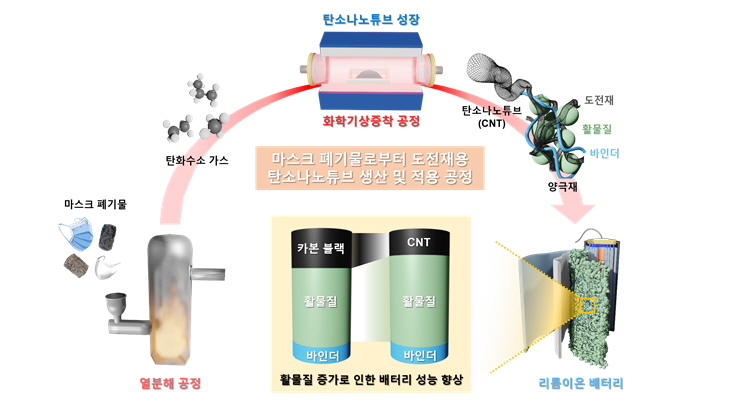
▲A schematic diagram illustrating the overall research process for producing carbon nanotubes from mask waste and applying them as a conductive material for lithium-ion batteries. The pyrolysis process of pelletized mask waste produces hydrocarbon gas, which is then fed into a chemical vapor deposition process to produce carbon nanotubes. The produced carbon nanotubes are then mixed with active materials and binders to form a cathode material, which is then applied as a cathode conductive material for lithium-ion batteries.
A technology has been developed to process mask waste into advanced materials that can enhance battery performance. This recycling of waste plastic is expected to protect the environment and lead to the development of a core technology for use in advanced industries.
A research team led by Professor Ahn Kwang-jin of the Department of Energy and Chemical Engineering at UNIST (President Yong-Hoon Lee) announced on the 18th that they have developed a process for producing carbon nanotubes from mask waste and applying them as positive electrode conductive materials for lithium-ion batteries.
“Producing carbon nanotubes from mask waste and studying their battery performance is a good example of plastic upcycling development,” said first author Nam Eon-woo, a researcher. “The process is not limited to mask waste, but can also be applied to other waste plastics with similar structures.”
Pyrolysis is one of the representative chemical recycling methods, and is a technology that produces pyrolysis oil and hydrocarbon gas from waste plastic. The hydrocarbon gases produced during this process, such as methane, ethylene, and propylene, are used as raw materials for the synthesis of carbon nanotubes (CNTs), a high-value-added carbon material. Carbon nanotubes are used in a variety of industrial fields due to their excellent thermal and electrical conductivity and mechanical strength.
Professor Ahn Gwang-jin of the Department of Energy and Chemical Engineering stated, “If we sequentially utilize two technologies – ‘thermolysis’ and ‘chemical vapor deposition’, which decomposes hydrocarbons at high temperatures – we can upcycle waste plastics to produce carbon nanotubes, a cutting-edge material.”
Carbon nanotubes are attracting significant attention as anode conductive materials for lithium-ion batteries. Conductive materials facilitate the movement of electrons between active materials, which determine the battery's capacity. Carbon nanotubes, when used as a conductive material, offer higher surface area and conductivity than conventional carbon black materials. In other words, the capacity and lifespan of the battery can be improved by reducing the amount of conductive material used and increasing the amount of active material input.
Professor Ahn Gwang-jin stated, “We were able to achieve great results through collaboration with various universities and institutions,” and announced follow-up research plans, saying, “We plan to conduct economic and environmental evaluations to determine the possibility of scaling up the process and implementing it industrially.”
Professor Seo Myung-won of Seoul City University said, “Unlike existing carbon nanotube production methods, this research is different in that the gases produced through the pyrolysis of solid waste such as masks can be utilized without a separate separation process,” and predicted, “This achievement will become a key technology in environmental aspects and various advanced industries.”
Professor Lee Kyung-jin of Chungnam National University said, “This study will be a new milestone for future research on upcycling and utilizing waste plastics.” He added, “Using carbon nanotubes as battery conductive materials can significantly improve battery capacity, and the fact that this process can be produced from waste plastics will have significant ramifications.”
This research was supported by funding from the Ministry of Trade, Industry and Energy's Materials and Components Technology Development-Strategic Core Materials Self-Reliance Technology Development Project and the Korea Research Foundation's Leading Research Center Group Research Project (ERC) funded by the Ministry of Science and ICT. The research was featured on the cover (Outside Back Cover) of Green Chemistry, a leading international journal in chemistry and the environment published by the Royal Society of Chemistry. It was published online on September 11, and the research results have been patented.
This study was jointly conducted by Professor Ahn Kwang-jin of UNIST, Professor Lee Kyung-jin of Chungnam National University, and Professor Seo Myung-won of Seoul City University, and provided technical support through the participation of Dr. Ra Ho-won's research team at the Korea Institute of Energy Research, Dr. Park Young-soo's research team at the Korea Carbon Industry Promotion Agency, Dr. Lim Ji-seon of the Korea Research Institute of Chemical Technology, and CEO Kang Deuk-ju of J.O.

Comments
Related news
Reusing Electric Vehicle Waste Batteries… Economic and Environmental Efficiency ↑
Policies and businesses are actively being pursued to enable batteries from end-of-life electric vehicles to be reused in various applications such as power wheelchairs and energy storage systems.
2022.04.12by 성유창 기자
KIMM Takes the Lead in Permanent Reuse of Organic Waste
The Korea Institute of Machinery and Materials (KIMM), under the Ministry of Science and ICT, is accelerating the realization of permanent reuse of waste organic materials such as waste plastics.
2022.10.04by 배종인 기자
Waste Battery Recycling: A New Future Growth Engine
A report has been submitted indicating that convergent technology development and investment foundations are necessary to preempt the 'spent battery recycling' market, which is emerging as a new growth driver for the battery industry.
2022.11.16by 배종인 기자
.jpg)
“No company has ever won the waste battery recycling market”
Experts have pointed out that while all companies are paying attention to the importance of waste battery recycling and continuing technology development, the position of industry leader remains vacant.
2023.09.19by 성유창 기자
UNIST Solves Electric Vehicle Battery Fire Problem
A joint research team from UNIST, Korea Chemical Research Institute, and Korea Energy Technology Research Institute has developed a 'non-flammable polymer semi-solid electrolyte' that enables molecular bonding within batteries, offering prospects for resolving battery fire issues in electric vehicles.
2023.10.17by 배종인 기자











