


The Ministry of Trade, Industry and Energy is establishing a platform for cooperation between automotive and semiconductor industries.
 Published2023.10.24 11:50
The importance of automotive semiconductors is increasing as autonomous driving, electrification, and other future vehicle technologies become a reality.
Automotive semiconductors are produced in small quantities and in a variety of varieties, posing challenges for profit generation and new investment.
On the 24th, the Ministry of Trade, Industry and Energy held a 'Technology Exchange Meeting between Automotive Semiconductor Demand and Supply Companies' at the Korea Conference Center, where representatives from the automotive, parts, and fabless semiconductor industries discussed ways to strengthen the competitiveness of automotive semiconductors and ways for mutually beneficial cooperation.
This year's exchange meeting, held for the second time following last year, was held in anticipation of the growing importance of automotive semiconductors as automobiles transition to autonomous, hyper-connected, and electrified vehicles of the future. The purpose of this meeting was to strengthen the competitiveness of the automotive semiconductor supply chain through exchanges and cooperation between demand and supply companies.
The exchange meeting was held under the auspices of the Korea Autonomous Driving Industry Association and the Korea Fabless Industry Association, with the participation of five demand companies, including Hyundai Motor Company, KG Mobility, Hyundai Mobis, LG Electronics, and Motrex, and approximately 25 supply companies, including Telechips and Lanix.
Lanix, a supplier, pointed out that automotive semiconductors require a high degree of defect-free operation temperature, voltage, and lifespan compared to general semiconductors, making a dedicated production line essential. Furthermore, it is difficult to generate profitability through small-batch production of a wide variety of products, making it difficult to make new investments.
Demand company Hyundai Mobis proposed that the automotive semiconductor market expand its scope from the existing foundry-centered 'manufacturing' ecosystem to a design-based 'development'-centered ecosystem through collaboration between demand companies and fabless companies, in line with the trend of transitioning to future vehicles.
Park Dong-il, Director General of Manufacturing Industry Policy at the Ministry of Trade, Industry and Energy, emphasized, “If we combine the capabilities of our automobile and semiconductor industries and cooperate, we will be able to manage the supply chain stably while developing the automotive semiconductor sector as a new growth engine.” He added, “The government will also actively support the process from automotive semiconductor research and development to performance evaluation and commercialization, and actively support necessary areas such as facility investment and human resource development.”
Comments
Related news
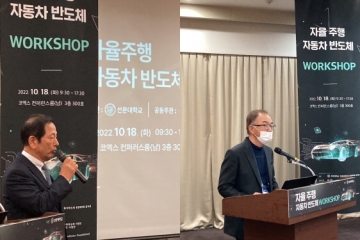
It is essential to train highly skilled automotive semiconductor personnel.
At the 'Autonomous Vehicle Semiconductor Workshop' held on October 18th in COEX Conference Room 300, jointly hosted by Sunmoon University and e4ds, experts in the autonomous vehicle semiconductor field took the stage as speakers to share technology and information, while also emphasizing the importance of cultivating advanced talent in the field.
2022.10.18by 성유창 기자
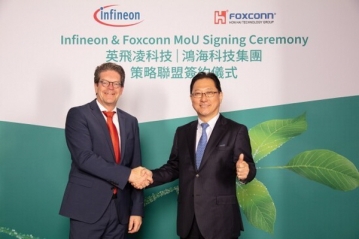
Infineon and Foxconn Join Hands for SiC and EV Development
Infineon Technologies AG, a global leader in automotive semiconductors, and Hon Hai Technology Group (Foxconn), the world's largest electronic manufacturing services provider, have joined forces to develop SiC and electric vehicle technologies.
2023.05.11by 배종인 기자
Automotive Semiconductors: New Opportunities Amidst the SDV Trend
As the transition to electric vehicles drives platform changes, industry insiders are analyzing that automotive semiconductor companies entering the market as latecomers are also encountering opportunities.
2023.07.07by 성유창 기자
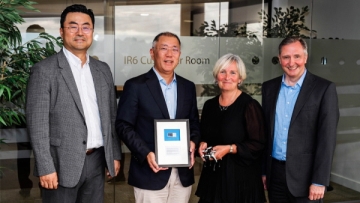
Chung Eui-sun Visits Intel to Assess Trends in Europe, the Battleground for Automotive Semiconductors
Hyundai Motor Group Chairman Chung Euisun visited Intel's Irish campus to examine emerging trends in Europe, which is emerging as a new battleground in the automotive semiconductor industry, and to explore semiconductor supply and demand for vehicles.
2023.07.10by 배종인 기자
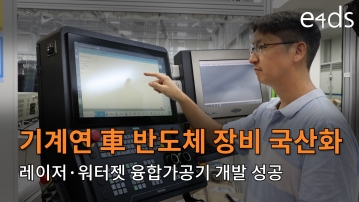
KIMM Localizes Key Automotive Semiconductor Equipment
As electric vehicle technology rapidly grows, demand for high-value-added automotive semiconductors is increasing. Equipment that processes key components of automotive semiconductors using both lasers and water pressure has been developed for the first time in Korea, generating expectations that it will help reduce import dependence and achieve cost savings.
2023.08.08by 배종인 기자











