


Samsung Electronics reports 3.75 trillion won loss in semiconductor business in Q3… Deficit narrows and improvement
 Published2023.10.31 10:31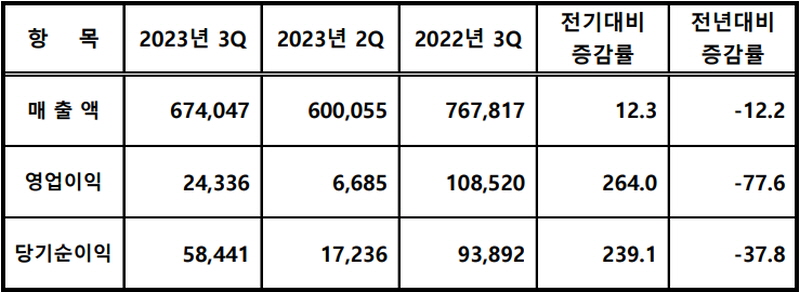
▲ Samsung Electronics Q3 2023 Business Performance (Unit: KRW 100 million, %, Based on consolidated financial statements)
Foundry Achieves Record Quarterly Orders, Memory Recovery Trend
Samsung Electronics' semiconductor performance in the third quarter of 2023 saw its deficit narrow, driven by record-high quarterly foundry orders and a recovery trend in memory.
Samsung Electronics disclosed its business results for the third quarter of 2023 on the 31st. Based on consolidated financial statements, revenue was 67.4047 trillion won, down 12.2% from the same period last year, and operating profit was 2.4336 trillion won, down 77.6% from the same period last year. Net profit was 5.8441 trillion won, down 37.8% from the same period last year.
Despite weak semiconductor performance, revenue improved compared to the previous quarter due to the launch of new flagship smartphones and expanded sales of premium display products. Similarly, operating profit increased compared to the previous quarter as the deficit in the DS division narrowed, driven by robust sales of flagship smartphones and increased demand for new products from major display customers.
The DS (Device Solutions) division recorded sales of 16.44 trillion won and an operating loss of 3.75 trillion won.
The deficit in memory semiconductors narrowed compared to the previous quarter due to increased sales of high-value products such as HBM (High Bandwidth Memory), DDR5 (Double Data Rate 5), and LPDDR5x, as well as some price increases.
In addition, as the perception that the market has hit its bottom spreads, numerous purchasing inquiries have been received from clients seeking to secure parts inventory.
System LSI saw sluggish performance improvement due to delayed recovery in demand from key applications and inventory adjustments.
Although the foundry business continued to experience sluggish performance due to factors such as declining line utilization rates, it solidified its preparations for the future by achieving its highest-ever quarterly orders, centered on High Performance Computing (HPC).
The DX (Device eXperience) division recorded sales of 44.02 trillion won and an operating profit of 3.73 trillion won.
MX (Mobile eXperience) showed solid growth in sales and operating profit compared to the second quarter due to the launch of a new flagship model.
Sales of new products in the third quarter, including smartphones, tablets, and wearables, were all strong, and overall revenue grew and double-digit profitability was secured as the proportion of flagship products increased and the average selling price rose.
The network is North due to reduced investment by telecommunications operatorsSales in major overseas markets, including the U.S., decreased.
In the case of VD (Visual Display), although global TV demand decreased compared to the same period last year, the company expanded its leadership in the premium market and improved profitability compared to the same period last year by focusing on the sales of high-value products such as Neo QLED, OLED, and ultra-large displays.
Home appliances recorded performance at the same level as the previous year due to a decrease in the peak season effect.
Harman recorded sales of 3.8 trillion won and an operating profit of 450 billion won.
Harman achieved its highest-ever quarterly performance driven by increased orders from automotive clients and expanded sales of consumer audio and car audio, including portable speakers.
SDC recorded sales of 8.22 trillion won and an operating profit of 1.94 trillion won.
In the display business, profits for small and medium-sized panels increased significantly compared to the previous quarter by actively responding to the launch of flagship products by major clients. For large panels, the deficit narrowed due to improved yield and cost reductions.
With global IT demand expected to gradually improve in the fourth quarter, the DS division plans to maintain solid profitability by focusing on expanding sales of high-value products such as HBM and technological leadership, while the Display and DX divisions will strengthen their premium strategies.
Capital expenditure in the third quarter was 11.4 trillion won, with 10.2 trillion won for the DS division and 700 billion won for the display division by business sector. Cumulative investment for the first three quarters totaled 36.7 trillion won, comprising 33.4 trillion won for the DS division and 1.6 trillion won for the display division.
Annual facility investment in 2023 is expected to reach approximately 53.7 trillion won, marking the largest annual facility investment execution. By business segment, DS is 47.5 trillion won and Display is 3.1 trillion won.
In the case of memory, the completion of Pyeongtaek Phase 3 to meet mid-to-long-term demand, investment in the framework of Phase 4, and an increased proportion of R&D investment to strengthen technological leadership are expected. In particular, investments in new technologies are being actively pursued, including investments to secure HBM production capacity at the industry's highest level.
The foundry business is expected to grow year-on-year due to the expansion of production capacity in Pyeongtaek to meet demand for advanced processes and infrastructure investment in the Taylor plant in the U.S. to prepare for the future.
Investments in the display sector are planned to focus on supporting IT OLEDs and flexible products.

Comments
Related news
Samsung Electronics, semiconductor deficit of KRW 4.58 trillion in Q1
Samsung Electronics announced its first quarter 2023 results on the 27th. On a consolidated basis, the company recorded revenue of 63.75 trillion won and operating profit of 0.64 trillion won, representing a 9.5% decrease in revenue compared to the previous quarter and an 82% decline in operating profit compared to the previous quarter. Samsung Electronics stated that first quarter revenue was affected by a slowdown in overall purchasing sentiment due to global economic uncertainty and concerns about economic slowdown.
2023.04.27by 명세환 기자

Memory Sector to See Significant Boom in 2024 Following Deep Recession
Domestic semiconductor revenue in the first quarter plummeted sharply. With Samsung Electronics' memory division and SK Hynix announcing losses in the 4 trillion and 3 trillion won ranges respectively, the market assessed that the semiconductor industry hit bottom in the first quarter. Alongside forecasts expecting improvements in supply-demand balance and performance from the second half onwards, observations have emerged that 2024 will be a major turnaround point for the memory industry.
2023.05.02by 명세환 기자
Samsung Electronics, Q2 operating profit down 95%… L-shaped recession concerns
The semiconductor downturn is passing through its lowest point. As Samsung Electronics' second quarter provisional results have been announced, sending shocks through the market, there are conflicting views between expectations for improvement in the second half of the year and forecasts of an L-shaped downturn, where the slump is expected to be longer than anticipated.
2023.07.07by 명세환 기자
Samsung Electronics, semiconductor deficit continues in Q2, smartphones also worsening
Samsung Electronics' second quarter 2023 operating results showed continued poor performance following the first quarter, due to semiconductor division losses stemming from persistent semiconductor price declines and deteriorating results in the foundry and MX business divisions caused by weak mobile demand.
2023.07.27by 배종인 기자
LG Electronics Hit Record Q2 Revenue Despite Downturn
LG Electronics recorded the highest quarterly revenue in its second-quarter history despite the downturn, delivering solid performance in the second quarter of 2023. Operating profit surpassed Samsung Electronics for the second consecutive quarter.
2023.07.27by 배종인 기자











