



UNIST: "One-Stop Diagnosis for Spent Car Batteries"
 Published2023.11.08 11:03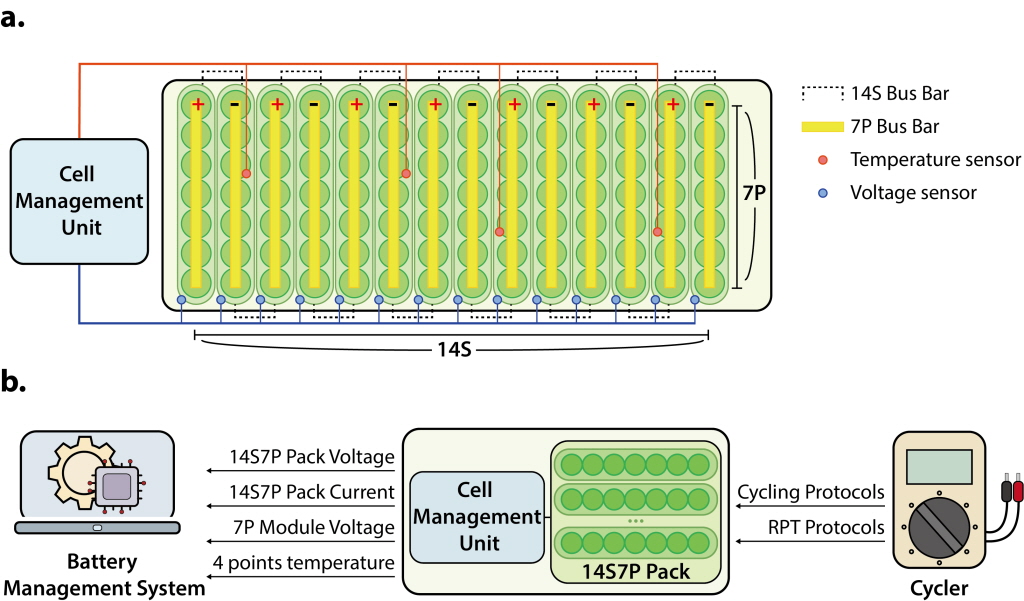
▲Experimental setup for generating training data for deep learning algorithms.
A technology has been developed that can diagnose the health of used batteries and easily determine whether they can be recycled. This technology is expected to have a significant impact on battery health management, as it can diagnose devices regardless of their type.
UNIST (President Yong-Hoon Lee) announced on the 8th that a team led by Professors Dong-Hyeok Kim and Yun-Seok Choi of the Department of Energy and Chemical Engineering and Professor Han-Kwon Lim of the Carbon Neutral Graduate School developed DeepSUGAR, a system that can diagnose the health status of battery components based on deep learning, which trains computers independently.
It combines the generative artificial intelligence technology 'Generative Adversarial Network (GAN)', which creates new creations through learning, and the 'Convolutional Neural Network (CNN)', which can effectively process images.
DeepSUGAR converts voltage, current, and capacity data obtained during charging and discharging of lithium batteries into the three primary color values of light and visualizes them. Based on this, a deep learning model is used to predict the battery's health. It can be applied regardless of battery configuration, such as modules and packs, and is differentiated from existing battery diagnosis methods.
Professor Kim Dong-hyeok explained, “By leveraging DeepSUGAR’s ability to visualize charge and discharge data, we have built a verification system that can determine whether a used battery can be recycled without disassembling it.”
The system developed by the research team utilizes generative AI to extract charge and discharge data from battery modules based on the battery's health status. This allows the team to determine whether the internal modules are recyclable without disassembling the battery or conducting actual charge and discharge tests.
First author Seo-Jeong Park, a researcher in the integrated master's and doctoral program in the Department of Energy and Chemical Engineering, explained, "The developed system was able to simplify the recycling process by using generative AI to check whether each internal component module can be reused just by charging and discharging the pack." She added, "It is expected to make a great contribution to the field of battery recycling because it can be applied universally without being limited to the type of device."
In addition, co-first author Dongjun Lim, a researcher in the integrated master's and doctoral program in the Department of Energy and Chemical Engineering, said, "Not only in the field of battery recycling, but also in real life, we can predict the health status of internal modules through battery pack diagnosis." He added, "We expect that this will help realize green energy in various fields in the future because only modules with degraded performance can be replaced."
This research was supported by the UNIST Carbon Neutrality Demonstration Center, the Ministry of Science and ICT's Bio-Medical Technology Development Project, and the Korea Industrial Technology Evaluation and Planning Institute with funding from the Ministry of Trade, Industry and Energy. It was published online on October 17th in the international academic journal 'Journal of Materials Chemistry A' and was selected as the cover paper for the November issue.

Comments
Related news

Accelerates commercialization of all-solid-state batteries with inexpensive, eco-friendly materials
Professor Lee Hyun-wook and Jung Sung-kyun from the Department of Energy Chemical Engineering at UNIST (President Lee Yong-hun) and Professor Seo Dong-hwa from KAIST have developed an all-solid-state sodium secondary battery that operates at room temperature. By using Prussian blue-based materials, which are inexpensive and environmentally friendly, they have simultaneously resolved issues of high cost and environmental concerns associated with solid electrolytes, significantly accelerating the commercialization of all-solid-state batteries.
2023.09.26by 배종인 기자
.jpg)
UNIST Develops Skin-Stretching High-Resolution Display
Prof. Choi Moon-gi's research team at the Department of Materials Science and Engineering at UNIST (President Lee Yong-hoon) has developed a "high-resolution patterning technology for stretchable light-emitting layers through surface control of stamps," a manufacturing technology for skin-like stretchable and soft high-resolution displays. This is expected to be useful in wearable devices, mobile devices, and the Internet of Things (IoT) as next-generation displays in the future.
2023.09.27by 배종인 기자
UNIST Solves Electric Vehicle Battery Fire Problem
A joint research team from UNIST, Korea Chemical Research Institute, and Korea Energy Technology Research Institute has developed a 'non-flammable polymer semi-solid electrolyte' that enables molecular bonding within batteries, offering prospects for resolving battery fire issues in electric vehicles.
2023.10.17by 배종인 기자
.jpg)
UNIST Improves Secondary Battery Performance by Recycling Mask Waste
Professor An Gwang-jin's team in the Department of Energy and Chemical Engineering at UNIST (President Lee Yong-hun) has developed a process to produce carbon nanotubes from discarded mask waste and apply them as a cathode conductive material in lithium-ion batteries. This is expected to develop into a key technology that can protect the environment through future plastic waste recycling and be utilized in advanced industries.
2023.10.19by 배종인 기자
From green hydrogen to nitrogen and oxygen, we make whatever you want.
A research team led by Professors Ryu Jeong-gi and Lee Dong-wook from the Department of Energy Chemical Engineering at UNIST (President Lee Yong-hoon) has developed a large-area hydrogel thin film technology that can be universally applied to gas-producing electrodes. It is anticipated that this technology will enable easy production of clean gas feedstocks such as green hydrogen.
2023.10.24by 배종인 기자











