


KIMM Realizes Future Buildings with Urban Rooftop Greenhouses
 Published2023.11.14 10:46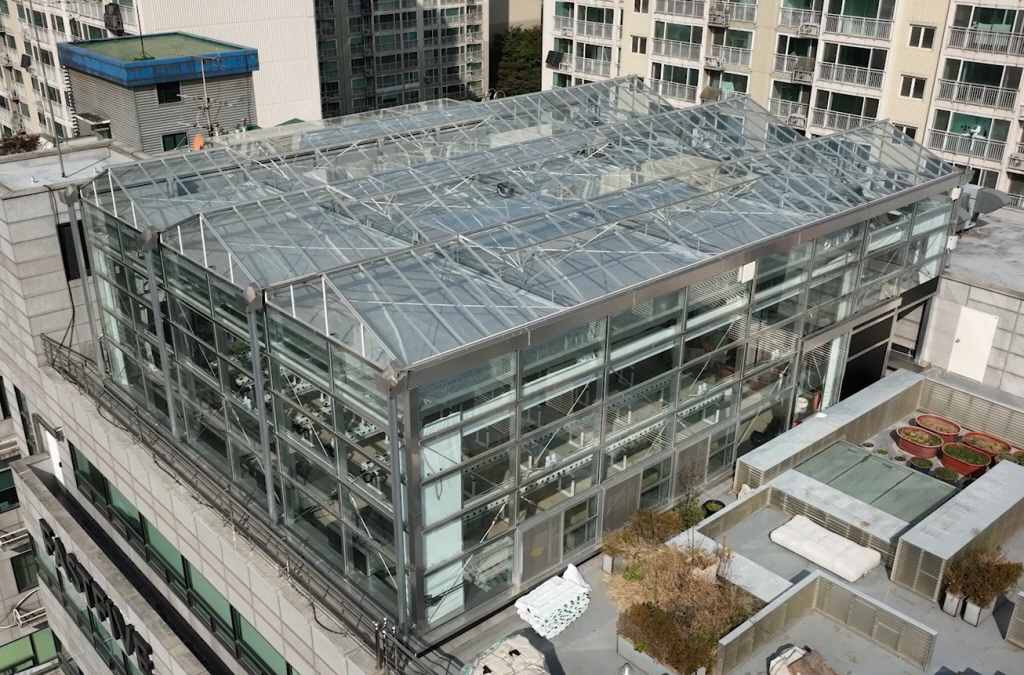
A technology has been developed to reduce building energy consumption and greenhouse gas emissions by constructing a building-integrated rooftop greenhouse in the heart of the city, and it has successfully undergone its first building demonstration in Korea. Through this rooftop greenhouse demonstration, it is expected to contribute not only to the realization of carbon neutrality but also to solving future food issues by implementing sustainable urban agriculture.
The Korea Institute of Machinery and Materials (KIMM), under the Ministry of Science and ICT, announced on the 14th that a research team led by Principal Researcher Lee Sang-min has developed world-class active energy exchange technology and successfully demonstrated a rooftop greenhouse with an area of 200 square meters on the roof of a building located in Seongsu-dong, Seongdong-gu, Seoul. This is the first time a domestic research team has constructed a greenhouse in a commercial building.
Building-integrated rooftop greenhouses utilize idle rooftop spaces in space-constrained cities to cultivate high-value crops suitable for use as ingredients in nearby restaurants, while utilizing heat and carbon dioxide wasted from the building and optimally controlling the greenhouse environment.
You can expect effects such as a 20% reduction in heating and cooling energy, a 30% reduction in greenhouse gases, and a 20% increase in crop productivity.
In addition, bringing production areas and consumption centers closer can reduce cold chain losses during transportation and storage, and allow fresh crops to be provided directly to consumers.
To maximize building energy savings using rooftop greenhouses, the research team has independently developed a 'customized smart farm solution' capable of integrated control of all systems, including heating, cooling, LEDs, and nutrient supply, based on external weather conditions, and plans to utilize the constructed greenhouse as a testbed for performance verification.
The Korea Institute of Machinery and Materials (KIMM) plans to collaborate with the Architectural Space Research Institute and the Korea Institute of Construction Technology to develop standard designs and construction technologies for rooftop greenhouses in new and existing buildings, and to promote domestic adoption and expansion of building-integrated rooftop greenhouses by establishing relevant certifications and regulations. The Korea Institute of Machinery and Materials (KIMM) has signed an MOU with the Seongdong-gu Office for the construction of a rooftop greenhouse and building demonstration.
After completion, the rooftop greenhouse will be operated as a living lab for residents to pursue various social values through urban agriculture, and is planned to be utilized as a multi-purpose welfare space for experiences, education, and healing.
Lee Sang-min, a principal researcher at the Carbon-Free Fuel Power Generation Research Laboratory, stated, “Building-integrated rooftop greenhouse technology, which combines mechanical, energy, architectural, and agricultural technologies, is a true future convergence technology capable of not only expanding urban agriculture but also saving building energy.” He added, “We will contribute to the widespread adoption of rooftop greenhouses by successfully demonstrating the nation’s first model on a building in downtown Seoul.”
This research was conducted as part of the Ministry of Trade, Industry and Energy's core technology development project for energy demand management, 'Development and Demonstration of a Rooftop Green Building Convergence System Based on Multi-Distributed Generation.'

Comments
Related news
The Korea Institute of Machinery and Materials presents a blueprint for mechanical technology to secure and foster national strategic technologies.
The Korea Institute of Machinery and Materials (President Park Sang-jin) will simultaneously host the "2023 Global Forum on Mechanical Engineering" with the theme of "National Strategic Technology and Mechanical Engineering Technology" both online and offline on the 14th at the National Assembly Museum (former Constitutional Memorial Hall) in Yeouido, Seoul.
2023.05.31by 배종인 기자
KIMM Develops Next-Generation Semiconductor Large-Area Etching Technology
Next-generation two-dimensional semiconductor process technology, which offers superior performance and reduced power consumption compared to silicon-based semiconductor technology, has been developed for the first time in the world, and is expected to address future industries such as artificial intelligence, IoT, and autonomous driving.
2023.06.22by 배종인 기자
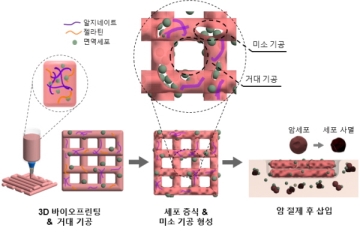
Korea Institute of Machinery and Materials: "3D Bioprinting Technology Eliminates Cancer Cells"
The Korea Institute of Machinery and Materials (KIMM, Director Park Sang-jin) under the Ministry of Science and ICT has developed 3D bioprinting technology using NK cell therapeutics as a novel immunotherapy for cancer treatment through joint research with the Korea Research Institute of Bioscience and Biotechnology (KRIBB, Director Kim Jang-sung).
2023.07.11by 배종인 기자
KIMM Localizes Key Automotive Semiconductor Equipment
As electric vehicle technology rapidly grows, demand for high-value-added automotive semiconductors is increasing. Equipment that processes key components of automotive semiconductors using both lasers and water pressure has been developed for the first time in Korea, generating expectations that it will help reduce import dependence and achieve cost savings.
2023.08.08by 배종인 기자
Machinery Research Institute Develops Turbo-Brayton Cryogenic Cooling System
The research team led by Dr. Yeom Han-gil, Principal Researcher at the Extreme Heat and Fluid Machinery Research Division of the Korea Institute of Machinery and Materials (KIMM, Director Park Sang-jin) under the Ministry of Science and ICT, has successfully constructed a turbo-Brayton cryogenic cooling system with 10kW cooling capacity at -196°C and completed operational testing. This marks the first domestic development of complete process technology from cryogenic cooling system design through construction.
2023.09.21by 배종인 기자











