


Lowering the Cost of Car Batteries ① - Expanding LFP Battery Development… Promoting Lower Costs by Compromising Driving Range
 Published2023.11.20 10:01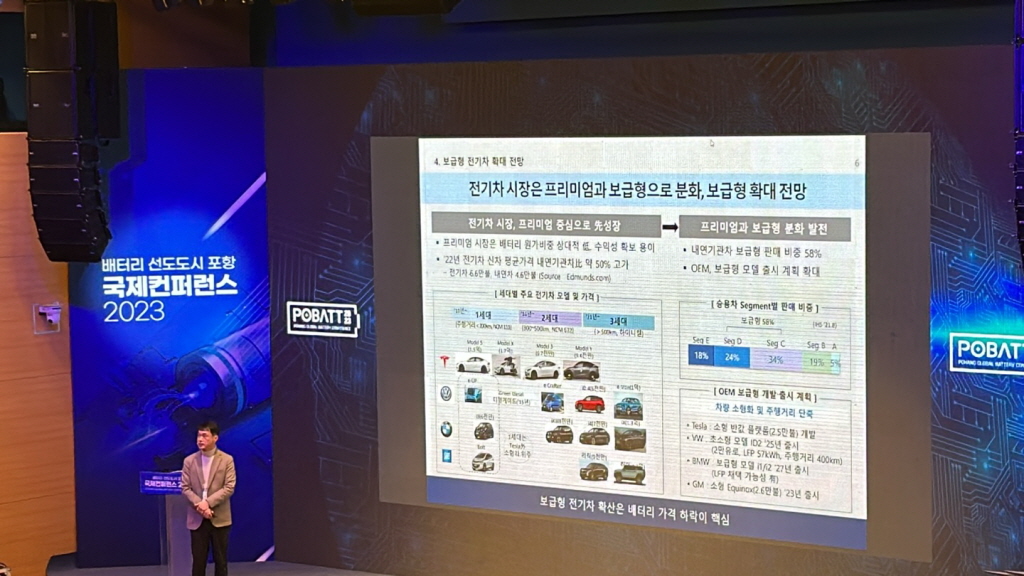
▲Jeong Ho-il, a research fellow at the POSCO Research Institute, is giving a presentation.
Ioniq 6 driving range: 524km vs. average daily driving: 36.5km
80% of internal combustion engine vehicle sales are small and medium-sized vehicles. The launch of mass-market electric vehicles is being promoted to expand their distribution.
[Editor's Note] Battery capacity, performance, and type are crucial to an electric vehicle's driving range. Depending on performance and battery raw materials, they can account for up to 40% of the electric vehicle's price. Companies have focused on improving battery performance, making significant technological advancements and earning premium labels. This high price tag has left electric vehicles vulnerable to price competition from internal combustion engine vehicles. To address this, lower-priced batteries, led by LFP batteries, are being pursued as a solution. In this feature article, we will examine the trends in domestic LFP batteries and the opinions of experts.
With the prospect of expanding the number of electric vehicles, Korean battery companies, which have been mainly producing NCM batteries, are expected to rush to supply relatively low-cost LFP batteries.
At the 'Pohang Battery Conference 2023' held on the 14th, Jeong Ho-il, a researcher at the POSCO Research Institute, gave a presentation on 'Battery Industry Issues in the Era of Popularization of Electric Vehicles' and said, "The electric vehicle market is segmented into premium and popular models, and the popular model is expected to expand." He added, "Popular electric vehicles are likely to focus on lowering prices by compromising on driving range, and there is also a trend to reduce the use of expensive metals in batteries."
Korean battery companies are known as the leaders in NCM (nickel-cobalt-manganese) batteries, which use nickel, cobalt, and manganese as cathode materials, and have supplied high-quality batteries to Hyundai, Kia, the U.S., and Europe.
Electric vehicles equipped with Korean batteries are priced at △BMW i7 138.9 million won (Samsung SDI), △EV6 72 million won (SK ON), and △Tesla Model Y 60-70 million won (LG Energy Solution) based on Naver search prices.
The average price of a new electric vehicle in 2022 is expected to be 150% higher than that of an internal combustion engine vehicle, and batteries account for 40% of the total vehicle price.
The global trend of subsidy reductions and the weakening consumer sentiment due to high interest rates are leading to a slowdown in electric vehicle sales, and the battery industry is also preparing for hibernation.
As a breakthrough, battery companies are developing strategies to produce relatively inexpensive batteries and supply them to mass-market vehicles.
It is highly likely that the focus will be on lowering prices through compromises on mileage..
The reason a compromise is possible is because drivers' actual average daily driving distance is much shorter than the range of electric vehicles.
The current driving range for the Ioniq 6 Long Range 2WD 18-inch model is 524 km on a single charge.
On the other hand, according to data from the Korea Transportation Safety Authority, the average daily driving distance per car in Korea in 2022 was only 36.5 km.
Thomas Franke and Josef F. Krems, in their paper 'The EV Range Paradox', announced that consumers who have no experience driving electric vehicles demand more driving range than necessary, and that this is an instinct to avoid unexpected risks, and that those who have experience driving electric vehicles actually have a lower expected driving range.
Additionally, the expansion of charging infrastructure and the development of rapid charging technology, which are currently insufficient, are expected to have an impact on the reduction in driving distance.
According to Researcher Jeong's announcement, the sales share of popular internal combustion engine vehicles (segments C and D) reaches 58%, and when segments A and B are combined, it reaches 80%.
Against this backdrop, OEMs plan to actively expand the distribution of electric vehicles by releasing popular models with reduced size and driving range.
The LFP battery is attracting attention as a popular battery.
Although the mileage is shorter than that of NCM, its greatest advantages are stability and low price, and it is still installed in vehicles such as Kia's Ray.
Volkswagen is expected to equip its ID2 model, which is scheduled to be released in 2025, with LFP batteries also expected to be adopted in models such as BMW's i1.
Accordingly, battery companies are also actively developing LFP batteries.
br /> K ON unveiled a prototype of an LFP battery last March, LG Energy Solution announced that it would begin mass production of LFP batteries starting in 2025, and Samsung SDI is also participating in a government project to develop LFP batteries that will run until 2026.
However, the economic feasibility of recycling LFP batteries is an obstacle.
Electric vehicles were originally designed to be environmentally friendly and prioritize the goal of contributing to carbon neutrality.
According to data from the POSCO Research Institute, each electric vehicle emits 11 tons of carbon, half of which, or 5.3 tons, is generated during the battery production process.
Battery recycling and reuse have garnered attention as technologies that can dramatically reduce carbon emissions generated during the production process and alleviate concerns about the supply chain.
NCM batteries are economically viable when recycled as they contain high-value-added raw materials such as nickel and cobalt, but LFP batteries' iron phosphate is not economically viable, so recycling companies are keeping quiet.
The EU's draft new battery regulations, published in 2020, call for sustainability in batteries, taking into account the carbon footprint of battery manufacturing, ensuring ethical sourcing of raw materials, and promoting reuse, remanufacturing, and recycling. The Core Materials Management Act (CRMA), published in March, also sets a target for recycling at least 15% of the EU's annual consumption.
If exports of vehicles equipped with LFP batteries increase, the issue of recycling will likely need to be addressed.
Comments
Related news

Prevents electric vehicle thermal runaway
LG Chem and LX Hausys have developed a battery thermal runaway delay material that can withstand flames at 1,500℃ for more than 20 minutes, which is expected to contribute to driver evacuation in the event of electric vehicle fires in the future.
2023.10.27by 배종인 기자
[Technical Contribution] ADI Kyle Johnson - USB-C-based parallel battery charging to improve user experience in consumer devices
Analog Devices' Kyle Johnson discusses USB-C based parallel battery charging to enhance user experience in consumer devices.
2023.11.06by 명세환 기자
UNIST: "One-Stop Diagnosis for Spent Car Batteries"
A research team from UNIST's Department of Energy and Chemical Engineering led by Professors Kim Dong-hyuk and Choi Yun-seok, along with Professor Yim Han-gwon from the Carbon Neutrality Graduate School, has developed DeepSUGAR, a system capable of diagnosing the health status of battery components based on deep learning that enables computers to train independently.
2023.11.08by 배종인 기자
Hanjayeon, Asset Management Event Held...Battery Material Related Companies in One Place
The Korea Automotive Research Institute (hereinafter referred to as KARI) has established a forum for diverse communication and exchange among relevant companies regarding issues and industry trends in the battery materials sector.
2023.11.17by 성유창 기자

[e4ds Tech Day 2026 ⑨] Sim Sang-gyu, Autocrypt CTO: "In the Physical AI Era, Automotive Security Must Extend Beyond the Vehicle"
At e4ds Tech Day 2026, Sim Sang-gyu, CTO of Autocrypt, explained automotive cybersecurity strategies in the era of Physical AI and SDV (Software-Defined Vehicle). Automobiles are evolving as part of an ecosystem connected to AI, cloud, chargers, IoT, and robots, and he emphasized that the scope of security must expand beyond the vehicle interior to the entire connected environment. In particular, AI model tampering, adversarial attacks, OTA updates, and EV charger hacking were identified as major threats. He explained that response measures require zero trust, AI model integrity protection, intrusion detection, Security by Design and Default, and full lifecycle security management, and that proactive security system establishment beyond regulatory compliance is critical for securing future mobility competitiveness.
2026.10.12by 배종인 기자











