



Car Battery Cost Reduction ② - Emerging LFP Cathode Materials: Market Dominance Is in Difficulty
 Published2023.11.20 16:55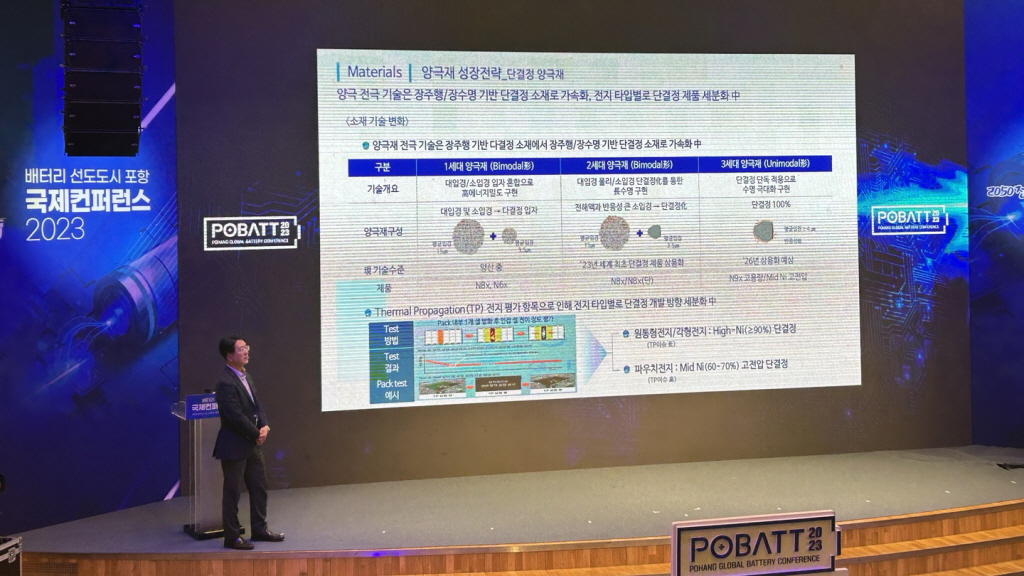
▲Hong Jeong-jin, Executive Director of POSCO Future M, is giving a presentation.
POSCO FutureM and EcoproBM Expand Development of LFP Battery Cathode Materials
Technological advancement and recycling economics are bad… dominating the battery market is impossible.
As the cost of electric vehicles is being pushed to lower prices as an alternative to overcome the significant weakness of electric vehicles in terms of price competitiveness compared to internal combustion engine vehicles, the direction of battery cathode material companies is also drawing attention.
Hong Jeong-jin, Managing Director of POSCO Future M, presented “POSCO Future M’s Future Strategy for Secondary Battery Materials Business” at the “Pohang Battery Conference 2023” on the 14th, saying, “There is a trend of electric vehicle sales slowing down, but there are no major doubts in the mid- to long-term.” He added, “However, there is a growing trend of automakers requesting inexpensive batteries to solve the problem of electric vehicles falling behind in price competitiveness.”
In line with the outlook that the electric vehicle market will be divided into premium and mass-market vehicles, materials company POSCO Future M is also diversifying its portfolio.
Starting in 2025, the company plans to begin development of N9x with a nickel content of over 90%, with mass production starting in 2026. It also plans to actively pursue the development of cathode materials for all-solid-state batteries and continue to target high value-added markets.
In addition, POSCO Future M plans to develop and commercialize a non-NCM manganese-rich product for batteries for standard and entry-level electric vehicles by 2024, becoming the first in the industry to do so, and to produce 150,000 tons of cathode materials for LFP by 2030.
Manganese enrichment is considered a way to secure price competitiveness by lowering the relatively expensive cobalt and nickel content and maximizing the manganese content.
Executive Director Hong Jeong-jin expressed his expectations, saying, “If we succeed in developing and commercializing manganese-rich cathode materials, the energy density will be 10% higher than LFP products, and the price will be similar, so the impact on the market will be huge.”“There are still many areas that need to be developed technically, such as the generation of a lot of gas during the cycle,” he said.
EcoPro BM was selected for the Ministry of Trade, Industry and Energy's 'LFP Battery Development Project' and is currently carrying out a project worth a total of 23 billion won together with Samsung SDI and others.
In addition, EcoPro Group announced that it will build a pilot line for LFP cathode materials at its Ochang plant by June of next year to meet the growing demand for LFP batteries.
L&F, which had focused on high-nickel cathode materials, also began developing LFP cathode materials.
L&F is also preparing LMFP cathode materials by adding manganese, similar to POSCO Future M, and announced plans to mass-produce LFP in 2025 and LMFP in 2026.
LG Chem signed an MOU with China's Huayou Group regarding the cathode material supply chain last September.
The two companies plan to build a joint LFP cathode material plant in Morocco with an annual capacity of 50,000 tons, with the goal of mass production starting in 2026.
Although the development of LFP batteries is being rushed, experts predict that it will be difficult for LFP to become the absolute leader in the market.
This is because LFP batteries have relatively limited further technological advancements, are not economically viable for recycling, and have limited space utilization due to their low energy density.
Other experts say that if high nickel takes hold, LFP may lose its absolute price advantage and lose its biggest advantage.
For the various reasons mentioned above, many experts, including Research Fellow Jeong Ho-il, have evaluated that Korea's strategy of advancing into premium batteries based on NCM batteries was the right one.
Jeong Ho-il, a research fellow at POSCO Management Institute, said, “LFP is currently “90% of sales are in China,” he said, adding, “We will have to watch closely to see how it expands to other regions in the future.”
He continued, “Various options for ternary batteries, such as nickel-free and cobalt-free, are being developed,” adding, “In order to not fall behind China, it is important to accelerate the time to success and establish a recycling ecosystem for key metal materials.”
Comments
Related news
.jpg)
Samsung SDI to supply batteries to Hyundai Motors
Samsung SDI has concluded its first battery supply contract for electric vehicles with Hyundai Motor, securing additional growth momentum alongside plans for expanded cooperation between the two companies.
2023.10.23by 배종인 기자
Prevents electric vehicle thermal runaway
LG Chem and LX Hausys have developed a battery thermal runaway delay material that can withstand flames at 1,500℃ for more than 20 minutes, which is expected to contribute to driver evacuation in the event of electric vehicle fires in the future.
2023.10.27by 배종인 기자
Hanjayeon, Asset Management Event Held...Battery Material Related Companies in One Place
The Korea Automotive Research Institute (hereinafter referred to as KARI) has established a forum for diverse communication and exchange among relevant companies regarding issues and industry trends in the battery materials sector.
2023.11.17by 성유창 기자
Lowering the Cost of Car Batteries ① - Expanding LFP Battery Development… Promoting Lower Costs by Compromising Driving Range
According to prospects that entry-level electric vehicles are expected to expand, domestic battery companies, which have primarily manufactured NCM batteries, are also expected to accelerate their supply of relatively low-cost LFP batteries.
2023.11.20by 성유창 기자

[e4ds Tech Day 2026 ⑨] Sim Sang-gyu, Autocrypt CTO: "In the Physical AI Era, Automotive Security Must Extend Beyond the Vehicle"
At e4ds Tech Day 2026, Sim Sang-gyu, CTO of Autocrypt, explained automotive cybersecurity strategies in the era of Physical AI and SDV (Software-Defined Vehicle). Automobiles are evolving as part of an ecosystem connected to AI, cloud, chargers, IoT, and robots, and he emphasized that the scope of security must expand beyond the vehicle interior to the entire connected environment. In particular, AI model tampering, adversarial attacks, OTA updates, and EV charger hacking were identified as major threats. He explained that response measures require zero trust, AI model integrity protection, intrusion detection, Security by Design and Default, and full lifecycle security management, and that proactive security system establishment beyond regulatory compliance is critical for securing future mobility competitiveness.
2026.10.12by 배종인 기자











