


Korea Mechanical Engineering & Construction Co. develops eco-friendly refrigerant compressor using hydrogen
 Published2023.11.24 14:39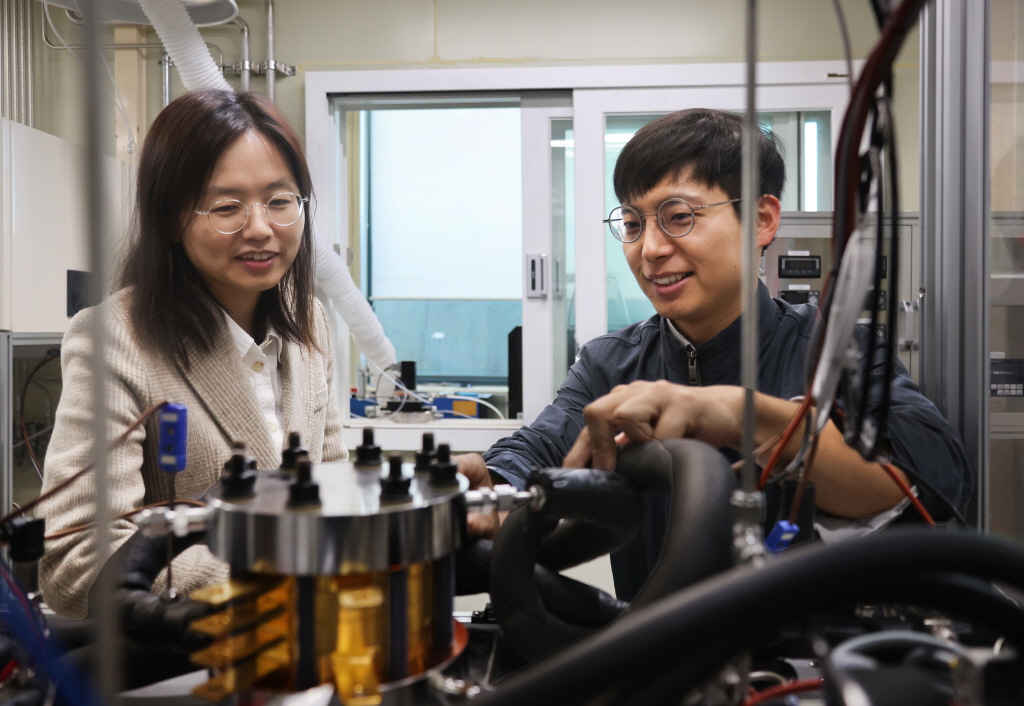
▲Kim Young, Senior Researcher (left) and Lee Dong-geun, Senior Researcher (right) of the Korea Institute of Machinery and Materials are inspecting a compressor stack.
Overcoming the limitations of existing ones with the advantages of no noise, no vibration, and oil-free
Recently, as the government is pushing to achieve carbon neutrality by 2050 and the transition from fossil fuels to new and renewable energy is accelerating, a technology that can apply eco-friendly refrigerants in refrigeration and air conditioning systems has been developed for the first time in Korea, and it is expected to reduce greenhouse gas emissions and save energy.
The research team of Senior Researcher Kim Young of the Korea Institute of Machinery and Materials (President Park Sang-jin) under the Ministry of Science and ICT and the research team of Professors Kim Min-seong and Kim Dong-gyu of Chung-Ang University (President Park Sang-gyu) announced on the 23rd that they succeeded in developing an eco-friendly refrigerant compressor that utilizes an electrochemical method rather than a mechanical method.
Electrochemical compressors compress refrigerant by moving ions through an ion exchange membrane and using hydrogen as a medium to compress the gas.
The research team succeeded in operating an electrochemical eco-friendly refrigerant compressor by utilizing the principle that eco-friendly refrigerants such as ammonia and water are compressed as they pass through an ion exchange membrane like hydrogen.
Environmentally friendly refrigerants such as ammonia and water have very little impact on the environment, unlike conventional refrigerants including HFCs that destroy the ozone layer and cause global warming.
Developed countries such as the US, Europe, and Japan are freezing the use of HFCs until 2024.The trend is accelerating the transition to environmentally friendly refrigerants. The use of environmentally friendly refrigerants can prevent environmental pollution and contribute to sustainable development.
Existing compressors have problems such as durability issues of parts due to rapid rotation, refrigerant contamination due to the use of lubricants, and noise. This eco-friendly refrigerant compressor, developed this time, is expected to overcome existing limitations as it has the advantages of being noiseless, vibration-free, and oil-free.
The developed compressor is designed to operate robustly even under repeated high-pressure conditions, prevent energy leakage, and achieve high performance even in high-output ranges, thereby maximizing the efficiency of the electrochemical compressor.
In addition, it is advantageous for building small-scale systems as well as providing a stable energy supply regardless of size, and energy savings of up to 60% are possible compared to existing systems.
If eco-friendly refrigerants, rather than the existing air conditioner refrigerants that destroy the ozone layer and accelerate global warming, are applied to general household and industrial air conditioners, it is expected that greenhouse gas emissions will be reduced and climate change and carbon neutrality can be contributed to.
Kim Young, a senior researcher at the Korea Institute of Machinery and Materials’ Thermal Energy Solutions Laboratory, said, “The electrochemical eco-friendly refrigerant compressor has the advantages of high efficiency, economy, and space saving,” and “We will contribute to achieving carbon neutrality by 2050 by developing a heat pump system utilizing this technology in the future.”
Meanwhile, this study was conducted with the support of the project ‘Development of a chemical absorption heat pump system using an electrochemical compressor’ hosted by the Korea Institute of Energy Technology Evaluation and Planning, Ministry of Trade, Industry and Energy.

Comments
Related news
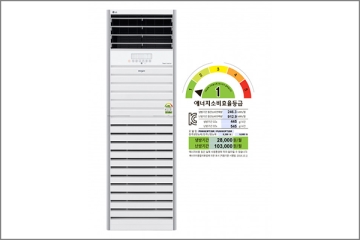
LG Electronics Unveils Energy Efficiency Grade 1 Commercial Air Conditioner
LG Electronics has launched the PW083PT2SR, a commercial stand-type air conditioner that achieves energy efficiency rating class 1 in the domestic market. LG Electronics applied vapor injection technology, which separates a portion of the refrigerant during compression, converts it to gas, and then injects it, thereby improving cooling and heating performance and efficiency. Inverter control technology has also enhanced energy efficiency.
2020.06.11by 강정규 기자
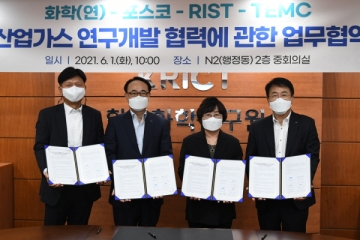
POSCO Begins Full-Scale Development of Etching and Refrigerant Gases for Semiconductors
POSCO is launching full-scale market development in the low global warming potential etching gas market, which grows at an average annual rate of 13%, by developing environment-friendly specialty gases with low global warming potential to replace semiconductor etching gases with high global warming potential.
2021.06.03by 배종인 기자
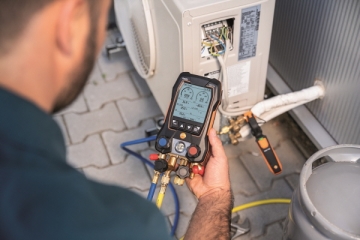
Testo Korea Helps Make Refrigerant Gas Measurement Easier
Testo Korea, the Korean subsidiary of Testo, a global leader in measurement technology (Branch Manager Jeon Kyung-woong), has introduced the digital manifold gauges 'testo 557s' and 'testo 550s' to support refrigeration engineers in making gas measurement work for refrigerant management easier and more convenient.
2023.03.07by 배종인 기자
Materials Research Institute Develops Ultra-thin Coating Water Electrolysis Catalyst Technology
The Korea Institute of Materials Science has simultaneously resolved the performance and durability trade-off problem in water electrolysis catalysts by applying ultra-thin surface coating technology. Achieving 1.9 times higher performance compared to conventional catalysts while demonstrating 1,000-hour long-term stability, the institute has developed technology scalable to industrial water electrolysis systems through a simple process.
2026.10.07by 배종인 기자
Gigaphoton Develops Neon Gas Recycling System for ArF Excimer Lasers...Achieves 50% Recycling Rate
Gigaphoton announced that it has developed a gas recycling system for ArF excimer lasers and achieved a 50% neon gas recycling rate.
2026.10.02by 배종인 기자











