



ETRI develops AI technology for autonomous robot assembly.
 Published2023.11.24 15:50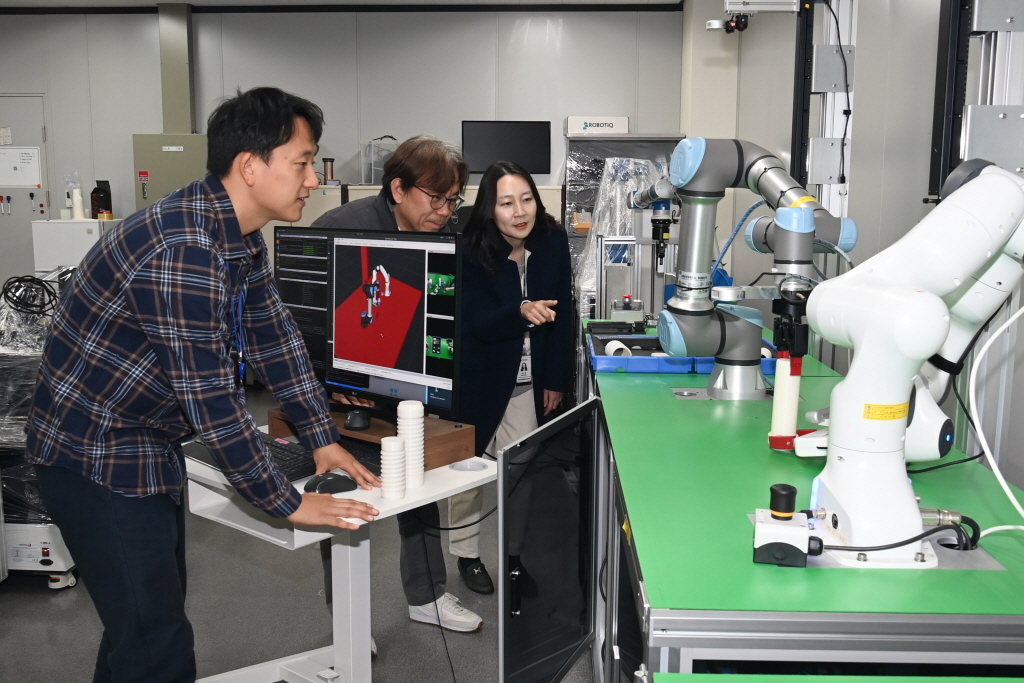
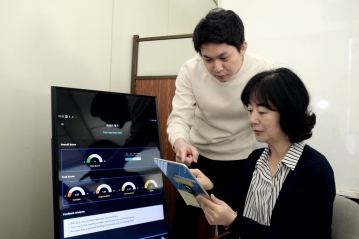
▲ETRI researchers demonstrate AI technology for autonomous robot product assembly.
Robots can perceive, judge, plan, and perform actions on their own using multi-artificial intelligence.
A domestic research team has developed an artificial intelligence technology for autonomous product assembly robots that can collaborate with multiple robots to assemble products on their own. The construction of an unmanned, autonomous product assembly plant is expected to greatly contribute to improving productivity and helping small and medium-sized enterprises respond to the industrial digital transformation.
The Electronics and Telecommunications Research Institute (ETRI) announced on the 22nd that it has successfully developed a technology that utilizes the latest artificial intelligence (AI) and digital twin technologies in the field of product assembly, enabling a multi-joint robot (robot arm) to perform the recognition, judgment, planning, and movements required for product assembly on its own.
The technologies developed by the research team are broadly categorized into cognitive intelligence, movement intelligence, operational intelligence, and motion intelligence.
First, cognitive intelligence is an intelligence that utilizes deep learning technology and a camera to enable the robot to recognize the location and direction of randomly placed parts on the workbench and parts box and semi-finished products being assembled.
In addition, motion intelligence is a deep reinforcement learning intelligence that can grasp parts and semi-finished products and manipulate them in detail.
And we developed a task intelligence that can independently plan the sequence and parameters of assembly tasks such as fitting, inserting, and tightening for any situation.
Additionally, we developed motion intelligence that utilizes digital twin technology to find the optimal trajectory by simulating at high speed in a virtual space so that the robot arm moves without collision with parts, semi-finished products, surrounding equipment, and installations.
The autonomous product assembly robot artificial intelligence technology developed by ETRI was applied to the production of automobile suspension products that are assembled in three ways: △snap-fit of four parts, △peg-in-hole, and △screw-fit.
The performance is such that two robots work together to achieve a success rate of over 90% without installing an assembly jig.
The researchers explained that the technology can detect abnormalities and recover from failures on its own if an error occurs during assembly.
This level is the unmanned system of the National Institute of Standards and Technology (NIST) in the United States.It is the world's first autonomous product assembly technology that has reached level 8 of machine autonomy.
ETRI also developed a software platform along with software tools that support automatic generation of learning data and training of learning models using commercial simulators.
This platform allows companies to quickly build autonomous assembly systems for their desired products by flexibly combining and configuring learned intelligence with existing robotic automatic control technologies to suit specific needs.
ETRI has developed an intelligent framework for autonomous robot product assembly and, based on the elemental technologies developed through joint research with Seoul National University and Gwangju Institute of Science and Technology, has applied for and registered approximately 10 domestic and international patents and published seven research papers in international academic journals.
Last year, the research team participated in the International Conference on Robotics and Automation (ICRA), an excellent international academic conference on robotics, and won top prizes in the Autonomous Material Handling and Tracking Competition (OCRTOC).
The research team is working to commercialize the technology by building a real-world robot autonomous manufacturing test bed capable of manufacturing parts using a 3D printer within the ETRI Convergence Technology Research and Production Center, automatically supplying manufactured parts, and assembling finished products.
In the future, the ETRI research team announced that they plan to further enhance the technology and improve its perfection so that it can autonomously assemble products of small size and complex shape or products that require delicate manipulation such as wire connections, by further improving the current performance level applied to the assembly of relatively simple and appropriately sized mechanical products.
ETRI's Lee Il-woo, head of the Industrial Energy Convergence Research Center, said, "This technology will greatly contribute to reducing the technological gap with leading countries and enhancing the competitiveness of the manufacturing industry's digital transformation. He said, “We will continue to work with small and medium-sized manufacturing companies in the field to improve the perfection of the technology and to apply and expand it in the field.”
The research team is actively promoting technology dissemination through various technology briefings, such as the ETRI Promising Commercialization Technology Briefing Session and the Ministry of Science and ICT ICT Technology Commercialization Festival, as well as exhibitions such as RoboWorld.

Comments
Related news
ETRI Unveils No-Code Machine Learning Development Tool
The Electronics and Telecommunications Research Institute (ETRI), with support from the Ministry of Science and ICT and the Information and Communications Planning and Evaluation Institute (IITP), will disclose the core technologies of a no-code machine learning development tool (MLOps) as open source and hold a public seminar at the Science and Technology Hall on the 1st to promote community expansion on GitHub.
2023.10.30by 배종인 기자
.jpg)
ETRI is the first to explore promising commercialization technologies.
The Electronics and Telecommunications Research Institute (ETRI) has released the 'e-Tech Preview' both online and offline, containing information about technologies that its research team will complete development on by the end of this year and within the next 1-2 years.
2023.11.06by 배종인 기자
ETRI, “Technology Pioneer Creating a Happy Future Through Digital Innovation”
The Electronics and Telecommunications Research Institute (ETRI) held the 'ETRI Conference 2023', where it unveiled its vision as a technology pioneer creating digital innovation and a prosperous future through proactive and outstanding technologies, including introducing six top challenge projects such as △AI computing △AI robot intelligence △6G △metaverse △advanced mobility △advanced biotechnology to the public.
2023.11.08by 배종인 기자
ETRI, a leader in resolving mid-term technology challenges
ETRI established the 'Semiconductor Materials, Parts and Equipment Technology Center' in February 2021 to handle technology support related to materials, parts, and equipment (MPE), and has successfully provided technology support to 110 companies in 174 cases, actively participating as a leading player in resolving technological challenges faced by small and medium-sized enterprises.
2023.11.13by 배종인 기자
ETRI, 'Most' National Research and Development Excellence Achievements for 5 Consecutive Years
The Electronics and Telecommunications Research Institute (ETRI) has had a total of 11 research outcomes selected across the fields of information and electronics, convergence, and energy and environment in the '2023 National Research and Development Excellence 100' announced by the Ministry of Science and ICT. The institute has been recognized as the research organization that has produced the most outstanding research outcomes for five consecutive years.
2023.11.14by 배종인 기자











