


ETRI solves the problem of narrow viewing angles in holographic displays.
 Published2023.11.27 14:06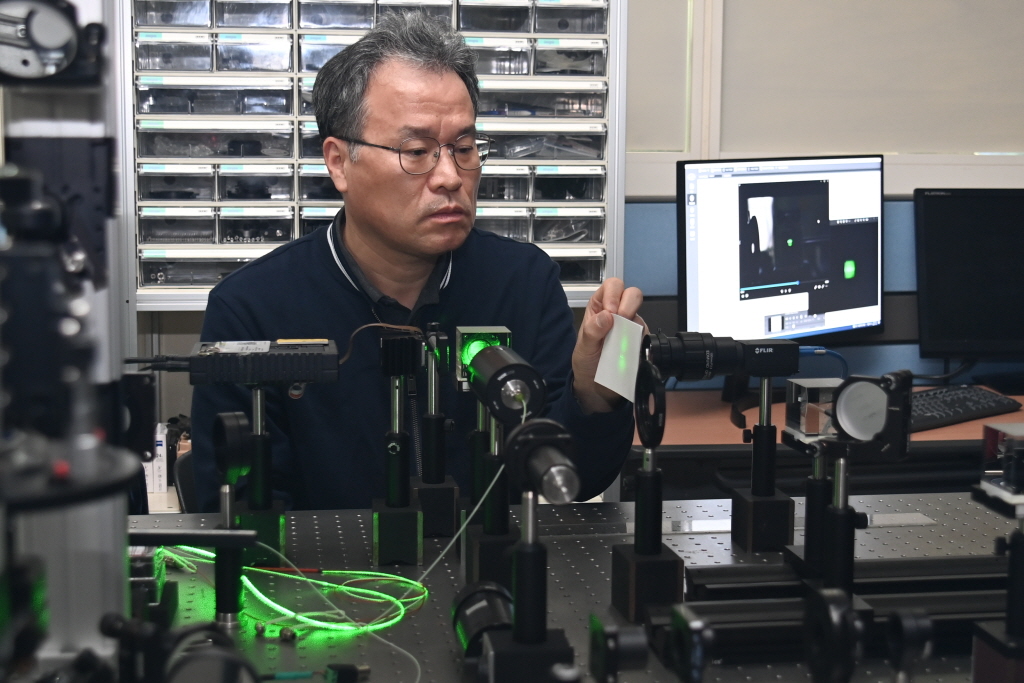
▲ETRI Senior Researcher Chae Byeong-gyu conducting research on expanding the field of view of holographic images.
Domestic researchers are focusing their efforts on finding a solution to the problem of expanding the field of view of holographic displays, which are said to be the crystal of perfect stereoscopic images. It is significant that it presents a new technological method, breaking away from the existing pixel size-based approach to expanding the field of view.
The Electronics and Telecommunications Research Institute (ETRI) announced on the 6th that it has presented a research direction to solve the problem of the narrow field of view of about 3.8 degrees, which is known as the biggest obstacle to commercializing holographic displays, with support from the Ministry of Science and ICT, and that the major research results were introduced in a video published by the Optical Society of America.
Unlike the analog film holograms currently on display in museums, holographic displays use a digital hologram recording device known as a hologram display element to float a three-dimensional hologram image in the air. However, due to issues such as a narrow viewing angle, they have not yet been commercialized.
In order to secure a wide viewing area, i.e. a viewing angle of more than 30 degrees, like an analog film hologram, a holographic electronic recording device with a resolution of several hundred nanometers (nm), which is about the wavelength of light, must be developed.
On the other hand, the pixel size of current commercial devices remains at several micrometers (㎛), making it difficult to avoid the problem of a narrow viewing angle of less than 4 degrees.
There are methods to spatially and temporally multiplex holographic display elements to expand the field of view, or to develop nanometer-level display elements. However, even putting aside the technical difficulties, this is not desirable because it creates another problem of having to process massive amounts of data that are difficult to process with current computers.
The ETRI research team noted that the holographic image field of view is fundamentally dependent on the holographic image resolution rather than the diffraction angle for the digital hologram pixel size.
In other words, the holographic image field of view must be redefined using the numerical aperture of the holographic display system, which determines the image resolution.
This opens up the possibility of securing a sufficient field of view even using existing commercial holographic electronic recording devices.
br /> The researchers found that the larger the numerical aperture, the better the resolution, and the numerical aperture is determined by the size of the hologram and the distance at which the image appears.
This means that the resolution varies depending on where the hologram appears, and the resolution is ultimately related to the viewing angle.
Accordingly, even if it is a holographic electronic recording device with 8 micrometer pixels, if the image is displayed at a sufficiently close distance, the field of view can be increased by 4 or 8 times, and can be made to be more than 30 degrees.
The research team analyzed digital hologram patterns to establish related theories and proved the possibility of expanding the field of view through numerical analysis and optical experiments.
It was revealed that digital holograms have the characteristic of maintaining high-frequency bands without loss even at low sampling, and thus maintain the numerical aperture that determines the hologram image resolution regardless of the pixel size of the hologram display element.
Using this principle, the research team developed an optimization algorithm to create a digital hologram extended to the high-frequency range, and analyzed the created digital hologram numerically. As a result, they discovered that the image field of view could be increased by four times from the existing 3.8 degrees to 13.1 degrees without reducing the hologram pixel size.
The researchers said there are still limitations to this achievement.
When the field of view is doubled from 3.8 degrees, the size of the hologram image must also double, but this causes the problem of the images appearing to overlap, so the higher-order diffraction terms must be filtered.
The research team plans to develop an optical filtering method that efficiently removes high-order optical diffraction terms in the future and to pursue practical research on holographic displays.
Dr. Chae Byeong-gyu of ETRI's Holographic Content Research Lab said, "The technology we developed can be applied to solve the problem of holographic near-eye display eye boxes used in augmented reality."
This study attracted attention when it was introduced as a video of the main research results on the main page of the Optical Society of America website.
Additionally, the research was published in the optical journal 'Optics Express' as 'Study on expanding the viewing angle of holographic displays'.
This research was conducted with support from the Ministry of Science and ICT's Hologram Core Technology Development Project and the ETRI Research and Development Support Project.
Meanwhile, ETRI developed the world's first 360-degree color hologram display in 2012, and in 2020, it received the highest award from the Society for Information Display (SID), the world's largest display society, for its development of a 30-degree viewing angle hologram display technology.

Comments
Related news
Converse face-to-face with a holographic AI avatar
SK Telecom will unveil 'HoloBox,' a holographic display that enables face-to-face conversations with humanoid avatars, at Mobile World Congress 2018 (MWC 2018). 'HoloBox' is a service that combines hologram technology, a next-generation media technology, with SK Telecom's artificial intelligence platform 'NUGU' to enable users to have face-to-face conversations with virtual AI avatars. The avatar in 'HoloBox' accompanies the user at all times, even in daily life outside the home. Even without 'HoloBox' nearby, augmented reality (AR) technology on smartphones allows users to summon virtual characters on mobile devices.
2018.02.22by 김지혜 기자
ETRI Develops Hologram 250 Times Sharper Than 8K
Hologram display primarily uses spatial light modulation technology based on liquid crystals. This method creates images by applying voltage to liquid crystals to change the phase of light. To enhance the image quality and viewing angle of hologram displays, the key is to reduce the pixel pitch in the liquid crystal devices. The Electronics and Telecommunications Research Institute announced on the 23rd that it has developed a new pixel structure technology that significantly reduces both pixel size and pixel pitch to the micrometer level, enabling a 30-degree viewing angle and substantially improved image quality. With this technology, it is expected that panel development implementing 72K resolution using the world's smallest 1㎛ pixel pitch device will become possible.
2019.05.26by 이수민 기자
ETRI Creates Motion Sickness-Free 3D Images
Domestic researchers have developed a technology that can create and edit stereoscopic images the way the human eye perceives them. This technology is expected to be highly beneficial in producing next-generation content such as virtual reality (VR), augmented reality (AR), and holograms, as well as enabling more immersive experiences.
2021.07.07by 배종인 기자
ESP32 Development Environment Selection and GPS Application Implementation
The ESP32 is a microcontroller that integrates Wi-Fi, Bluetooth, 12-bit ADC, capacitive touch, PWM, DAC, and UART in a single SoC. However, the abundance of features does not by itself solve the designer's problems. The real challenges lie in selecting the appropriate development environment, determining which pins can be used and which must be avoided, and converting raw data from modules into usable information. This document addresses ESP32 peripheral constraints (ADC2 and Wi-Fi coexistence limitation, UART1 occupancy, ADC non-linear regions), the trade-offs between Arduino IDE and ESP-IDF, and the process from connecting NEO-6M/NEO-M8N GPS modules to UART2, parsing NMEA sentences, and visualizing routes in Google Earth, all organized based on documented references.
2026.10.12by 편집부
MIPI CSI-2, DSI-2, C-PHY, D-PHY Test Solution Technical White Paper
The MIPI interface adopts a burst mode that transitions between low-power (LP) and high-speed (HS) states for low-power consumption, and in return, strict timing rules are imposed on state transitions. Additionally, the high-speed section operates as a packet-based protocol with headers, ECC, and CRC, so verification engineers must handle waveforms and protocols simultaneously. Traditional configurations combining general-purpose oscilloscopes and AWGs reveal limitations in setup complexity, measurement uncertainty, and lack of reproducibility when faced with these requirements. This white paper, based on webinar materials, organizes the structure of this problem and describes how the SV5C-DPTXCPTX generator for receiver testing and SV5C-DPRXCPRX analyzer for transmitter testing integrate state transition testing, stressed eye testing, and protocol analysis into a single bench, along with their application boundaries.
2026.10.12by 편집부











