


Huawei Contributes to Sustainable Social Development through Digital Technology
 Published2023.11.27 15:06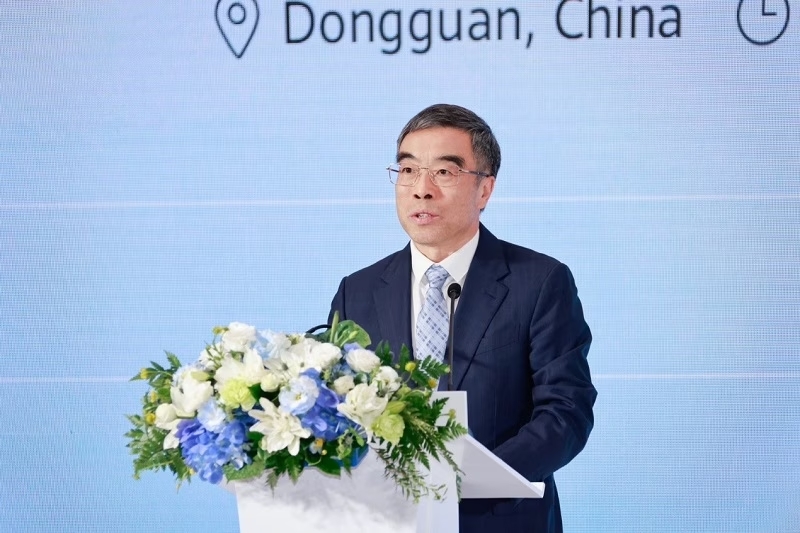
▲Liang Hua, Chairman of the Board of Huawei, is giving a presentation at the Sustainability Forum.
Huawei is contributing to sustainable social development through digital technology, collaborating with partners around the world, including in Europe and Asia, to promote digital inclusion and preserve biodiversity.
Huawei recently held a sustainability forum themed “A Company that Grows with Technology: Achieving Sustainable Development.”
At the event, Huawei discussed ways to promote sustainable development through digital infrastructure and build an intelligent world that is both eco-friendly and inclusive, along with ITU Secretary-General Doreen Bogdan-Martin, UN Sustainable Development Solutions Network (SDSN) Executive Director Jeffrey Sachs, and representatives of key regulatory authorities.
“Next-generation digital infrastructure such as connectivity and computing is as essential to driving socio-economic development as physical infrastructure such as roads, and is crucial to the sustainable development of human society,” said Liang Hua, Chairman of the Board of Huawei. “Rapid construction of computing infrastructure will help accelerate digital transformation across various industries, achieve closer integration between the digital economy and the real economy, and promote global economic stability and sustainable development.”
Huawei previously announced sustainable development As one of the measures, it announced that it would join the International Telecommunication Union (ITU)'s Partner to Connect (P2C) Digital Alliance and provide connectivity to 120 million digitally excluded people in 80 countries around the world by 2025.
Over the past year, Huawei has already empowered 90 million digitally excluded people in approximately 80 countries to connect to the digital world, promoting sustainable development by bridging the digital divide.
Furthermore, Huawei is actively working with the European region to utilize digital technology to conserve biodiversity and ecosystems, under the belief that “digital technology and the digitalization of industry and commerce may be the most powerful force created by mankind.”
Biodiversity is directly linked to the global food supply, requiring a diverse range of plant and animal species to maintain fertile soil, clean water and air, and protect crops from pests and diseases.
Ana Maria Hernandez Salgar, former chair of the UN Intergovernmental Panel on Biodiversity and Ecosystem Services (IPBES), warned that biodiversity loss is “a clear moral and existential problem,” and that human survival will inevitably be affected if biodiversity is lost.
He added that “given the current negative trends, the chances of achieving the UN’s Sustainable Development Goals (SDGs), including those related to poverty, hunger, health, cities, water and land, are slim.”
To address this biodiversity crisis, Huawei is collaborating with the World Wildlife Fund Italy (WWF Italy) on a multi-stage project aimed at protecting biodiversity.
In June 2021, Huawei and WWF Italy joined hands to protect Italy's vast wetlands. The first phase of the project, aimed at tackling wetland habitats under threat, involved installing audio recording devices called Nature Guardians.
The Guardian captures sounds, transmits the recordings to the cloud for analysis, and uses AI to send near-real-time alerts to park rangers and other local authorities when it detects the sounds of poachers' gunshots or chainsaws used for illegal logging. It also captures animal sounds, helping scientists determine whether wetland habitats are changing in ways that could threaten long-term biodiversity.
In November of last year, the project entered Phase 2, which explores a diverse approach to agriculture. With many protected bird species inhabiting European rural ecosystems, including the red-billed sandpiper, the black-faced snipe, and birds of prey, suffering from food and nesting losses due to modern agriculture, Huawei and WWF Italy are working on a project to restore agricultural lands to nature and reduce pesticide use.

Comments
Related news
Huawei, “Leading Digital Infrastructure Innovation”
Huawei declared that it will undertake the establishment of a diverse software ecosystem through seven digital infrastructure innovations.
2021.10.01by 배종인 기자

Huawei adopts self-designed 7nm AP… Surface area gap '2 years'
Huawei unveiled the Huawei Mate 60 Pro on August 29th last month, equipped with its own AP and GPU. While the self-developed processor Kirin 9000S is reported to be a 7-nanometer-class chip, recent foreign media reports have expressed concern that China's semiconductor rise has not been deterred by U.S. sanctions.
2023.09.04by 명세환 기자
Huawei, Q3 cumulative revenue 84.0966 trillion
Huawei announced its accumulated operating results for the first three quarters of 2023. Huawei's cumulative revenue through the third quarter of this year reached 456.6 billion yuan (approximately 84 trillion 966 billion won), representing a 2.4% increase compared to the same period last year, with a net profit margin of 16%.
2023.10.30by 배종인 기자

ESP32 Development Environment Selection and GPS Application Implementation
The ESP32 is a microcontroller that integrates Wi-Fi, Bluetooth, 12-bit ADC, capacitive touch, PWM, DAC, and UART in a single SoC. However, the abundance of features does not by itself solve the designer's problems. The real challenges lie in selecting the appropriate development environment, determining which pins can be used and which must be avoided, and converting raw data from modules into usable information. This document addresses ESP32 peripheral constraints (ADC2 and Wi-Fi coexistence limitation, UART1 occupancy, ADC non-linear regions), the trade-offs between Arduino IDE and ESP-IDF, and the process from connecting NEO-6M/NEO-M8N GPS modules to UART2, parsing NMEA sentences, and visualizing routes in Google Earth, all organized based on documented references.
2026.10.12by 편집부
MIPI CSI-2, DSI-2, C-PHY, D-PHY Test Solution Technical White Paper
The MIPI interface adopts a burst mode that transitions between low-power (LP) and high-speed (HS) states for low-power consumption, and in return, strict timing rules are imposed on state transitions. Additionally, the high-speed section operates as a packet-based protocol with headers, ECC, and CRC, so verification engineers must handle waveforms and protocols simultaneously. Traditional configurations combining general-purpose oscilloscopes and AWGs reveal limitations in setup complexity, measurement uncertainty, and lack of reproducibility when faced with these requirements. This white paper, based on webinar materials, organizes the structure of this problem and describes how the SV5C-DPTXCPTX generator for receiver testing and SV5C-DPRXCPRX analyzer for transmitter testing integrate state transition testing, stressed eye testing, and protocol analysis into a single bench, along with their application boundaries.
2026.10.12by 편집부











