


The Korea Electrotechnology Research Institute (KERI) selected two projects for its 2023 Outstanding Research Achievements Award.
 Published2023.12.01 15:51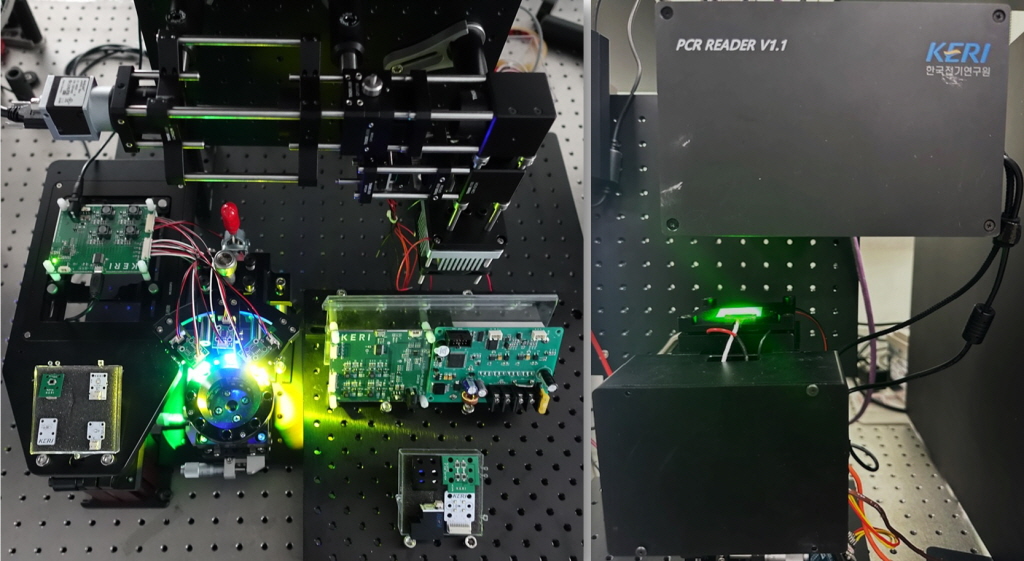
▲KERI's core modules for optical fusion technology and molecular diagnostic systems
The Korea Electrotechnology Research Institute (KERI) has been recognized for its contributions to localizing technology in the battery and electrical medical device fields.
The Korea Electrotechnology Research Institute (KERI) announced on the 30th that it had produced two out of a total of 15 '2023 Outstanding Research Achievements'.
The Outstanding Research Achievements Award recognizes technologies that have created significant scientific, technological, economic, social, and infrastructural value among major research projects conducted by government-funded research institutes in the past year, based on the evaluation criteria of the selection committee. This year, a total of 15 projects were selected, including 10 awards from the Minister of Science and ICT and 5 awards from the President of the National Research Council of Science and Technology (NST).
The "Next-Generation Anode Binder Material Technology for Future Mobility Batteries" developed by KERI's Smart Insulating Materials Research Team won the Minister's Award. Binders are a type of adhesive that helps the active material and conductive material adhere to the current collector, making them essential for batteries. Currently, binders in the market are mainly made of polyvinylidene fluoride (PVDF), a fluorinated polymer, but this has caused stability issues and environmental problems during the battery utilization process.
The research team's achievement was the development of a binder manufacturing technology utilizing a substance called "siloxane," a combination of silicon atoms and oxygen. Because it does not use fluorine, it is environmentally friendly and offers comparable performance to existing binders while costing less than half the price. Furthermore, the siloxane binder exhibits excellent affinity for the cathode active material, maintaining stability even during repeated charging and discharging of the battery.
KERI Insulating Materials Research Center Director Kang Dong-jun said, “Our country’s battery industry boasts the world’s best level, but we are completely dependent on imports for cathode binders because we do not have the specialized technology or companies in the country.” He added, “As batteries become more high-performance and require both stability and environmental friendliness, the importance of binders is growing, and KERI will strive to play a major role in this.”
Additionally, the "Core Technology for a Non-Face-to-Face Infectious Disease Molecular Diagnosis System" from the Electromedical Device Research Group at the Korea Institute of Advanced Medical Sciences was recognized with the Chairman's Award. This achievement is used in "in vitro molecular diagnostics," a testing method that analyzes specific genetic material collected from blood, urine, and tissues to identify the cause of disease. Through high-precision, cutting-edge optical analysis technology and thermoelectric amplification technology, we have achieved low-cost, miniaturized, and automated in vitro molecular diagnostic devices, previously only available at large hospitals, and have established a system that enables continuous monitoring of various diseases, including infectious diseases, even in primary medical institutions and at home.
Dr. Kim Jong-jin of KERI, the head of the research, said, “Over 95% of in vitro molecular diagnostic equipment for severe diseases were expensive imported products, but our research institute succeeded in localizing and developing advanced technology.” He added, “By securing core medical response technologies for the future, molecular diagnosis of infectious diseases will become possible on-site, and by analyzing specific genetic mutations of each patient, early prediction and management of diseases will be possible.”
The research team believes that this achievement will be widely utilized in the vaccine manufacturing and performance verification process in the advanced bio-field, which has been designated as one of the 12 national strategic technologies, and aims to contribute to improving national medical services and strengthening national industrial competitiveness through continuous research.
Meanwhile, KERI is a government-funded research institute specializing in electricity under the National Research Council of Science and Technology of the Ministry of Science and ICT. Following the two achievements (low-cost mass production technology for sulfide-based solid electrolytes for non-flammable all-solid-state secondary batteries and robotic arm-based omnidirectional 3D printing technology) listed on the "National Research and Development Excellence 100" list announced in early November, KERI was also named to this year's "Government-funded Research Excellence List" list for two more, reaffirming its status as a top-tier research institute in Korea.

Comments
Related news
KERI named Best Institution at '2023 Korea SNS Awards'
Korea Electrotechnology Research Institute (KERI) has been selected as the best institute in the research institute category at the '2023 Korea SNS Awards' in recognition of its outstanding achievements and contributions in online communication.
2023.10.12by 배종인 기자
.jpg)
Korea Electrotechnology Research Institute develops core power source for space exploration
Korea Electrotechnology Research Institute (KERI) has successfully developed a "new thermoelectric efficiency formula and high-efficiency stacked thermoelectric power generation device" that can enhance the performance of radioisotope thermoelectric generators (RTGs), a core power technology for space exploration, and has obtained verification from the German Aerospace Center (DLR).
2023.10.16by 배종인 기자
Korea Electrotechnology Research Institute (KERI) leads the international standardization of eco-friendly ship charging systems.
The Korea Electrotechnology Research Institute (KERI), an internationally recognized testing and certification body for power equipment, is leading the international standardization of eco-friendly ship charging systems, accelerating the environmental friendliness of coastal vessels and contributing to the domestic shipbuilding industry's preemption of global markets.
2023.10.23by 배종인 기자
KERI Celebrates 47th Anniversary with President Kim Nam-gyun Emphasizes Development of "Big Technologies"
The Korea Electrotechnology Research Institute (KERI), marking its 47th anniversary, is taking on the challenge of generating groundbreaking achievements with far-reaching impact and technologies that all citizens can recognize and take pride in.
2023.10.30by 배종인 기자
Electrotechnology Research Institute develops insulating gas to replace 'SF6', the main culprit of global warming
The Korea Electrotechnology Research Institute (KERI) has developed a specialty gas capable of replacing SF6 (sulfur hexafluoride), a specialty gas with a high global warming potential, and expectations are gathering that it will be able to make a significant contribution to future carbon reduction.
2023.11.01by 배종인 기자











