


Korea Electrotechnology Research Institute Constructs Domestic Largest-Scale Nano Infrastructure Worth 19.7 Billion Won
 Published2023.12.08 13:48
.jpg)
▲Kim Nam-gyun, President of Korea Electrotechnology Research Institute, delivering remarks at the completion ceremony.
Enhancement of Laboratory Safety and Activation of Small and Medium Enterprise Support
The Korea Electrotechnology Research Institute (KERI) has initiated full-scale efforts to enhance laboratory safety and activate support for small and medium-sized enterprises through the construction of a 19.7 billion won-scale nano infrastructure to lead material and component technologies in the electrification era.
The Korea Electrotechnology Research Institute held the completion ceremony of the 'e-nanomaterial chemical/wet process platform,' which will serve as a core hub for national strategic technology development, at its Changwon headquarters on the 8th.
The event was attended by approximately 100 people including Kim Bok-chul, President of the National Research Council of Science and Technology, Ryu Myung-hyun, Director of the Industry and Trade Bureau of Gyeongnam Province, Jang Geum-yong, First Vice Mayor of Changwon Metropolitan City, and relevant officials from local governments and key related institutions and companies.
With the recent advent of the 'electrification' era, most products we use now employ new materials and components based on electrical functionality. While semiconductors and displays are large-enterprise-based fields relying on dry-process-centered large-scale nano process equipment, the development of new electrical materials and components requires chemical/wet process methods, which are multiple-product, low-volume production methods centered on small and medium-sized enterprises.
Meanwhile, the lack of a central hub (infrastructure) to support chemical/wet processes domestically has been one of the major factors hindering companies' technological advancement.
Accordingly, KERI has been pursuing related infrastructure construction since 2011, and from 2021 onward, with support from the Ministry of Science and ICT and other agencies, it has begun full-scale project implementation.
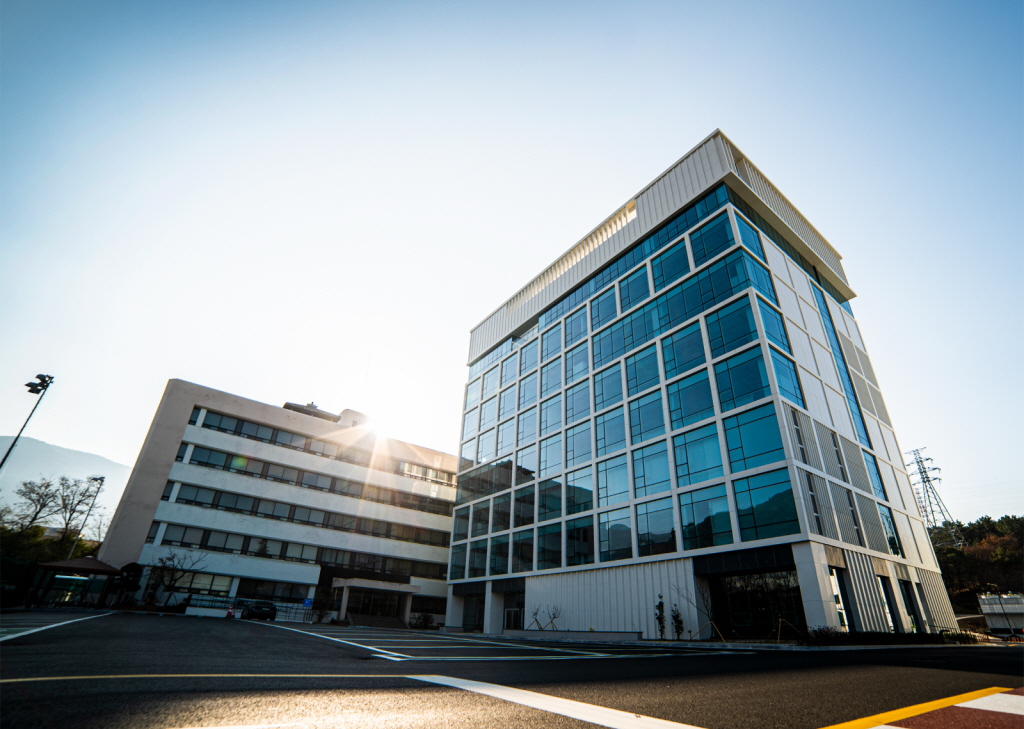
Subsequently, after the platform groundbreaking ceremony in April 2022, the completion ceremony was held in December this year. This marks the fruition of 13 years of dedicated effort. The total project cost is 19.75 billion won over three years (2021-2023) (from contributions and self-funding), with a gross floor area of 6,243m² (1,891 pyeong), and the building structure consists of 9 floors above ground and 1 floor below ground.
The completed 'e-nanomaterial chemical/wet process platform' is the largest-scale domestic infrastructure constructed to secure technological competitiveness in the electrical new materials and components field and foster related hidden champion enterprises.
In particular, a 'commercialization-oriented solution center' operates that provides one-stop support—from transferring KERI-developed technologies to companies, through performance verification, to mass production.
Rather than stopping at simple research and development and technology transfer, the goal is to dramatically shorten product commercialization timelines through continuous collaboration with companies.
Another strength of the platform is its high potential for collaboration with regional key institutions and companies. Beyond KERI's partner companies as a technology core institution of the Changwon, Gyeongnam Advanced Research and Development Special Zone, the platform has sufficient potential to grow into an electrical materials field hub cluster through collaboration with various partners including Miryang Nano Industrial Complex, Gyeongnam Technopark, Korea Institute of Materials Science, and Korea Institute of Ceramic Engineering and Technology.
From the perspective of researchers developing technologies, it is anticipated that the advancement of research facilities will significantly enhance safety, convenience, and work efficiency. Chemical/wet processes, by their nature, have high frequency of use of hazardous and dangerous substances and require many spaces to safely store multiple chemical materials.
The platform building houses numerous advanced equipment laboratories with researcher-centered facilities including various chemical laboratories, large-scale equipment (pilot plant) facilities, temperature and humidity control rooms, dry rooms, precision measurement laboratories, battery charge/discharge test laboratories, conductive/insulating material laboratories, and data analysis facilities. Through this, domestic researchers are expected to gain a solid foundation to create major achievements in national strategic technology fields in a stable work environment.
KERI President Kim Nam-gyun stated, "With the recent development of e-mobility and smart devices, there is a significant demand for high reliability and high performance in electrical new materials and components," and added, "The completion of this platform will expand the foundation of research and development in related fields, create a stepping stone for domestic companies to grow together, and greatly contribute to strengthening national industrial competitiveness."
Lee Geon-ung, Head of the Electrical Materials Research Division at KERI and project manager, stated, "The first phase platform facilities have been completed, and the second phase large-scale equipment construction project is underway," and added, "Through the completed platform, we will provide support not just for technology transfer to companies, but for actual commercialization."
Meanwhile, KERI is a government-funded research institute under the National Research Council of Science and Technology under the Ministry of Science and ICT. The institute is currently designated as a 'National Research Laboratory (N-Lab)' and 'National Research Consortium (N-Team)', and has consistently produced top-tier outcomes in the 'Top 100 National Research and Development Achievements' in the secondary battery and nanotechnology fields for two consecutive years, boasting the highest domestic standards in related fields.

Comments
Related news
.jpg)
Korea Electrotechnology Research Institute develops core power source for space exploration
Korea Electrotechnology Research Institute (KERI) has successfully developed a "new thermoelectric efficiency formula and high-efficiency stacked thermoelectric power generation device" that can enhance the performance of radioisotope thermoelectric generators (RTGs), a core power technology for space exploration, and has obtained verification from the German Aerospace Center (DLR).
2023.10.16by 배종인 기자
Korea Electrotechnology Research Institute (KERI) leads the international standardization of eco-friendly ship charging systems.
The Korea Electrotechnology Research Institute (KERI), an internationally recognized testing and certification body for power equipment, is leading the international standardization of eco-friendly ship charging systems, accelerating the environmental friendliness of coastal vessels and contributing to the domestic shipbuilding industry's preemption of global markets.
2023.10.23by 배종인 기자
KERI Celebrates 47th Anniversary with President Kim Nam-gyun Emphasizes Development of "Big Technologies"
The Korea Electrotechnology Research Institute (KERI), marking its 47th anniversary, is taking on the challenge of generating groundbreaking achievements with far-reaching impact and technologies that all citizens can recognize and take pride in.
2023.10.30by 배종인 기자
Electrotechnology Research Institute develops insulating gas to replace 'SF6', the main culprit of global warming
The Korea Electrotechnology Research Institute (KERI) has developed a specialty gas capable of replacing SF6 (sulfur hexafluoride), a specialty gas with a high global warming potential, and expectations are gathering that it will be able to make a significant contribution to future carbon reduction.
2023.11.01by 배종인 기자
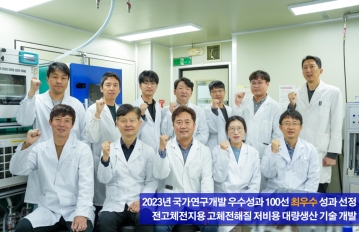
Korea Electric Power Research Institute, National Research and Development Excellence Achievement 100 'Best'
Korea Electrotechnology Research Institute (KERI) has been selected for the '2023 National Research and Development Excellence 100' for its achievements in secondary battery and nano 3D printing fields. Among these, the all-solid-state secondary battery field was selected as a top excellence achievement, with only 12 projects chosen from the 100 best research and development achievements selected by the Ministry of Science and ICT this year.
2023.11.13by 배종인 기자











