



77% of Companies Say They Have No Plans to Adopt Zero Trust... Reason is 'Lack of Information'
 Published2023.12.11 15:33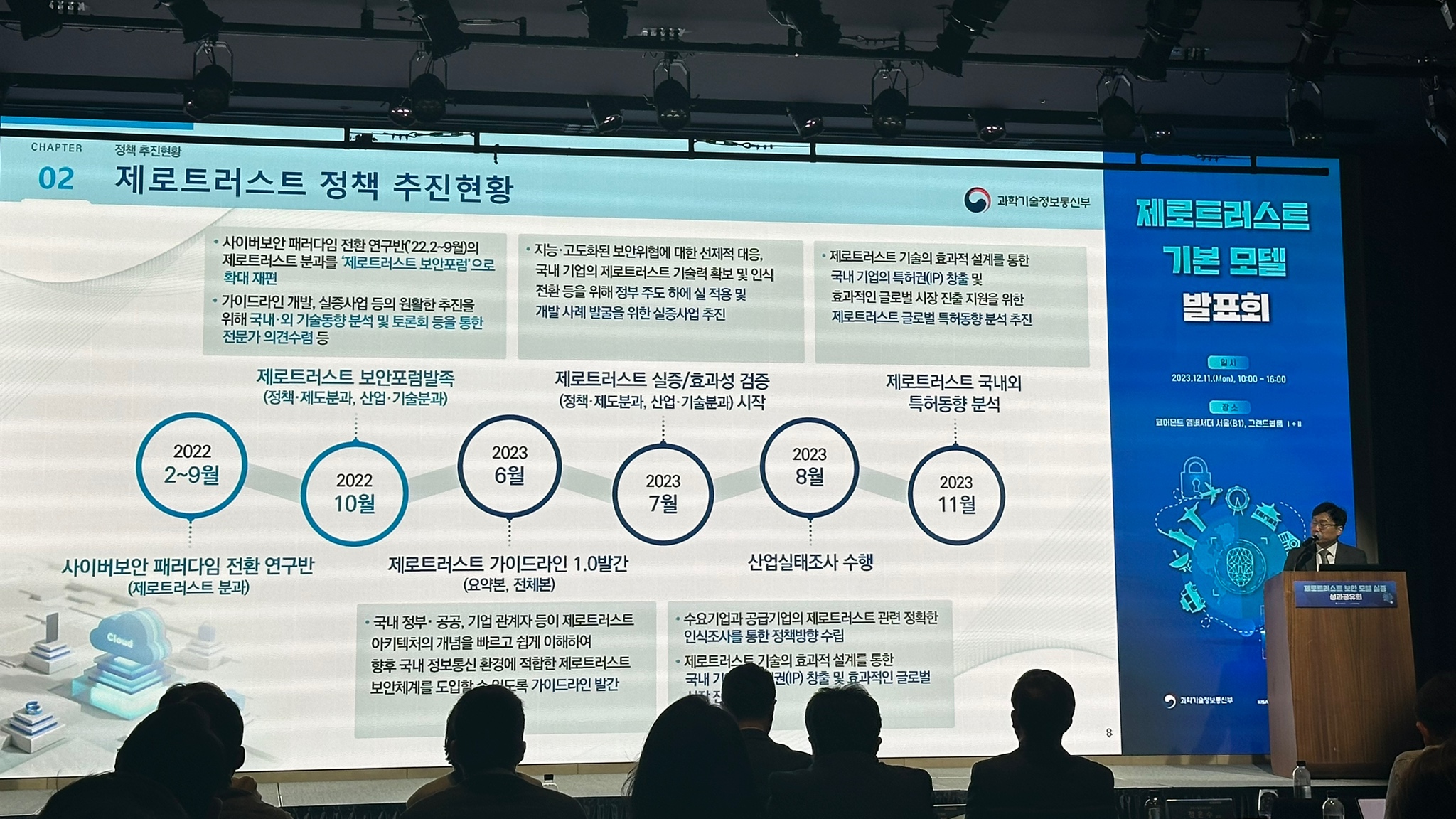
Need to Raise Awareness Among Korean Zero Trust Demand Companies
Ministry of Science and ICT Announces Two Zero Trust Models for Different Work Environments
Experts have suggested that long-term investment is necessary to adopt Zero Trust security suitable for the domestic environment, involving the setting of strategies and goals tailored to corporate circumstances and maturity levels. To this end, emphasis is being placed on establishing policies to raise overall awareness of Zero Trust security and ensuring compatibility with existing security products when building models.
At the Zero Trust security model demonstration results sharing meeting held by the Ministry of Science and ICT and the Korea Internet & Security Agency (KISA) at the Fairmont Ambassador on the 11th, the results and strategies for the introduction and demonstration of Zero Trust security were discussed.
'Zero Trust' is a security strategy that enhances security by gaining reliability through continuous verification based on the assumption that an internal infection already exists. Recently, the concept has expanded from traditional network security to all core elements of the enterprise network.
The Zero Trust security concept expanded rapidly following the 2014 data breach involving 20 million people at the U.S. Office of Personnel Management, and it began to gain attention in Korea as well, amidst digital transformation, the increase in remote work, and the sophistication of cyber threats following the COVID-19 pandemic.
In October 2022, the domestic Zero Trust Forum was launched to establish a strategy for the introduction of Zero Trust in the public and private sectors, and Zero Trust Guidelines 1.0 were released in July 2023 to strengthen the competitiveness of domestic companies.
However, despite the importance of such Zero Trust security, it is currently predicted that it will take time for Zero Trust to flourish in Korea.
According to Professor Yoo Jin-ho of Sangmyung University, more than half of the companies seeking Zero Trust—62.5%—answered that they “do not know.” Additionally, the majority—77%—answered that they “have no plans to adopt it.”
Among these, 'lack of information' regarding Zero Trust was identified as the main problem preventing adoption, accounting for 62%. The ultimate limitation is that demand-side companies do not recognize the necessity of adoption and therefore do not see it as worthwhile to invest.
Accordingly, 78.3% of client companies considered "raising awareness of the necessity of Zero Trust" to be the most important policy. This suggests that, given the security model is still in its early stages, the government needs to raise awareness regarding incentives for adoption and its differentiation from existing security systems. To this end, a detailed implementation roadmap that client companies can accept across various sectors is emphasized.
Professor Yoo argued, “The task in the first stage is to consider what the adoption of zero-trust security can offer to client companies.” Furthermore, they argued that “global Zero Trust providers must ensure compatibility between solutions and establish a trusted environment among companies by opening APIs,” and that “best practices for Zero Trust models suitable for the domestic environment must be disseminated through continuous demand-supplier pilot projects.”
■ Ministry of Science and ICT Announces K-Zero Trust Security Model
On this day, the Ministry of Science and ICT announced two types of 'Zero Trust Basic Models' applicable to domestic corporate network environments: cloud-based and on-premise models. It also established scenarios to verify security effectiveness.
The demonstration project for the domestic Zero Trust (K-Zero Trust) security model broke ground this July following the publication of the guidelines.
First, by applying a cloud-based Zero Trust security model, services, servers, applications, and data can be logically separated and protected. This makes it easier to apply Zero Trust security to SaaS applications in the future.
In the telecommunications sector as well, vulnerabilities that could lead to DDoS attacks on domestic networks have been improved. Problems in the wireless communication network environment can be blocked at the source by developing and applying a dedicated router equipped with a PEP (Policy Enforcement Point).
In addition, we confirmed the potential to enhance security from the connection stage during virtual private network-based remote and work-from-home environments, even in on-premises settings, and to provide a customized Zero Trust security model.
In 2024, the Ministry of Science and ICT plans to expand the scope of support for demonstration projects through a new budget of 6.2 billion won and publish Guideline 2.0 in the first half of next year.
Jeong Eun-su, Head of the Information Security Industry Division at the Ministry of Science and ICT, said, “In Guideline 2.0, we will consider ways to drive expansion from a legal and institutional perspective, while making it more specific based on demonstration cases and maintaining connectivity with existing security systems.”
He also stated, “In the future, we will analyze specific characteristics by industry domain and implement practically necessary models to expand in line with actual market demand.”
Comments
Related news
Sailpoint: "Zero-Trust-Based Unified Identity Security Is Essential"
As data management complexity increases, SailPoint has unveiled an enterprise-grade identity security platform. Chern-Yue Boey, President of SailPoint Asia-Pacific, stated, "Many enterprises' identity security remains at a foundational stage, and they are facing difficulties in managing unstructured data. Identity security is no longer simply a security issue like on smartphones—it is now a business issue," adding, "SailPoint provides a solution that automates data and application access management, enabling integrated management."
2023.11.08by 김예지 기자
.jpg)
160,000 malicious open-source packages discovered last year
Software development utilizing open source has reached approximately 90%, with over 700,000 open source-based packages distributed monthly on average, while software supply chain security faces mounting threats. Recent incidents have also revealed attacks on open source packages (OSS) distributed by banking institutions, indicating that heightened attention to software supply chain security is becoming increasingly necessary.
2023.11.20by 명세환 기자
.jpg)
Infineon Supports LED Cards with SECORA™ Pay Security Solution
Infineon Technologies (Korea Representative Director Lee Seung-soo) supports card inlays with LEDs through its SECORA™ Pay security solution, enabling banks to implement differentiated card designs.
2023.12.01by 배종인 기자
Cisco Launches Security AI Assistant
Cisco has strengthened security by expanding AI application to its cloud solutions through the launch of a security AI assistant.
2023.12.07by 배종인 기자
.jpg)
SalePoint Signs Multi-Year Partnership Agreement with AWS… Promoting Identity Security that Integrates Even AI Agents
Sailpoint has entered into a multi-year strategic partnership agreement with AWS and is moving forward with establishing an integrated governance system that manages both human and non-human identities together. The plan is to consistently manage access permissions in an environment where AI agents are increasing as work execution entities, while applying the principle of least privilege and automated policy enforcement. The two companies plan to jointly expand capabilities to manage the identities of various entities, including AI agents, within a single layer in the AWS environment. This collaboration is interpreted as a move to design security and governance together in corporate environments where AI adoption is expanding.
2026.03.26by 배종인 기자











