


UNIST Successfully Synthesizes New Organic Semiconductor Material with Different Materials
 Published2023.12.14 15:05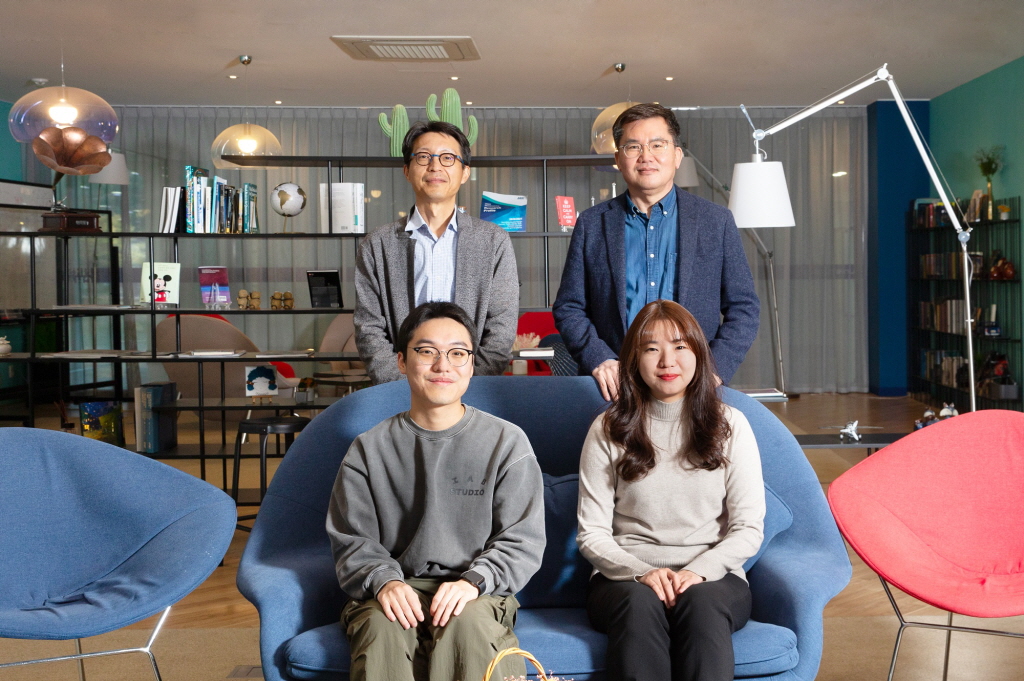
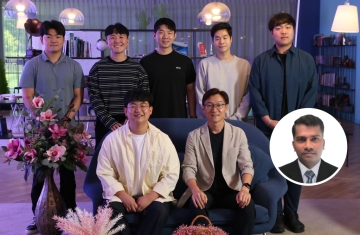
▲ The leaders of this research (from left in the top row): Professor Park Young-seok, Professor Choi Won-young, (from left in the bottom row): First author Researcher Jung Seong-hwa, Researcher Kim Ji-yeon
We have succeeded in synthesizing a new organic semiconductor material. It is expected to present a new type of semiconductor material.
A team led by Professor Young-Seok Park of the Department of Chemistry at UNIST (President Yong-Hoon Lee) announced on the 14th that they have synthesized a new anthracene derivative, 'BNBN anthracene', through continuous boron-nitrogen (BN) bonding.
In addition, a 'BOBN anthracene' molecule, in which boron-oxygen (BO) bonds and boron-nitrogen (BN) bonds are connected in succession, was used as a blue host for an organic light-emitting diode (OLED).
The developed anthracene molecule can operate even at low voltages, confirming its potential as an organic semiconductor material.
Anthracene derivatives are key materials that enhance electron mobility and light-emitting properties in carbon-based organic electronic devices. They are particularly attracting attention as core components of high-performance electronic devices.
The research team replaced the carbon-carbon bonds (CC) that make up anthracene with consecutive boron-nitrogen (BN) bonds having the same number of electrons. We synthesized a new type of anthracene derivative that had not been previously reported and studied its properties.
Compared to existing carbon-only anthracene derivatives, 'BOBN anthracene' and 'BNBN anthracene' molecules exhibit different optical and electrochemical properties.
In particular, when using 'BOBN anthracene' molecules as the blue host for organic light-emitting diodes, it was possible to operate at a lower voltage (3.1V) than before.
In addition, at the same current density, the values for current usage efficiency, energy efficiency, and amount of emitted light were found to be about 10% higher.
Additionally, the research team identified the crystal structure of 'BNBN anthracene' using an X-ray diffraction analyzer, which can obtain information about the structure of materials.
The potential for using the new molecule was confirmed by further studying structural changes, such as bond length and angle, caused by boron-nitrogen (BN) bonds by comparing it with the structure of existing carbon-only anthracene derivatives.
"This study served as a fundamental study on anthracene, a type of acene that is gaining attention as an organic semiconductor," explained Jung Sung-hwa, the first author and a researcher in the integrated master's and doctoral program in chemistry. "The continuous boron-nitrogen (BN) bonds synthesized through this research could be applied to organic semiconductors in the future."
"The synthesis and characterization of compounds with continuous boron-nitrogen (BN) bonds will contribute to basic research in the field of chemistry," said Professor Park Young-seok of the Department of Chemistry. "It will become an important tool that can be utilized to synthesize new compounds and control their electronic properties."
Professor Kim Joong-han's team from the Department of Chemistry at Catholic University, UNIST ChemistryThe results of this research, in which Professor Won-Young Choi's team and the SFC research team participated, were published online on December 11 in 'Angewandte Chemie International Edition,' the most prestigious journal in the field of chemistry.
This research was conducted with support from the Mid-Career Researcher program promoted by the National Research Foundation of Korea (NRF) under the Ministry of Science and ICT, the Corporate SFC, and the Ministry of Trade, Industry and Energy.
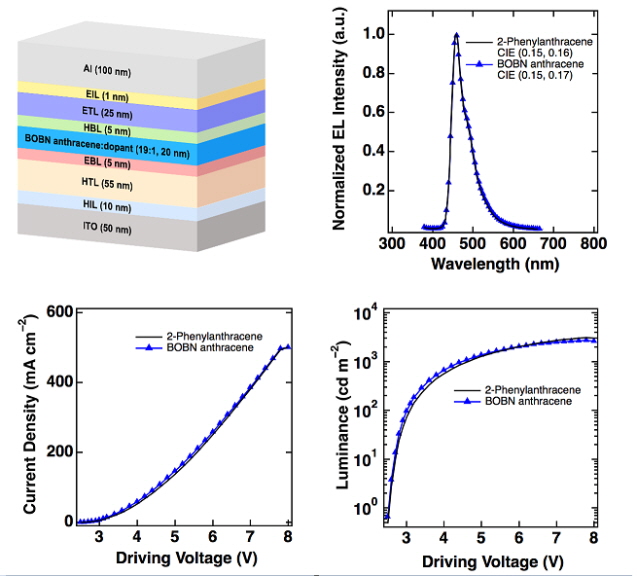
▲ Device structure and OLED performance using anthracene derivatives as the blue host of an OLED

Comments
Related news
.jpg)
UNIST Improves Secondary Battery Performance by Recycling Mask Waste
Professor An Gwang-jin's team in the Department of Energy and Chemical Engineering at UNIST (President Lee Yong-hun) has developed a process to produce carbon nanotubes from discarded mask waste and apply them as a cathode conductive material in lithium-ion batteries. This is expected to develop into a key technology that can protect the environment through future plastic waste recycling and be utilized in advanced industries.
2023.10.19by 배종인 기자
From green hydrogen to nitrogen and oxygen, we make whatever you want.
A research team led by Professors Ryu Jeong-gi and Lee Dong-wook from the Department of Energy Chemical Engineering at UNIST (President Lee Yong-hoon) has developed a large-area hydrogel thin film technology that can be universally applied to gas-producing electrodes. It is anticipated that this technology will enable easy production of clean gas feedstocks such as green hydrogen.
2023.10.24by 배종인 기자
UNIST: "One-Stop Diagnosis for Spent Car Batteries"
A research team from UNIST's Department of Energy and Chemical Engineering led by Professors Kim Dong-hyuk and Choi Yun-seok, along with Professor Yim Han-gwon from the Carbon Neutrality Graduate School, has developed DeepSUGAR, a system capable of diagnosing the health status of battery components based on deep learning that enables computers to train independently.
2023.11.08by 배종인 기자

Method Found to Manufacture Ultra-Superpowerful Lasers Beyond Superpowerful
Professor Heo Min-seop's team from the Department of Physics at UNIST (President Lee Yong-hoon), Professor Seok Hee-yong's team at GIST (President Lim Ki-chul), and Professor Jaroszynski's team at Strathclyde University in the UK have proposed an idea for creating laser pulses more than 1,000 times stronger than existing ones through joint research and verified this through computer simulations.
2023.11.15by 배종인 기자
UNIST, Improved Water Electrolysis Performance and Stability with New Catalyst Layer Introduction Technology
A research team led by Professor Kwon Young-kook of the Department of Energy Chemical Engineering at UNIST (President Lee Yong-hun) has developed an 'integrated membrane-catalyst-support electrode manufacturing technology' that directly grows a catalyst layer between an anion exchange membrane and a support to fabricate a Membrane Electrode Assembly.
2023.11.21by 배종인 기자











