


ETRI Achieves World-Leading 3Gbps 5G Small Cell Speed
 Published2023.12.19 11:36
.jpg)
▲ETRI researchers demonstrate 5G small cell uplink.
Key technologies that will flourish in 5G specialized networks will reduce costs and time when commercialized.
The Electronics and Telecommunications Research Institute (ETRI) has succeeded in developing a '5G small cell base station SW' that can connect two frequencies simultaneously for dual communication, and gigabit (Gbps) data communication speeds are expected in specialized 5G networks such as smart factories and defense networks.
ETRI announced on the 19th that it has succeeded in developing dual connectivity technology that uses Sub-6GHz (mid-band) and millimeter wave (mmWave, high-band) frequencies simultaneously as part of the Ministry of Science and ICT's Broadcasting and Communications Industry Technology Development Project, 'Development of 5G NR-based Intelligent Open Small Cell Technology.'
This technology is a '5G small cell base station SW technology' that provides a downlink speed of 3 Gbps at the world's highest level.
Ucast, Qualcomm, Contela, Hanwha Systems, and SK Telecom participated as joint research institutions.
Dual connectivity is a technology that allows simultaneous connection and operation on different frequency bands.
By connecting to users from two base stations simultaneously and providing services, a significant improvement in transmission speed and distribution of base station load are expected.
Millimeter waves, which previously enabled high-speed data transmission(mmWave) Small cell base stations were only capable of NSA mode.
It could not be used in a 5G-specific network built as a standalone 5G network.
The dual connectivity technology developed by ETRI researchers has enabled the use of millimeter-wave small cell base stations in standalone 5G networks.
It is expected that data transmission speeds will be greatly improved when used in 5G specialized networks.
The research team explained that the significance of this technology lies not only in its technological superiority in terms of simple data transmission speed, but also in the fact that it has proven the utility of using millimeter wave frequencies, which are strong in high-speed transmission after the commercialization of 5G.
In addition to dual connectivity technology, ETRI also presented achievements such as uplink performance improvement, automated base station operation control technology, and energy saving technology.
The research team also succeeded in achieving an uplink speed of up to 800 Mbps through time division duplexing technology and uplink carrier frequency aggregation (CA) technology.
This result represents the world's highest performance for a 5G small cell base station with a downlink speed of 3 Gbps.
It is expected to become a core infrastructure communication in other industries and technology fields that require high-speed/large-capacity data communication.
In particular, the improvement of high-speed uplink performance is expected to be key to 5G specialized network solutions, such as smart factories, smart cities, and smart buildings, where uplink data is expected to increase explosively compared to existing systems.
One of the main goals of this development technology is to reduce costs for companies through lower technology fees compared to foreign products.
To this end, ETRI has also completed verification of interoperability with commercial terminals currently on the market at home and abroad.
Therefore, this technology can be commercialized immediately.
In other words, the company that received the technology transfer This means that new business models can be created at low cost in a short period of time.
In addition, ETRI has significantly reduced the complexity of base station operation through Plug & Play technology, which allows multiple small cell base stations to automatically connect and operate simply by plugging in power.
The research team also introduced a solution that can solve the social problem of reducing electric energy consumption by automatically turning small cell base station equipment on and off through traffic and user location prediction.
The research team stated that they were able to achieve this result because they had accumulated many years of research experience related to 5G base stations.
This study implemented a small cell base station with performance similar to that of a macro base station using low-spec hardware.
Of course, high-speed transmission services in the millimeter wave band are possible with 5G wireless access technology alone, without the control of LTE base stations.
Hong Jin-bae, Director of the Network Policy Office at the Ministry of Science and ICT, said, "We expect 5G small cells to be a significant contributor to the activation of various convergence services in specialized 5G networks. It is significant that technology developed through collaboration between small and medium-sized network companies and research institutes is being recognized as world-class. We will continue to support the revitalization of the small cell industry through technology transfer, prototype production, and market development."
ETRI Mobile Communications Research Center Director Kim Il-gyu also said, “Not only can we utilize millimeter waves with 5G technology alone, but we have also achieved a maximum terminal transmission speed of 3 Gbps. “We have succeeded in developing software that can achieve high performance at low cost, and this has significantly increased the utilization of millimeter-wave small cells,” he said.
ETRI explained that this technology can be widely used in future high-definition services, mobile broadcasting transmission, high-definition CCTV services, and smart factories.
Through this technology development, the research team achieved 139 domestic and international patents, 27 international standards, 26 SCI(E) papers, and 8 technology transfers.
Not only was it selected as one of the 100 Best National Excellences in Korea in 2023, but its excellence was also recognized internationally when it was selected as an excellent SW at the Small Cell World Summit Forum (SCF) Awards 2023 held in London, England in June.
Recently, companies that have received technology transfer for this technology are conducting pilot projects in Japan, Brazil, and other countries.
Additionally, as 5G specialized network pilot services are being promoted domestically, industrial utilization of 5G small cells for specialized network services is also progressing in various ways.
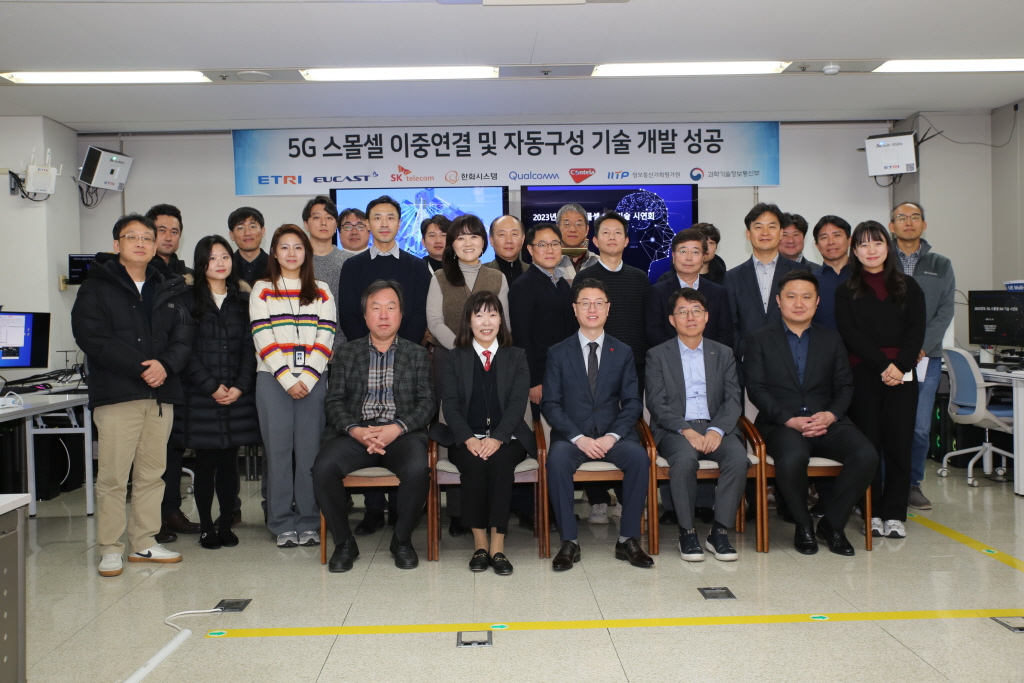
▲The Electronics and Telecommunications Research Institute (ETRI) held a successful demonstration of its 5G small cell dual-connectivity and auto-configuration technology development on the 19th. (Photo: Third from left, front row (center)) Hong Jin-bae, Director of the Network Policy Office at the Ministry of Science and ICT

Comments
Related news
ETRI Develops 5G Small Cell Hardware Following Software Success
The Electronics and Telecommunications Research Institute (ETRI) has achieved localization of LTE small cell software for compact base stations used like wireless access points within a radius of 10m to 1km, and is now embarking on full-scale research for localization of small cell equipment essential to future 5G infrastructure. ETRI is targeting commercialization by 2022.
2018.08.25by 이수민 기자

ETRI succeeds in localizing millimeter wave band 5G small cell SW
ETRI has successfully developed 28GHz band-supporting 5G small cell software technology that improves transmission capacity and perceived communication speed in 5G coverage blind spots and densely populated areas. This has opened the path for domestic small and medium-sized enterprises to commercialize Korean-developed software rather than foreign software in 5G small cell communication equipment.
2020.10.28by 이수민 기자
ETRI Successfully Develops 5G Standalone Mode Small Cell Software
Domestic researchers have developed technology that enables 5G implementation without LTE assistance in small base stations, which is expected to be widely utilized in providing users with high-capacity, high-quality data or delivering 5G specialized network services.
2021.11.25by 배종인 기자

Korea Airports Corporation Successfully Implements '5G Specialized Network' in Airport Environment
According to the "5G Specialized Network Small Cell Network Technology Verification (PoC) Implementation Result Report" disclosed by the Korea Airports Corporation's Smart Airport Promotion Division, a 5G-grade wireless communication network can now be established even at aeronautical radiobeacons not serviced by the three telecom carriers, enabling a communication system for emergency response.
2022.12.22by 김예지 기자

2026, 5G market value '45 trillion won'
TrendForce announced on the 19th that the global 5G market size in 2023 is expected to reach $14.5 billion (17 trillion won) through activation of enterprise 5G private networks, advancement of small cell dedicated equipment, and 5G FWA, and is projected to reach $37 billion (45 trillion won) in 2026 with a CAGR of 11.0%. Metaverse-related applications were noted as a noteworthy application area.
2023.01.31by 김예지 기자











