


Jeju Island Begins Recycling of Used Electric Vehicle Batteries
 Published2023.12.20 09:02
Ultra-low temperature freeze-crushing → sorting technique eliminates fire and explosion risks even from external impact
Black powder extracted from waste battery pretreatment can be transported by sea.
The Ministry of Environment announced on the 19th that it will sign a written agreement (MOU) with Jeju Special Self-Governing Province and SF Eco Co., Ltd. to promote a pilot project for the pretreatment of used electric vehicle batteries intended for recycling that are stored in Jeju.
Pretreatment involves crushing and grinding battery packs, scrap, etc., to produce black powder, and black powder (BP) is a black powder containing lithium, nickel, cobalt, manganese, and the like.
Used electric vehicle batteries returned in Jeju Island must be recycled within Jeju Island or transported to the mainland, but there are no recycling companies in the region, and transporting the batteries to the mainland poses a risk of fire and explosion, so they were being stored at Jeju Technopark (281 units as of the end of September 2023, 181 remanufactured/reused, 100 recycled).
Accordingly, the parties intend to process waste batteries for electric vehicles in Jeju Island in an eco-friendly manner through a pilot project, and this agreement aims to establish the necessary matters for carrying out such a pilot project.
The Ministry of Environment and Jeju Special Self-Governing Province reviewed the installation of pretreatment facilities for the safe recycling of waste batteries in the Jeju region.
As a result, waste batteries are pretreatedIt was confirmed that the black powder produced there can be transported by sea to onshore post-processing facilities (for extracting lithium, cobalt, etc. through a smelting process).
This pilot project involves pre-treating waste electric vehicle batteries by applying an ultra-low temperature freeze-crushing method, after freezing the battery electrolyte at temperatures below -50°C using liquid nitrogen or liquefied natural gas (LNG) cold energy to cut off the power and eliminate the risk of fire or explosion.
The pilot project's method of collection → ultra-low temperature freeze-crushing → sorting, which eliminates the discharge process from the existing collection → discharge → crushing → sorting (BP production) method, has the significant advantage of preventing the risk of fire or explosion even from external impact.
The pilot project was decided to proceed only up to the pretreatment of extracting black powder from waste batteries, and the post-treatment of extracting minerals from black powder, which poses a risk of environmental pollution, was excluded from the scope of the pilot project.
In this pilot project, the Ministry of Environment supports the transportation costs of waste batteries, the improvement of related systems, and the acquisition of permits and licenses.
Jeju Special Self-Governing Province will provide the site (paid lease), supply used electric vehicle batteries (paid sale), and support the acquisition of permits, while SF Eco plans to install and operate ultra-low temperature freeze-crushing pretreatment facilities.
This pilot project is expected to help secure the supply chain by safely pre-processing used electric vehicle batteries stored on Jeju Island for recycling, transporting them to post-processing facilities on the mainland, and recovering valuable metals.
In addition, by utilizing the cold energy of liquefied natural gas (LNG), it can contribute to promoting carbon neutrality and the transition to a circular economy, such as reducing greenhouse gases.
Cho Hyun-soo, Director General of the Resource Circulation Bureau at the Ministry of Environment, stated, “To strengthen the supply chain security of key battery minerals, it is crucial to stably supply recycled raw materials to battery manufacturing through recycling,” adding, “this "We will safely recycle used batteries stored in Jeju through the pilot project, and analyze the results to review the expanded application of eco-friendly technologies," they stated.
Comments
Related news
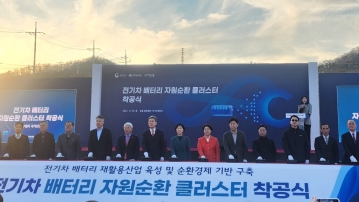
Gyeongbuk Province Holds Groundbreaking Ceremony for Used Battery Resource Recycling Cluster… Plans to Become a Forward Base for Battery Recycling Industry
Gyeongsangbuk-do held a groundbreaking ceremony for a used battery resource recycling cluster and is now formally implementing plans to emerge as a national hub for battery resource recycling and a core component of an eco-friendly green industry ecosystem.
2023.12.06by 성유창 기자
LG Ensol and KAIST Develop Lithium Metal Battery Technology Capable of 900km of Driving Range on a Single Charge
LG Energy Solution and a joint research team with KAIST have successfully developed technology that can dramatically enhance the performance of lithium metal batteries, which are garnering attention as next-generation batteries.
2023.12.07by 성유창 기자
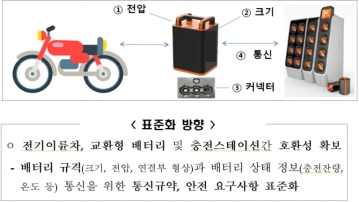
National Standards Agency, Electric Motorcycle Battery Exchangeable Charging Station National Standard Establishment Notice
Due to issues with electric two-wheeled vehicle batteries such as charging time (3–4 hours), price (1–1.5 million won), and manufacturer-specific specifications, the need for standardization of battery swapping stations has been raised. Accordingly, the Ministry of Industry has established national standards for three types of electric two-wheeled vehicle battery swapping charging stations and one type of electric two-wheeled vehicle.
2023.12.07by 성유창 기자
.jpg)
LG Ensol accelerates its advance into the European commercial vehicle market… Agrees to supply 200,000 modules over 3 years
LG Energy Solution announced on the 8th that it has signed a battery module supply contract with ICPT (Impact Clean Power Technology), a Polish battery pack manufacturing and sales company.
2023.12.08by 성유창 기자
.jpg)
Pii Co., Ltd. develops vision inspection solution for next-generation cylindrical '46-pi' batteries.
PIE Inc. (CEO Choi Jung-il), a specialist in vision inspection and smart factory solutions, has developed a vision inspection solution applicable to '46-format (Ø diameter 46mm)' cylindrical batteries, which are attracting attention as next-generation batteries for electric vehicles.
2023.12.14by 배종인 기자











