


Korea Electric Power Research Institute: Pest Control Using Microwave Soil Heating
 Published2023.12.21 09:18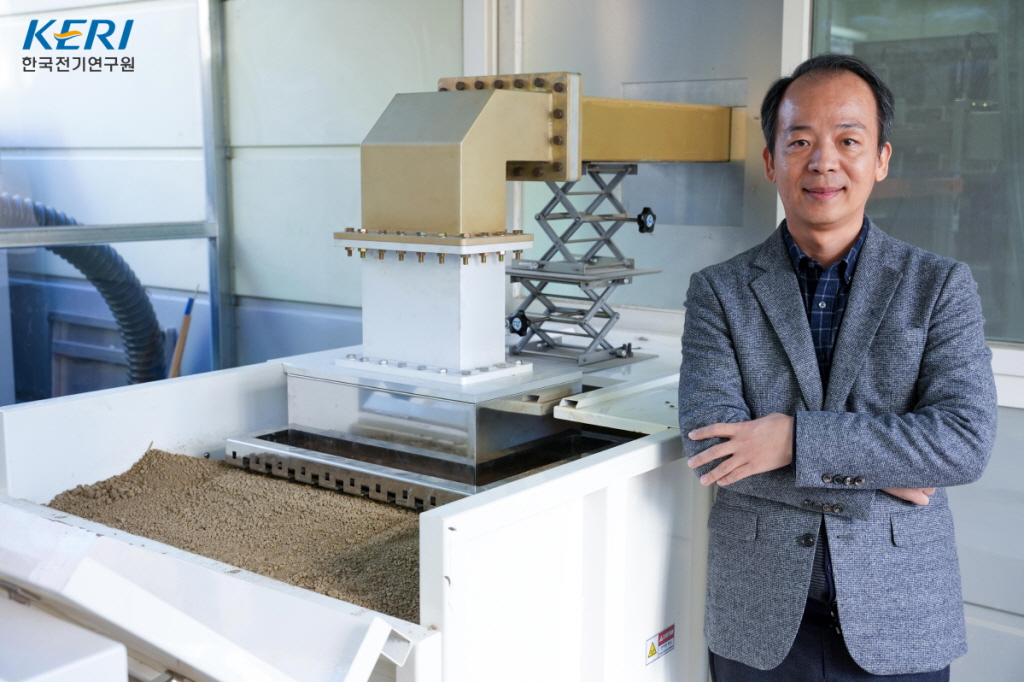
▲Dr. Jeong Sun-shin of the Korea Electrotechnology Research Institute
A technology has been developed to control pests and diseases by heating soil with microwaves, which is expected to alleviate the problem of continuous cropping, a concern for farmers.
The Korea Electrotechnology Research Institute (KERI) announced on the 20th that Dr. Jeong Sun-shin's team recently developed a groundbreaking technology that effectively controls pests and diseases without pesticides and prevents damage to farmers due to repeated cropping by utilizing microwaves, the core principle of microwave operation.
Repeated cropping disorder, a major challenge for farmers today, occurs when the same crop is planted consecutively in the same field, resulting in reduced yield and quality. While there are various causes, the primary issue is the spread of pests and diseases, such as soil-borne bacteria, fungi, and nematodes.
To prevent these damages, pesticides are widely used, but problems such as destruction of the agricultural ecosystem, increased pesticide resistance, and residual toxicity persist. While methods such as long-term fallow periods can help restore the soil, they pose significant challenges to farmers' livelihoods.
KERI's achievement is a technology that penetrates microwaves deep into the ground to heat soil moisture and control heat-vulnerable pests and diseases. This technology has already been studied in Australia and other countries, but because microwaves are easily scattered (wave diffraction), they cannot penetrate deep into the ground (about 10 cm), and so they were only used for removing weeds.
Dr. Jeong Soon-shin's team has meticulously studied and analyzed the properties of microwaves for years, achieving a level where they can control the spatial distribution of microwaves by increasing or decreasing their wavelength as desired. Based on this, they successfully developed a unique antenna (radiator) capable of maximizing microwave penetration. The microwaves emitted from the antenna were guided to meet at a specific point underground, where they combined (wave superposition), increasing their amplitude and enabling heating to a world-class depth of over 30 cm.
Deeply transmitted microwaves selectively heat soil moisture to temperatures ranging from 60 to 100 degrees Celsius (temperature controllable). Soil consists of 10 to 30% moisture, and most pests and diseases live near crop roots and are vulnerable to temperatures above 60 degrees Celsius. Therefore, KERI's technology can be highly effective in sterilizing these pests. Furthermore, soil has excellent thermal insulation properties, so once heated, it doesn't cool easily and can be maintained for a long time, resulting in long-term sustainability.
The research team's achievements are expected to play a significant role in reducing the damage caused by repeated cropping disorders on farms. Indeed, this technology originated at the request of an employee of the National Institute of Animal Quarantine and Plant Quarantine, and its promising results led to its transfer to Jueun Care Farm Co., Ltd. (CEO Choi Moon-heon), a pest control equipment specialist. The company plans to manufacture equipment based on the technology it has acquired and provide it to farmers across the country at low prices through local governments and public institutions.
KERI's Dr. Jeong Sun-shin said, "This is a principle that uses the wave properties of microwaves to heat deep into the ground by ensuring that microwaves are properly collected rather than spread out." He added, "Without worrying about the side effects of pesticides or environmental pollution, it will be possible to control pests and diseases remaining in empty fields after crop harvest with microwaves, greatly contributing to improving agricultural productivity and increasing farmers' income."
Moon-Heon Choi, CEO of Jooeun Care Farm, said, “The problem of soil pest damage caused by repeated cropping is a difficult problem that has not yet been solved not only in Korea but also in advanced agricultural countries overseas due to resistance to chemical pesticides.” He added, “The eco-friendly microwave pest control device will ease farmers’ worries, and the path to overseas exports is also very bright, leading to the next-generation agricultural revolution.”
Experts believe this technology can be utilized not only in agriculture but also in the non-destructive eradication of habitats of invasive pests (such as termites, red fire ants, and tropical fire ants) that have recently appeared in ports and airports. Furthermore, microwave heating devices installed on mobile vehicles could be used to remove black ice on winter roads, and microwave heating technology could also be used to purify oil-contaminated soil.
The KERI research team, which has completed numerous patent applications related to its performance, anticipates that microwave penetration heating technology will be utilized in various fields, and plans to continue to identify companies in need and promote commercialization.
Meanwhile, KERI is a government-funded research institute under the National Research Council of Science and Technology of the Ministry of Science and ICT. This research was conducted through KERI's basic project, 'Development of microwave penetration heating technology for soil pest control.'

Comments
Related news
Korea Electrotechnology Research Institute (KERI) leads the international standardization of eco-friendly ship charging systems.
The Korea Electrotechnology Research Institute (KERI), an internationally recognized testing and certification body for power equipment, is leading the international standardization of eco-friendly ship charging systems, accelerating the environmental friendliness of coastal vessels and contributing to the domestic shipbuilding industry's preemption of global markets.
2023.10.23by 배종인 기자
KERI Celebrates 47th Anniversary with President Kim Nam-gyun Emphasizes Development of "Big Technologies"
The Korea Electrotechnology Research Institute (KERI), marking its 47th anniversary, is taking on the challenge of generating groundbreaking achievements with far-reaching impact and technologies that all citizens can recognize and take pride in.
2023.10.30by 배종인 기자
Electrotechnology Research Institute develops insulating gas to replace 'SF6', the main culprit of global warming
The Korea Electrotechnology Research Institute (KERI) has developed a specialty gas capable of replacing SF6 (sulfur hexafluoride), a specialty gas with a high global warming potential, and expectations are gathering that it will be able to make a significant contribution to future carbon reduction.
2023.11.01by 배종인 기자
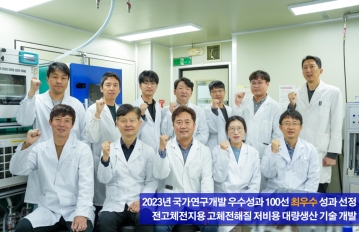
Korea Electric Power Research Institute, National Research and Development Excellence Achievement 100 'Best'
Korea Electrotechnology Research Institute (KERI) has been selected for the '2023 National Research and Development Excellence 100' for its achievements in secondary battery and nano 3D printing fields. Among these, the all-solid-state secondary battery field was selected as a top excellence achievement, with only 12 projects chosen from the 100 best research and development achievements selected by the Ministry of Science and ICT this year.
2023.11.13by 배종인 기자
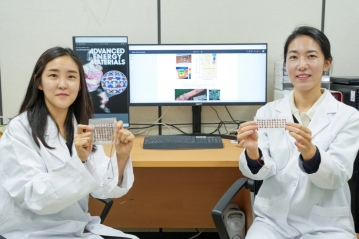
Generating electricity from body temperature through metamaterials, expected to be applied to IoT
A research team led by Dr. Choi Hye-kyung and Dr. Yun Min-joo at the Electrical Materials Conversion Research Center of the Korea Electrotechnology Research Institute (KERI) has developed a technology that can enhance both the stretchability and efficiency of thermoelectric power generation devices to world-class levels by utilizing 'metamaterials' that do not exist in nature.
2023.11.21by 배종인 기자











