



6G communications are within reach with electromagnetic waves amplified 30,000 times.
 Published2023.12.21 16:32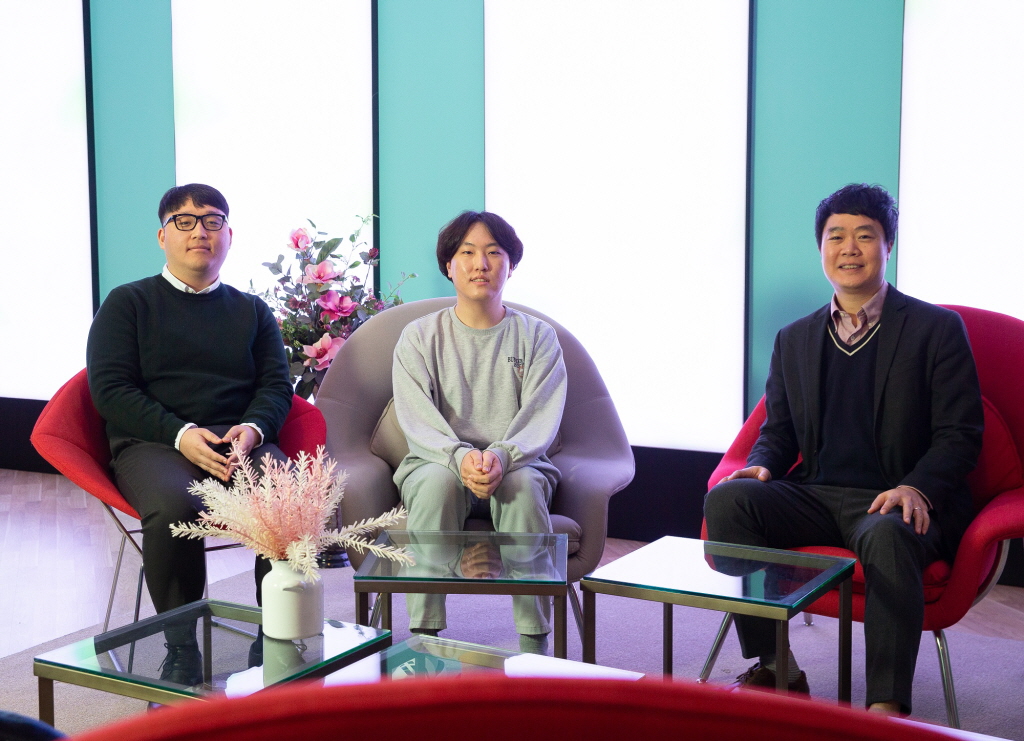
▲(From left) Researcher Kim Jeong-hoon, first author Researcher Lee Hyeong-taek, and Professor Park Hyeong-ryeol
Technology has been developed that can amplify terahertz (THz) electromagnetic waves, such as light and infrared, by more than 30,000 times. This technology, based on physics models and combined with artificial intelligence (AI), is expected to accelerate the commercialization of 6G communication frequencies.
Professor Hyung-Ryeol Park's research team in the Department of Physics at UNIST (President Yong-Hoon Lee), in collaboration with Professor Jun-Soo Lee's research team at the University of Tennessee and Professor Mi-Na Yoon's research team at Oak Ridge National Laboratory, has developed an optimization technology for THz nanoresonators for 6G communications. This task, which previously required a long time even on supercomputers, has been made easier to design on personal computers using AI learning based on physics theory models.
The research team analyzed the efficiency of the newly developed nanoresonator through THz electromagnetic wave penetration experiments. Compared to the electric field generated by conventional electromagnetic waves, they were able to generate an electric field that was amplified by more than 30,000 times. This represents a 300% increase in efficiency compared to previous THz nanoresonators reported in the academic community.
Until now, 'AI reverse engineering technology' has been used to find the optimal design method by combining optical simulation and AI. We designed a device that converts optical energy into electrical energy, mainly operating in the visible or infrared range.
Professor Park Hyeong-ryeol added, “In AI reverse engineering technology, optical device structures that are one-tenth or one-hundredth the size of a wavelength were mainly designed,” and “However, it was difficult to apply because the wavelength was one-millionth smaller than the wavelength of 0.075 to 0.3 THz, which is the frequency of 6G communication.”
Designing a nanoresonator operating at 6G frequencies can take tens of hours for a single simulation, even on a high-performance computer. In other words, optimizing a single device using conventional reverse engineering methods could take hundreds of years.
To address these issues, the research team combined theoretical physics models with AI reverse engineering methods to design a new THz-range nanoresonator. Even with a personal computer, the device was optimized within 40 hours.
First author and researcher Lee Hyeong-taek explained, “The nanoresonator optimized through this study can be used not only for ultra-precision detectors, but also for trace molecule detection sensors and bolometer research.” He added, “The methodology applied in the study is not limited to specific nanostructures, and can be utilized in various studies along with physical theory models of various wavelengths or structures.”
Professor Park Hyung-ryeol of the Department of Physics said, “The core of this research is to understand physical phenomena and improve the efficiency of technology using AI,” adding, “It may seem that AI can solve all problems, but it is still important to first understand physical phenomena.”
This study was published online on December 7th in Nano Letters, a world-renowned international academic journal. This research was supported by the National Research Foundation of Korea (NRF) of the Ministry of Science and ICT, the Global Core Talent Development Project of the National IT Industry Promotion Agency, the University ICT Research Center Support Project (IITP), and the AI Distribution and Expansion Support Project of Ulsan National Institute of Science and Technology.

Comments
Related news
UNIST: "One-Stop Diagnosis for Spent Car Batteries"
A research team from UNIST's Department of Energy and Chemical Engineering led by Professors Kim Dong-hyuk and Choi Yun-seok, along with Professor Yim Han-gwon from the Carbon Neutrality Graduate School, has developed DeepSUGAR, a system capable of diagnosing the health status of battery components based on deep learning that enables computers to train independently.
2023.11.08by 배종인 기자
Method Found to Manufacture Ultra-Superpowerful Lasers Beyond Superpowerful
Professor Heo Min-seop's team from the Department of Physics at UNIST (President Lee Yong-hoon), Professor Seok Hee-yong's team at GIST (President Lim Ki-chul), and Professor Jaroszynski's team at Strathclyde University in the UK have proposed an idea for creating laser pulses more than 1,000 times stronger than existing ones through joint research and verified this through computer simulations.
2023.11.15by 배종인 기자
UNIST, Improved Water Electrolysis Performance and Stability with New Catalyst Layer Introduction Technology
A research team led by Professor Kwon Young-kook of the Department of Energy Chemical Engineering at UNIST (President Lee Yong-hun) has developed an 'integrated membrane-catalyst-support electrode manufacturing technology' that directly grows a catalyst layer between an anion exchange membrane and a support to fabricate a Membrane Electrode Assembly.
2023.11.21by 배종인 기자
UNIST Department of Electrical and Electronic Engineering Papers Adopted for ISSCC
Three research achievements from the Department of Electrical and Electronic Engineering at UNIST (President Yong Hoon Lee) have been accepted for presentation at the 2024 International Solid-State Circuits Conference (ISSCC), known as the "semiconductor design Olympics."
2023.12.06by 배종인 기자
Recyclable electronics are coming
UNIST (President Yong-Hoon Lee) Professor Sim Gyo-Seung's team in the Department of Chemistry has developed organic-based flexible electronic devices and wearable devices capable of recovering and recycling all materials. The developed electronic devices have improved efficiency by introducing environmentally friendly and economical processes from fabrication through recycling.
2023.12.07by 배종인 기자











