


Next year's national R&D budget is set at 26.5 trillion won, down 4.6 trillion won from this year.
 Published2023.12.22 14:45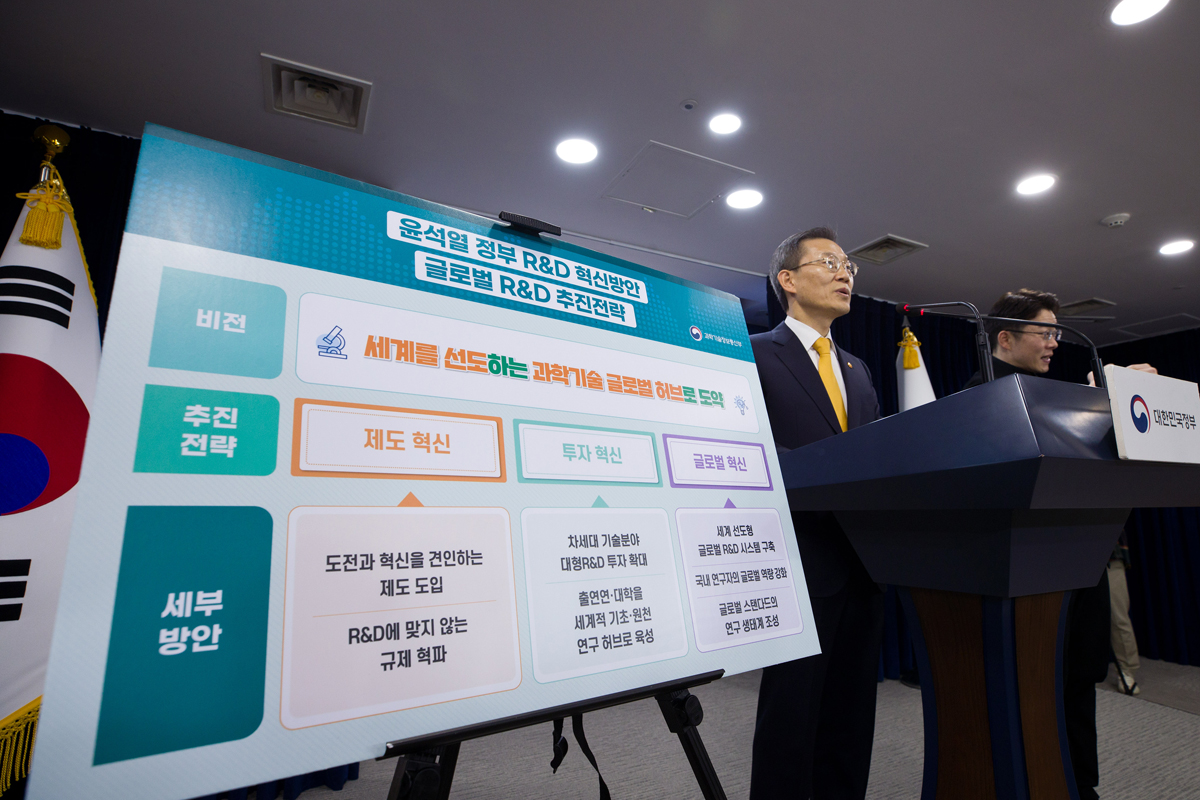
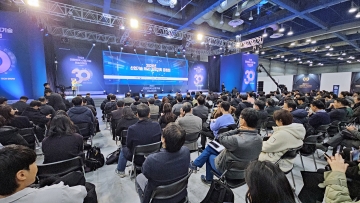
▲The photo shows Minister of Science and ICT Lee Jong-ho announcing the Yoon Seok-yeol administration's R&D innovation plan at the end of November.
The Ministry of Science and ICT budget has been confirmed at 18.6 trillion won, down 1.6% from last year.
The Ministry of Science and ICT will invest in next year's ultra-gap technological advantage.
The controversial R&D budget for next year has been set at 26.5 trillion won in the wake of the government's large-scale budget cuts.
The government's total research and development budget, including the research and development budget under the Ministry of Science and ICT, was finalized at 26.5 trillion won, and the Ministry of Science and ICT's budget was 18.6 trillion won, which was approved at the plenary session of the National Assembly on December 21.
The government's R&D budget increased by KRW 621.7 billion from the original budget of KRW 25.9 trillion, but decreased by KRW 4.6 trillion, or 14.7%, compared to this year's original budget.
The Ministry of Science and ICT's budget for next year has increased by 272.6 billion won compared to the government's original budget of 18.2899 trillion won, but it is still 306.1 billion won, or 1.6%, less than this year's 18.8686 trillion won.
After President Yoon Seok-yeol stated at the fiscal strategy meeting in June that “R&D, which is a dividing and dividing method, needs to be reexamined from zero base,” the Ministry of Science and ICT began cutting the R&D budget for the first time in 33 years.
It appears that the amount has increased from the original plan due to growing criticism from the scientific community, but concerns about budget cuts in the industry still remain.
The government stated, "Most of the funding will be used to address job insecurity concerns among researchers, including students and small and medium-sized enterprise employees. Furthermore, we will strengthen research on next-generation and fundamental technologies, and increase the cost of building and operating the latest high-performance research equipment."
The Ministry of Science and ICT announced that it will focus its investments on securing core strategic technologies (KRW 2.4131 trillion), supporting international cooperation and overseas expansion (KRW 1.1445 trillion), fostering science and technology and digital talent (KRW 2.8427 trillion), expanding digital technologies such as artificial intelligence (KRW 1.3046 trillion), and enhancing the capabilities of government-funded research institutes and regional innovation (KRW 4.3813 trillion).
Funding for basic research, including scholarships and research grants, increased by 207.8 billion won, adjusting the government's estimate from a 25% decrease the previous year to around 10%. New programs to support future generations of researchers were also established, including a 45 billion won group research program for postdoctoral researchers and a 3 billion won Presidential Science Scholarship for graduate students. Research grants for graduate students were also expanded.
The government stated, “In addition to securing financial resources for universities to conduct stable research, we will actively encourage the use of student personnel expense reserves that universities already have. We will also pursue institutional improvements to expand the number of integrated student personnel expense management organizations (currently 14) that guarantee a certain level of student personnel expense payment at schools.”
Corporate R&D support has also been strengthened to KRW 178.2 billion compared to the government's proposed budget. While the government budget was significantly reduced to prevent subsidies from being applied to R&D, temporary support for personnel expenses within completed projects will be provided for projects with concerns about sunk costs or job insecurity for researchers.
The budget for next-generation, core technology development also increased by 33.6 billion won. Major research and development budgets in various fields, including the lunar lander development project (KRW 4 billion), which passed the preliminary feasibility study last October, the next-generation network (6G) industrial technology development project (KRW 6 billion), and the next-generation mobility (K-UAM) technology development project, have been expanded. The budget for strengthening nuclear power plant safety and component competitiveness has also been increased.
The budget for the construction and operation of cutting-edge research equipment has been expanded by 43.4 billion won. Additional funding has been allocated to the construction and operation of large-scale research equipment, including the advancement of ultra-high-performance computing infrastructure and service systems (4 billion won), the Multipurpose Synchrotron Radiation Accelerator (11 billion won), the Heavy Ion Accelerator (5.5 billion won), a new research reactor for export (11 billion won), and KSTAR (3.5 billion won).
Minister of Science and ICT Lee Jong-ho said, “The 2024 budget focuses on creating a research environment where world-class research can be conducted, such as expanding global R&D and strengthening support for new researchers.” He added, “The government has been working to ensure that researchers, including students, can conduct research in a more stable environment, and in accordance with the budget confirmed today, we will continue to ensure that students and researchers do not face difficulties in the research field and make institutional improvements.”
Comments
Related news
Next year, the full impact of the R&D budget cuts will begin… “Research institutes will die”
With next year's R&D budget cuts confirmed, the second-half budgets for domestic public R&D institutions are also being reduced, and research facilities are reportedly facing difficulties.
2023.09.06by 배종인 기자
Materials Research Institute supports R&D of core technologies tailored to local companies.
The Korea Institute of Materials Science (KIMS, Director Lee Jung-hwan), a government-funded research institute under the Ministry of Science and ICT, is generating concrete results such as increased overseas sales for participating companies through the 'Customized Core Technology Information Support Project' implemented jointly with the Gimhae Bioindustry Promotion Agency (GBIA, Director Park Sung-ho).
2023.09.25by 배종인 기자
.jpg)
Criticism of R&D budget cuts, “Concerns over reduced talent inflow… Communication in the scientific community is essential”
On the 5th, the Democratic Party's People's Economy Countermeasures Committee (chaired by Kim Tae-nyeon) held a meeting titled "R&D Budget Cuts, Hearing Voices from the Field" at the National Assembly. The scientific community, which was directly impacted by the government's plan announced on the grounds of "research funding cartels," opposed the unprecedented budget cuts and launched the "National Science and Technology Alignment Science and Technology Community Coalition."
2023.10.10by 김예지 기자
Full-scale promotion of high-risk, high-performance R&D
The government will now make full-scale efforts to enable promising small and medium-sized ventures to boldly pursue support by providing large-scale funding for three innovative R&D projects with significant ripple effects, including secondary battery technology development that fundamentally blocks fire and explosion risks, while reducing the burden of failure.
2023.10.23by 배종인 기자
Next year's R&D mid-to-large-scale project-centered support... "Excluding sharing and handing out"
"Among the announcements made by the government, there was a request to exclude distribution-type, divisive-type, and scattering-type approaches. We will plan major and medium-sized projects with clear objectives and provide support centered on these major and medium-sized projects."
2023.12.07by 명세환 기자











