


Merck's Anand Nambier: "Driven by data platforms, we're driving materials innovation."
 Published2024.01.31 17:11
.jpg)
Achieving 100% material improvement through massive data analysis technology.
"Data platforms powered by digital and data innovation can improve material quality and eliminate defects in semiconductor processes."
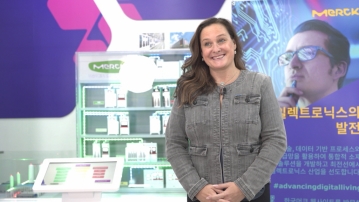
Anand Nambiar, Chief Commercial Officer of Electronics Business Sector, Merck, delivered a keynote speech titled 'Digital and Data in the Materials World' at SEMICON Korea 2024.
In his keynote speech, Anand Nambiar stated that by gathering and analyzing data from all semiconductor processes on a single platform, they were able to improve semiconductor materials and eliminate defects in the process, and that identifying the causes of semiconductor process defects and developing improvement plans, which previously took years, could be completed in a matter of months.
Anand Nambiar was a manufacturing process manager 15 years ago and had the experience of finding problems in the process despite putting in a lot of energy and effort to supply materials that met customer specifications. He said that he tried to solve the problem at the time, but the result was a temporary solution and was disappointed that it was not a perfect solution and he wanted to improve it. He introduced that he was trying to find a way to do so.
He noted that this is because no one has enough data, and that these problems are still often found in the field.
Recently, semiconductor manufacturers and material and equipment companies have begun sharing data to address these issues and are making joint efforts to identify problems, it said.
According to Anand Nambiar, data collection is difficult, but Merck recently announced that it has achieved 100% material improvement by converting previously paper-based data into digital form, collecting it on a platform, and using technology to analyze this vast amount of data.
In particular, the company said that through this, customers can also benefit, and when product issues are discovered, data can be collected and resolved, and the PCN (Problem Tracking No.) period has been reduced from 6 months to 6 weeks.
He argued that if all semiconductor manufacturers shared these data management techniques, the entire semiconductor industry would be able to save significant time and achieve a defect-free state in semiconductor manufacturing.
He also suggested that to achieve this, collaboration with customers is necessary and understanding of data sharing must come first, and that data should not be limited to a single product or a single customer's process, but rather that companies related to the entire semiconductor manufacturing process, including precursors, slurries, etching, and gases, should participate together to share information and collaborate throughout the semiconductor manufacturing process.

Comments
Related news
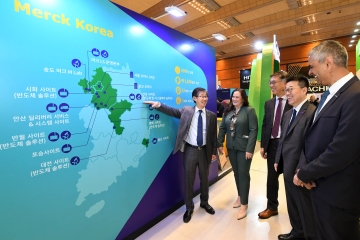
[Semicon Korea 2023] Merck Korea Emphasizes “Timely and Placely Material Supply” at Semicon Korea
The global value chain remains a critical issue for product manufacturing and shipment. At Semicon Korea, the country's largest semiconductor exhibition, global materials company Merck has emphasized the importance of "just-in-time and right-place" supply of materials.
2023.02.01by 명세환 기자
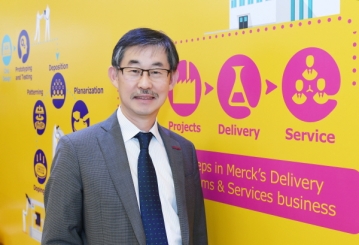
[SEMICON Korea 2023] Woo-Kyu Kim, CEO of Merck Korea - “Merck will continue to invest with confidence in the bright future of semiconductors”
We visited Merck at Semicon Korea 2023 and held an interview with Kim Woo-kyou, CEO of Merck Korea, to discuss Merck's investment strategy and plans to overcome the semiconductor downturn.
2023.02.08by 배종인 기자
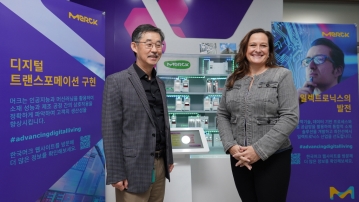
Merck, DS&S CEO visit Korea to discuss additional investment in Korea
Leading science and technology company Merck is progressing smoothly with its "Level Up" growth investment plan for innovation and production capacity in the electronics business division announced in 2021. To discuss additional investments in Korea, Katherine Dei Cas, Executive Vice President in charge of supplying and storing specialty chemicals and gases—key elements of the semiconductor business—visited Korea to tour related facilities for further investment discussions.
2023.10.26by 배종인 기자
[Interview] Woo-Kyu Kim, CEO of Merck Korea - “We will always prepare for the continued growth of semiconductors and supply capacity”
At Merck's production facility in Ansan, the site of Chief Vice President Catherine Day Kass's visit to Korea, we conducted an on-site interview with Kim Woo-kyou, CEO of Merck Korea, to discuss the company's investment in Korea.
2023.11.03by 배종인 기자
[Interview] Catherine Day Kass, Merck Senior Vice President - “Additional Investment in Korea is Crucial to Merck’s Success”
We met with Katherine Dei Cas, Executive Vice President of Merck, who visited Korea to discuss the company's additional investment in the country, and heard about their investment plans.
2023.11.03by 배종인 기자











