



Graduate students in science and engineering who participate in national R&D receive research life scholarships.
 Published2024.02.16 14:42
Development of the 2nd Nano and Semiconductor Research Complex in Daejeon's Kyochon District
The government is moving forward with a full-scale effort to foster domestic science and technology talent and support science and technology R&D by providing support for graduate students in science and engineering and providing stable support for science and technology research.
On the 26th, the government held the twelfth public discussion session, “Daejeon, the science capital innovating the Republic of Korea,” at the Daejeon ICC Hotel.
At this livelihood discussion, three topics related to our country's science and technology and the development plan for Daejeon were reported.
First, the government will establish a 'Korean-style Stipend Support System' to support a stable research life for science and engineering graduate students participating in national research and development projects.
Major scientifically advanced countries such as the United States, the United Kingdom, and Germany encourage students to pursue science and engineering studies through programs such as stipends and scholarships, which guarantee a certain amount of financial support per month to graduate students in science and engineering, and ensure stability in their studies and livelihoods.
In Korea, the scale of support for graduate students varies depending on the conditions and circumstances of each lab and the level of participation in research projects, resulting in a relatively lack of conditions for graduate students to steadily focus on learning and research.
To address these challenges for student researchers, the government plans to strengthen university-level support systems for student personnel expenses (such as the pooling of student personnel expenses). Building on this, the government will also pursue the introduction of a research stipend, which will provide a fixed amount of support each month to graduate students in science and engineering who participate in national research and development projects. The research life scholarship guarantees a certain amount, and additional amounts are paid based on laboratory conditions.
Furthermore, the government plans to continue strengthening its intensive support for outstanding graduate students through the fourth phase of the Brain Korea (BK) 21 project. The government plans to use this public forum as an opportunity to reflect feedback from the field and develop detailed implementation plans, with the goal of gradually introducing and expanding the system starting next year.
In addition, by establishing the Presidential Science Scholarship for graduate students in science and engineering, a full-cycle science scholarship support system will be established, covering undergraduate through master's and doctoral programs.
First, we plan to establish the Presidential Science Scholarship for Graduate School in 2024 to provide support to approximately 120 outstanding graduate students with outstanding capabilities and potential, and to expand the quality and quantity of this scholarship in the future.
We are also significantly expanding our research support program to enable young scientists, including master's and doctoral students and postdoctoral researchers, to verify and implement their ideas.
First, the Ministry of Education will support approximately 1,400 new projects (600 new master's programs in 2024, 822 new doctoral programs in 2024) to support creative and challenging research ideas related to thesis research for student researchers, including master's and doctoral students.
In particular, we plan to significantly expand domestic and international fellowship opportunities for young researchers, including postdoctoral researchers entering the research field in earnest, so that they can conduct research on topics and ideas of their choice and grow into capable global leading scientists. Additionally, we will expand opportunities for innovative and challenging research for promising young researchers and strengthen support for establishing laboratories for early research establishment.
In addition, to break down the barriers between research institutes, we will enhance the competitiveness of research institutes by removing their designation as public institutions. We will also launch the Global TOP Strategic Research Group Support Project (KRW 100 billion by 2024) to promote cooperation and convergence beyond the barriers between research institutes and establish an open cooperation system.
In addition, we are also moving forward in earnest with the development of the Daejeon 2nd Research Complex.
The area around Kyochon District in Yuseong-gu, Daejeon Metropolitan City will be developed into a second research complex centered on nanotechnology and semiconductors, and after designating and announcing a national industrial complex in the first half of 2026, it will be incorporated into a research and development special zone.
The second research complex will be developed as a specialized space for startups based on research and development achievements. To ensure that research achievements can be commercialized, the complex will provide a package of research and development services encompassing legal services, innovative financial services, and even culture to companies residing within the complex.
Minister of Science and ICT Lee Jong-ho said, “Daejeon is a true mecca of science and technology in Korea, with 26 government-funded research institutes with the best research capabilities and passion, KAIST, the cradle of future technology and scientific talent, and cutting-edge research institute companies in the fields of bio, defense, and space. It is also a stage for scientists with excellent research capabilities.” He added, “The government, including the Ministry of Science and ICT, will work together to ensure that Daejeon, the capital of science, can once again take a leap forward with excellent scientific talent, solid government-funded research institutes, and cutting-edge research institute companies, leading to the advancement of science and technology in Korea.”

Comments
Related news
We listened to feedback from the field to ensure the success of our 100 billion won investment in semiconductor packaging over five years.
Minister Lee Jong-ho of the Ministry of Science and ICT visited the research site at LG Innotek regarding substrates for advanced semiconductor packaging and held a discussion session with industry-academia-research experts to gather opinions on research and development (R&D) projects related to advanced semiconductor packaging.
2023.12.05by 배종인 기자
Next year's R&D mid-to-large-scale project-centered support... "Excluding sharing and handing out"
"Among the announcements made by the government, there was a request to exclude distribution-type, divisive-type, and scattering-type approaches. We will plan major and medium-sized projects with clear objectives and provide support centered on these major and medium-sized projects."
2023.12.07by 명세환 기자
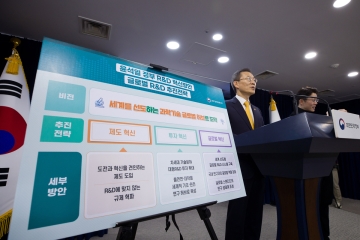
Next year's national R&D budget is set at 26.5 trillion won, down 4.6 trillion won from this year.
The government announced that the total government research and development budget, including the research and development budget under the jurisdiction of the Ministry of Science and ICT, was confirmed at 26.5 trillion won, with the Ministry of Science and ICT budget set at 18.5625 trillion won through final passage by the National Assembly plenary session on December 21.
2023.12.22by 김예지 기자
2024 R&D budget confirmed to be reduced by 590 billion won... Subsidy, customary, low-innovation eliminated
As budget cuts for next year's R&D are confirmed, it is anticipated that budget reductions will be implemented in subsidy-based projects stipulated by the Ministry of Industry, low-innovation projects, and conventionally supported projects.
2023.12.26by 명세환 기자

Ministry of Trade, Industry and Energy to Fully Promote Supply Chain Stabilization Project in 2024… R&D Support to 4x, Support for Stockpiling Core Minerals to 6x↑
The Ministry of Trade, Industry and Energy (hereinafter referred to as the Ministry) will significantly expand research and development (R&D) for supply chain stabilization items and will actively promote projects supporting small and medium-sized enterprises in identifying import sources.
2024.01.11by 성유창 기자











