


SKT and NTT Docomo Jointly Publish OpenRAN Virtualization Technology White Paper
 Published2024.02.20 14:39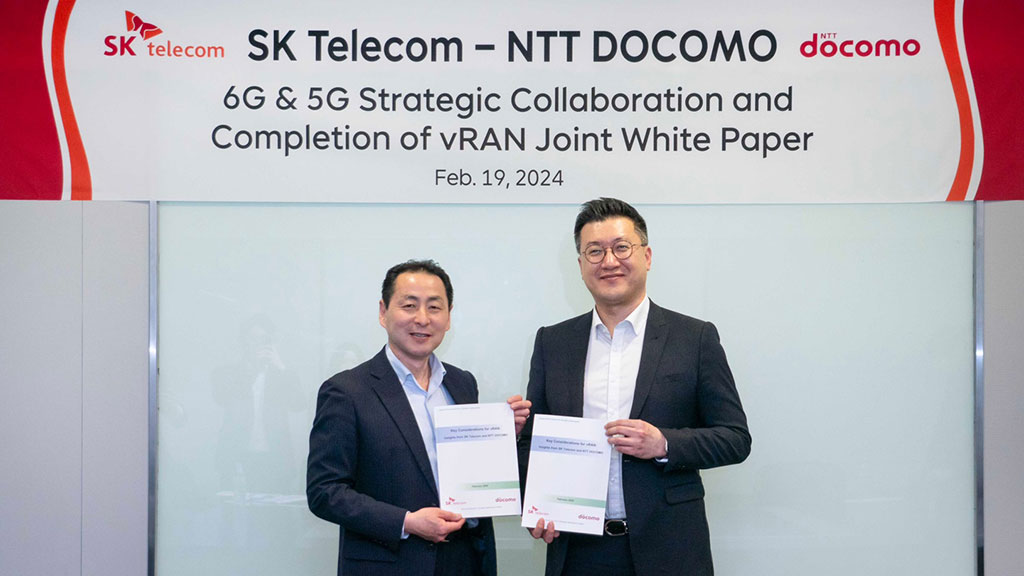
Presenting Considerations for vRAN Implementation, an Essential Element of Open RAN
vRAN cited as a key technology for 5G advancement and 6G standardization
SKT announced plans to lead the Open RAN ecosystem with global operators.
SKT announced on the 20th that it has jointly published a technical white paper with Japanese telecommunications company NTT Docomo containing key requirements for telecommunications operators in the process of introducing and developing virtualized base stations.
'Virtualized RAN (vRAN)' is a technology that incorporates various network functions of Radio Access Network (RAN) equipment in the form of software, and is considered a core element of Open RAN.
Virtualized base stations are an essential technology in the process of advancing 5G and establishing 6G standards. They have the advantage of being implementable by installing only the necessary software on a general-purpose server, without the need for the base station's hardware and software manufacturers to match.
On the other hand, the need for performance improvements in certain areas, such as capacity and power consumption compared to existing base stations, has been pointed out.
In the white paper released this time, the two companies presented the key elements necessary to improve the performance of virtualized base stations compared to existing base stations. Representative examples include the evolution of hardware accelerator technology, the development of virtualization-specific technologies (such as pooling), the development of power saving technologies, improved integration between virtualized base station components, and consideration for evolution to 6G networks.
SKT stated, “This white paper is significant in that it shares key considerations for virtualized base stations, deliberated from an operator's perspective, with various global manufacturers and operators within the Open RAN ecosystem, and presents the direction of future technological evolution.”
In addition, both companies predicted that hardware accelerator technology, a critical component of virtualized base stations, would evolve in various directions—such as accelerator-embedded CPUs and inline accelerators—to improve the cell capacity and power consumption of virtualized base stations.
It emphasized the importance of selecting an accelerator structure that considers the network architecture and requirements of each operator, and also introduced the factors that need to be considered.
Meanwhile, the two companies signed a strategic partnership in 2022 centered on cooperation in three areas: telecommunications infrastructure, media, and the metaverse. Following the publication of a joint 5G and 6G technical white paper last year, they have continued their close collaboration, culminating in this white paper on virtualized base stations. At the upcoming MWC 2024, they plan to discuss ways to revitalize the global Open RAN ecosystem based on the contents of this white paper.
Ryu Tak-ki, Head of Infrastructure Technology at SK Telecom, stated, “This is a meaningful white paper that captures realistic considerations and efforts regarding the development of core areas of Open RAN from an operator’s perspective,” adding, “We plan to lead the global Open RAN ecosystem based on close cooperation with global operators.”
Comments
Related news
.jpg)
Telecommunications 3 Companies Collude on Rental Fees for Installation of Telecommunications Equipment, '20 Billion Won Fine'
The Fair Trade Commission decided on the 25th to impose corrective orders and fines totaling approximately 200 billion won against three mobile carriers—SKT, KT, and LGU+—and SK O&S Co., Ltd. (hereinafter SKONS) for collusion on lease rates for mobile communication facility installation locations such as apartment and building rooftops (repeaters, base stations, etc.). SKONS is a 100% subsidiary of SKT.
2024.01.26by 김예지 기자

SKT, Actively Researching 6G Candidate Frequency and Network Structure
SKT announced on the 30th that it has conducted real-world measurements and simulations on 6G candidate frequency bands in collaboration with the academic communications community to design an optimal network architecture that takes into account 6G frequency characteristics.
2024.01.31by 김예지 기자
SKT achieved 1.7 trillion won in operating profit last year... "AI will produce tangible results this year."
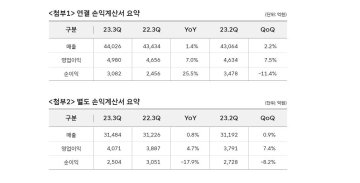
SK Telecom announced on the 5th that its consolidated operating profit for fiscal year 2023 increased 8.8% year-over-year to 1.7532 trillion won, with sales up 1.8% to 17.6085 trillion won, and net income rising 20.9% to 1.1459 trillion won. On a separate basis, operating profit reached 1.4559 trillion won, sales increased 1.4% year-over-year to 12.5892 trillion won, and net income came to 1.0597 trillion won.
2024.02.06by 김예지 기자
.jpg)
SKT to introduce 'Excalibur' to Australian animal hospitals in the first half of the year
SKT announced that it has signed a commercial contract on the 13th with ATX Medical Solutions, Australia's largest medical device distributor, for the distribution of X Caliber, an AI-based veterinary diagnostic assistance solution, within Australia.
2024.02.13by 김예지 기자
SKT-MediaTek-Nota, Develop Technology to Reduce Terminal Power Consumption
SK Telecom announced that it has successfully developed initial-stage technology in collaboration with MediaTek, a global mobile AP manufacturer, and Nota, an AI optimization startup, aimed at reducing terminal power consumption based on on-device AI.
2024.02.15by 김예지 기자











