



Spectrum Uses '8-Channel Digitizer System' as Key Device for Lightning Research
 Published2024.02.21 14:23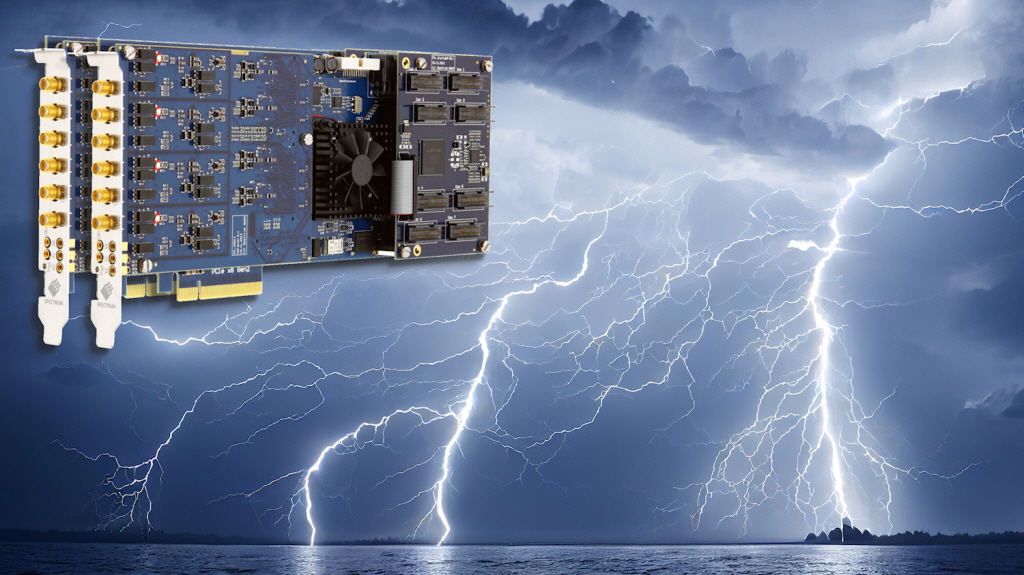
ADC cards from Spectrum Instrumentation, a company specializing in digitizers and generators, are being used as core research equipment in lightning research and have proven their excellence in large-scale data processing.
Spectrum announced on the 21st that its '8-channel digitizer system' was used as a key data device in lightning research at Duke University in the United States.
Lightning usually occurs within opaque clouds. Therefore, it is still difficult to accurately determine the phenomena that occur within them when lightning strikes.
Of course, while radio waves in the UHF and VHF frequency ranges generated during lightning strikes can be tracked and analyzed, processing and recording the vast amount of data for the few seconds before and after the event is another challenge.
To solve this challenge, a research team led by Professor Steven A. Cummer of Duke University in North Carolina selected Spectrum Instruments' ADC card.
The purpose of this study is to understand the process of lightning formation, utilize this knowledge to reduce building damage caused by lightning, and furthermore, to identify the correlation between climate change and the frequency of lightning occurrences.
Steven A. Comer of the Department of Electrical and Computer Engineering at Duke University Professor Cummer explains how Spectrum's '8-channel digitizer system,' including the ADC card, was utilized in their research as follows.
“During lightning strikes, we must be able to record over 1 terabyte per hour. Just a few years ago, there was no equipment capable of capturing and processing such a massive amount of data. We are currently utilizing four-channel Spectrum M4i.4451-x8 digitizer cards, two of which are used in our recording equipment. These cards allow for simultaneous data recording from eight antennas via Spectrum’s Star-Hub. Since the Star-Hub uses antennas to form an interferometer, it ensures that everything is perfectly synchronized.”
The Spectrum M4i.4451-x8 digitizer card collects the required amount of data at a sampling rate of 500 MS/s per second on each channel. It can also capture all minute signals using 14-bit resolution.
Professor Comer explained, “We can locate lightning up to 50 kilometers away by using minute signal differences between different antennas.”
Professor Kermer's research focuses not only on the immediate aftermath of a lightning strike but also on the situation prior to signal generation. However, when relying on optical data collection, it was difficult to obtain data prior to the lightning strike. Now, data collection before signal generation has become easier through the digitizer of the spectrum instrument.
Spectrum digitizer cards continuously record data and automatically delete it when it is no longer needed.
In this study, lightning serves as a trigger to determine whether data is stored.
In other words, when lightning actually occurs, prior data is automatically deleted, and when lightning strikes, data before and after is saved.
Therefore, using 2 gigabytes of memory per card allows you to collect all the necessary hundreds of megabytes of signals per second and then secure sufficient storage space to write to the SSD.
In this way, the system is quickly reset to record data upon the next lightning strike, and can collect data in seconds even during thunderstorms with lightning lasting for several hours.
In this study, Spectrum’s proprietary measurement software SBench 6 was used to control and program the 8-channel ADC card.
In this regard, Professor Commer stated, “The software is very easy to use and versatile, so I did not have to spend extra time on software program development.”
In addition, Professor Kermer's research team is conducting another study on whether the generation of high-energy gamma rays varies depending on the type of lightning, which was discovered about 30 years ago. Gamma rays, which were expected to be found only in space, are sometimes generated immediately when a thunderstorm flash begins. The prior data collected by the research team in this project regarding thunderstorms is helping the academic community understand gamma ray generation.
The 8-channel system with antennas has been operating at a fixed location at Duke University in Durham until now.
In particular, the lightning recorded on April 12, 2019 at 21:24:40 (UTC) is noteworthy in that the entire lightning occurred inside a dark cloud, so only a limited portion of the faintly illuminated cloud could be seen.
The entire structure was captured in a diagram via VHF radio measurements, and all locations in the sky are clearly marked through azimuth and altitude.
The sequence of these lightning occurrences can be verified through the link to the related research video below, which captures the slow motion of the lightning lasting for one second. Each point visible in the video represents radio wave data detected when lightning occurs, and by examining these points in combination, the spatial and temporal structure of the lightning can be clearly understood.

Comments
Related news
Keysight Announces 5G Massive MIMO Design Verification Solution
Keysight has launched the PROPSIM FS16 channel emulation solution, which enables verification of 5G NR device performance in mmWave spectrum, beamforming technology, and wideband support in multi-antenna configurations. The PROPSIM FS16 complements the PROPSIM F64 channel solution, which is used by 5G wireless equipment manufacturers to handle ultra-fast fading capability requirements.
2020.02.28by 이수민 기자
Keysight Launches Infiniium MXR Oscilloscope, Featuring Eight Integrated Instruments and Simultaneous Eight-Channel Measurements
Keysight announced the Infiniium MXR Series, a mid-range mixed-signal oscilloscope capable of simultaneously measuring 8 analog channels at 16GSa/s sampling rate in the 6GHz bandwidth. The new product combines 8 measuring instruments—a real-time spectrum analyzer, oscilloscope, digital multimeter, waveform generator, board plotting, counter, protocol analyzer, and logic analyzer—into one based on advanced ASIC hardware.
2020.05.19by 이수민 기자
Launch of 8.3GHz 'FSW Signal Analyzer' to Lead Next-Generation Technology
Rohde & Schwarz has announced a new option for the R&S FSW-B8001. This option extends the internal analysis bandwidth of the FSW high-performance signal and spectrum analyzer to 8.3GHz. The R&S FSW, supporting a maximum measurement frequency range of 85GHz, boasts superior measurement dynamic range and sensitivity, accuracy, and EVM performance. Additionally, it provides extended analysis bandwidth and dedicated measurements, meeting the test and measurement requirements for ultra-wideband (UWB) signal analysis and next-generation technologies.
2020.10.07by 김동우 기자

TI Unveils Industrial and Automotive Power Solutions Featuring Active EMI Filters
As the proportion of electronic components increases in industrial and automotive applications, reducing electromagnetic interference (EMI) has become increasingly important. Texas Instruments' LM25149-Q1 and LM25149 synchronous DC/DC buck controllers integrate active EMI filtering (AEF) and dual random spread spectrum (DRSS) technology to reduce the board area occupied by external EMI filters and lower conducted EMI in power solutions across the entire frequency band of CISPR 25 Class 5.
2021.04.08by 이수민 기자
Keysight Receives Industry-First Sub-Terahertz 6G Development License
▲Keysight has acquired an FCC Spectrum Horizon license for developing the industry's first sub-terahertz 6G technology.
2022.04.29by 김예지 기자











