



KT Develops RIS Technology to Support 5G and Satellite Commercial Frequencies
 Published2024.02.27 16:07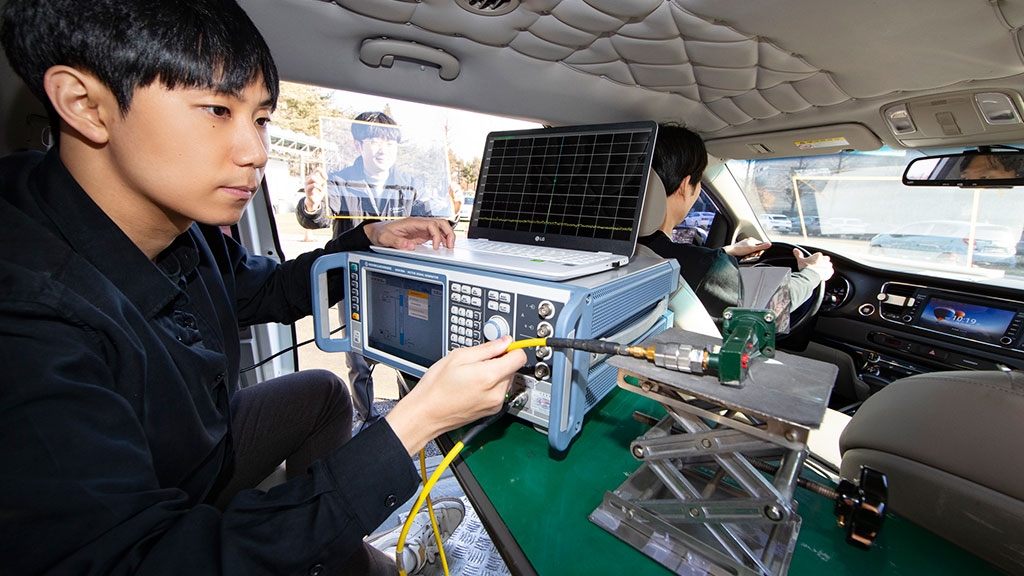
Seoul National University research team develops 'reconfigurable intelligent surface'
Operates in 5G and satellite frequency bands… Potential for improved communication coverage
KT is focusing on 'RIS' as a technology that can efficiently expand network coverage.
KT announced on the 27th that it has developed 'Reconfigurable Intelligent Surface (RIS) technology' that operates in the 5G wireless communication frequency band of 3.5GHz and the KT Skylife satellite frequency band of 12GHz, in collaboration with a research team from the School of Electrical and Information Engineering at Seoul National University. KT unveiled this technology at MWC 2024.
RIS is a technology that can guide the reflection and transmission of radio waves in a desired direction. By introducing RIS to the exterior walls of a building, it becomes possible to transmit and receive signals by transmitting high-frequency band frequencies without exposing wireless communication equipment to the outside of the building. It helps build network infrastructure more efficiently.
The RIS developed by KT and Professor Oh Jung-seok's research team at the Department of Electrical and Information Engineering, Seoul National University, is characterized by its ability to pass 5G wireless communication frequencies and KT Skylife satellite frequency bands through a small area, in addition to 6G candidate frequencies.
KT has been developing RIS materials and technologies that operate in the 8GHz and 15GHz bands, which are candidate frequency bands for 6G, starting with the 28GHz millimeter wave (mmWave) band. Since the frequency bands currently used in 5G utilize relatively low frequencies, the likelihood of commercialization was low due to issues such as the need for larger RIS sample areas.
The newly developed RIS utilizes new surface design technology and structure to simultaneously secure a wide transmission angle (negative refraction angle) that refracts more than 90 degrees relative to the direction of propagation and a high transmittance. A wide radio wave transmission angle is advantageous for improving indoor wireless quality. Made of transparent material, it can be attached to the glass of moving objects or manufactured as a single integrated unit, allowing for easy installation.
To verify the versatility of its proprietary RIS technology, KT and Seoul National University attached an RIS to a vehicle window and confirmed that wireless signals entering from a direction perpendicular to the vehicle's direction of travel, such as 5G radio waves from communication towers on the outskirts of highways or KT Skylife satellite signals, were refracted inward.
KT continues to cooperate with equipment manufacturers and materials and components companies to apply the RIS technology it has secured to building windows or vehicle windows. In addition, we plan to secure technological leadership in the 6G wireless communication field by continuously discovering elemental technologies applicable to various wireless network environments, such as RIS.
Professor Oh Jeong-seok of the Department of Electrical and Information Engineering at Seoul National University stated, “While most existing research and demonstrations on transparent RIS have focused solely on improving transmission loss, this RIS technology and verification is significant in that it is the first to prove that communication coverage can be greatly improved by refracting radio waves in arbitrary directions, even under the constraints of transparent materials and process conditions.”
Lee Jong-sik, Senior Vice President and Head of KT Network Research Institute, said, "We expect the RIS technology developed this time to improve the quality of wireless services inside mobile vehicles," adding, "We will strengthen our leadership in new wireless communication technologies and contribute to the construction of 6G networks."
Comments
Related news
SKT Successfully Develops RIS Technology for 6G Candidate Frequencies
SK Telecom (CEO Park Jae-chul) has developed the world's first advantageous RIS (Reconfigurable Intelligent Surface) application technology for 6G candidate frequencies, which is expected to improve indoor quality and other service quality enhancements for 6G.
2023.02.09by 배종인 기자

SAP Diversifies Cloud Services
SAP announced new services including the SAP S/4HANA Cloud, private edition 2023 release, a Premium Plus package for RISE with SAP, and a RISE transformation and modernization program.
2023.10.12by 배종인 기자
.jpg)
Cadence Announces Enterprise Multiphysics Platform… Accelerating Digital Twins
Cadence Design Systems, Inc. announced on the 5th the "Cadence Millennium Enterprise Multiphysics Platform," an industry-first HW/SW solution capable of accelerating multiphysics system design and analysis of digital twins.
2024.02.06by 김예지 기자
“Commercialization of 6G in 2030, balanced use of low-mid-high band frequencies is essential”
Global 6G connectivity is projected to reach 290 million connections by 2030, and in preparation for the 6G era, the domestic industry is pursuing strategies to discover and secure 6G frequencies. Additionally, RIS technology is gaining attention as a key enabler for early 6G services.
2024.02.13by 김예지 기자
Schneider Aims for Building Energy Savings and Operational Stability with Next-Generation HVAC Drives
Schneider Electric has unveiled its next-generation HVAC drive product line 'Altivar HVAC'. The new product line's key features center on enhanced energy savings, system operational stability, and building management system integration. The products are divided into 'ATH200' for OEM and small equipment applications, and 'ATH600' for environments requiring continuous operation and advanced control. The company plans to expand the application scope from commercial buildings to facilities where HVAC system stability is critical, such as hospitals, airports, and data centers. The announcement includes over 30% energy savings, operation from -10°C to +60°C, Modbus and BACnet support, and compatibility with low global warming potential refrigerants.
2026.03.26by 명세환 기자











