


89% of Korean CIOs See AI as Essential...Edge Spending Up 55% Year-Over-Year
 Published2024.03.04 10:39
Combining Data and AI to Strengthen Edge AI
“89% of Korean CIOs are confident that AI will create a competitive advantage, and 31% of them said AI is a game changer that will transform their companies.”
According to Lenovo's 'CIO Playbook 2024 - It's All About Smarter AI' released on the 29th, Asia-Pacific companies plan to increase AI-related spending by 45% year-on-year in 2024.
A survey found that 95% of Korean CIOs have already invested or plan to invest in generative AI, and 55% responded that their edge spending increased this year compared to last year.
Flynn Maloy, vice president of marketing for Lenovo Infrastructure Solutions Group (ISG), previously mentioned the high confidence in AI among Korean CIOs, adding, “The high investment in generative AI, machine learning, and deep learning demonstrates the will of companies to improve operational efficiency, security, decision-making processes, and customer experience.”
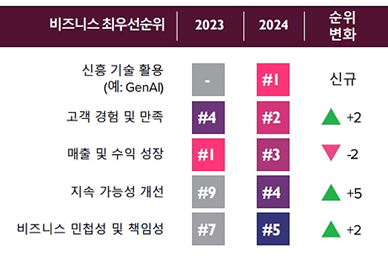
▲Asia-Pacific region business priorities (Source: Lenovo)
Additionally, in the Asia Pacific region, ‘utilizing emerging technologies’ such as AI is ranked as the top business priority.It showed a significantly different appearance from last year.
In particular, "Sales and Profit Growth" fell from first place in 2023 to third place in 2024, while "Customer Experience and Satisfaction" rose to second place. This shift signifies companies' strategic moves to achieve cutting-edge innovation and customer-centric approaches in an evolving business environment.
However, there appears to be a gap in perception between business leaders and CIOs regarding AI technology. While business leaders prioritize generative AI for improving customer experience and driving performance, CIOs expressed cautious optimism.
South Korea, along with India, was found to be investing the highest in generative AI in the Asia-Pacific region. Following South Korea were 33%, India 28%, ASEAN 11%, Australia and New Zealand 2%, and Japan 2%.
Domestic use cases for emerging technologies like generative AI include risk and fraud detection within the BFSI sector. In particular, the BFSI sector is expected to see the largest spending this year on high-performance computing platforms (34%) and digital infrastructure management automation (36%).
Domestic CIOs in the retail sector view AI as a critical element in improving automation and efficiency, customer experience, and overall business operations. They believe AI will help retailers maintain their competitiveness in a rapidly changing market.
Domestic spending on edge computing increased by 55% year-over-year, while spending on edge computing in the Asia-Pacific region increased by 25%. As edge devices generate massive amounts of data in real time, a variety of new use cases for AI models are expected to emerge.
Domestic CIOs responded that real-time analytics and insights (42%) and remote monitoring and telemedicine (39%) are the edge use cases most affected by AI.
As of 2024, the growth rates of domestic edge computing spending were as follows: manufacturing 40%, healthcare 33%, retail 31%, BFSI 28%, telecommunications 19%, and government 14%.
Meanwhile, generative AI's reliance on extensive datasets is expected to pose a major challenge for AI. Furthermore, business leaders expressed concerns about employee job security and a lack of essential IT support, resources, and skills.
Comments
Related news
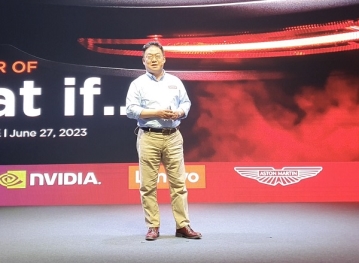
Lenovo Unleashes Extreme Workstation Performance with Aston Martin Aerodynamics
Lenovo has unveiled a new workstation that applies advanced aerodynamics developed through collaboration with Aston Martin, enabling CPUs and GPUs to deliver peak performance even in extreme environments, marking the company's full-scale entry into the domestic workstation market.
2023.06.27by 배종인 기자
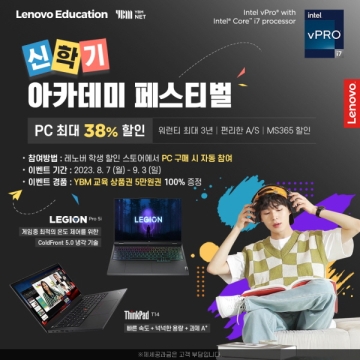
Lenovo Korea and YBM offer up to 38% discounts on Academy Festival events.
Lenovo Korea is running an Academy Festival offering discounts of up to 38% for student store PC purchase customers.
2023.08.25by 배종인 기자

Lenovo Launches Next-Generation Edge AI Solutions
As data volumes grow exponentially worldwide, efficient edge computing infrastructure is helping overcome complex AI deployment methods and enabling enterprises to rapidly transform data into actionable insights. Next-generation infrastructure technologies that deliver data center-like computing to the edge are implementing AI across industries for improved emergency response systems, public safety, accessibility, tourism, and retail experiences.
2023.09.21by 명세환 기자
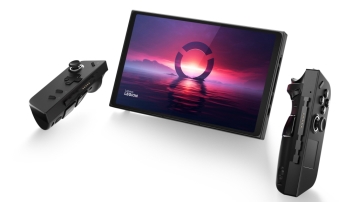
Lenovo Launches 'Legion Go' and 'Legion Glass' Portable Gaming PCs
Lenovo Korea will officially launch the portable gaming PC (UMPC·Ultra-Mobile PC) 'Legion Go' and wearable device 'Legion Glasses' in the domestic market on the 1st.
2023.10.30by 배종인 기자
Lenovo to Unveil AI-Based Devices and Solutions at CES 2024
Lenovo showcased AI PC innovation at CES 2024 under the vision of "AI for All," presenting customized computing experiences to B2C and B2B customers through new products including Yoga, ThinkBook, ThinkCentre, ThinkPad, Legion, and LOQ.
2024.01.09by 배종인 기자











