


IBS Implements Brain-Computer Interface with Tattoo-Thin Electronic Circuits
 Published2024.03.12 16:51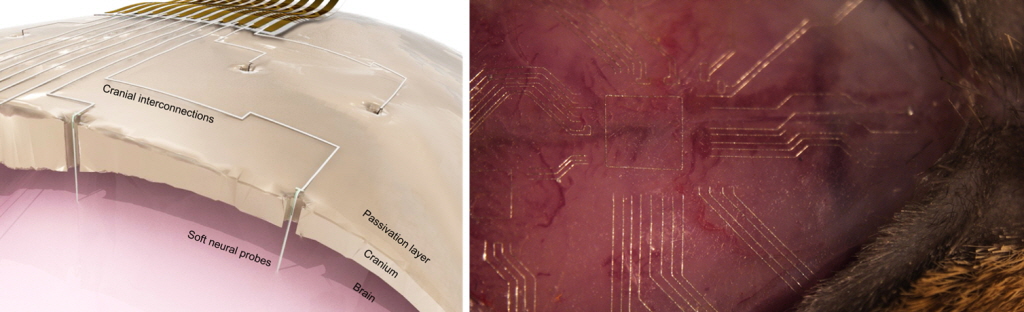
▲ (Left) A diagram illustrating a liquid metal-based soft neural electrode inserted into the brain and an electronic circuit formed thinly along the surface of the skull. (Right) A photograph of a bio-integrated communication electronic circuit formed along the curved surface of the skull.
A new brain-computer interface (BCI) technology has been released that minimizes side effects and significantly extends the usage period.
A research team led by Director Jin-Woo Cheon (Distinguished Professor at Yonsei University) and Professor Jang-Woong Park (Professor of Materials Science and Engineering at Yonsei University) of the Institute for Basic Science (IBS, President Do-Young No) and a research team led by Professor Hyun-Ho Jung and Professor Jin-Woo Jang of Severance Hospital’s Department of Neurosurgery have succeeded in implanting artificial neural electrodes, which are soft like brain tissue, into the brains of mice and printing electronic circuits on the surface of the skull using a 3D printer to transmit and receive brain waves (neural signals) for an extended period.
BCI is a technology that controls external machines or electronic devices through brainwaves. Its development is active because it can help patients with communication difficulties or physical disabilities express themselves freely and accurately. For example, Neuralink, a startup founded by Elon Musk, recently succeeded in moving a computer mouse using only thoughts after implanting a computer device in the brain.
Implantable neural electrodes that detect signals generated in the brain and electronic circuits that transmit and receive the detected signals to external devices are the core of a BCI. Existing technologies utilized electrodes and electronic circuits made of rigid metals and semiconductor materials, which presented problems such as significant alienation upon implantation and the induction of inflammation and infection in soft brain tissue. Additionally, there was a limitation in that brain damage interfered with signal transmission between nerve cells, making long-term use difficult. For these reasons, BCI devices developed to date have been regarded merely as a last resort for treating patients with terminal brain diseases.
First, the research team fabricated artificial neural electrodes using soft, gallium-based liquid metal similar to brain tissue instead of solid metal. The fabricated electrodes are thin, with a diameter about one-tenth the size of a hair, and are soft like jelly, which can minimize damage to brain tissue.
Next, a thin electronic circuit was printed along the curve of the skull using a 3D printer and implanted into the brain. The BCI created in this way is so thin that the user is unaware of it, and like a tattoo, it does not cause any difference to the appearance of the skull after implantation. This means that the problems of foreign body sensation and discomfort associated with existing electrodes can be resolved.
The interface implemented by the research team has the advantage of allowing multiple neural electrodes to be implanted, enabling the simultaneous measurement of signals from various brain regions. Additionally, because it utilizes 3D printing technology, a customized interface can be designed to fit the user's brain structure. Furthermore, unlike existing technologies that use wired electronic circuits, it can wirelessly transmit and receive brainwaves, making it possible to use even during the patient's daily life.
The research team succeeded in stably detecting nerve signals in the body for over eight months in animal experiments using a mouse model. It was difficult to measure neural signals for more than one month with existing interfaces that were in the form of rigid solids.
Professor Park Jang-woong, who led the research, said, “We have developed a new brain-computer interface that can measure neural signals for more than 33 weeks while minimizing brain tissue damage,” and predicted that “this will be widely applicable to patients with various brain diseases such as Parkinson’s disease, Alzheimer’s disease, and epilepsy, as well as general users.”
The results of this study were published in the international journal Nature Communications (IF 16.6) on February 27 (local time).

Comments
Related news
Black phosphorus, could it become the main material for angstrom semiconductors smaller than nanometers?
The IBS Multidimensional Carbon Materials Research Group has realized a conductive channel with a linewidth of 0.43nm using two-dimensional black phosphorus. Two-dimensional black phosphorus is considered a leading semiconductor device for the post-graphene era. With a thickness of approximately one atomic layer, it can be applied to flexible and transparent devices that are difficult to implement with silicon-based semiconductors. Additionally, it exhibits the highest electron mobility among two-dimensional semiconductor devices.
2021.07.30by 이수민 기자

IBS celebrates its 10th anniversary with a variety of events, including lectures by Nobel laureates.
The Institute for Basic Science (IBS, Director No Do-young) has organized various science concerts, including lectures by Nobel Prize laureates, to commemorate its 10th anniversary since its establishment.
2021.11.08by 배종인 기자
.jpg)
IBS produces hydrogen four times cheaper and for more than twice as long.
A new catalyst that produces hydrogen from any water has been developed and is drawing expectations to contribute to environmentally friendly hydrogen production.
2021.11.23by 배종인 기자
IBS Discovers Next-Generation Magnetic Semiconductor Materials
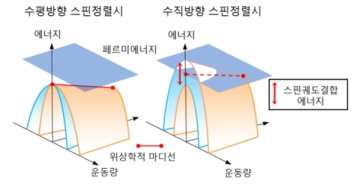
Domestic researchers have discovered a next-generation magnetic semiconductor material for the first time globally, and it is expected to play an important role in implementing spin information devices that are robust against external noise and free from information loss.
2021.11.25by 배종인 기자
Development of Clean Semiconductor Processing Without Performance Degradation
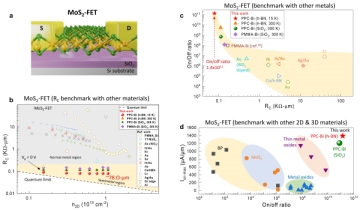
The Institute for Basic Science (IBS, Director No Do-young), Nanostructure Physics Research Center, under the direction of Lee Young-hee (Sungkyunkwan University HCR Chair Professor), announced that through collaborative research with Yumin Yoon, Group Leader at Oak Ridge National Laboratory in the United States, they have developed a new process capable of fabricating next-generation semiconductor devices without residual materials that cause performance degradation.
2023.09.06by 배종인 기자











