



Parking lot door ding, AI quickly solves it
 Published2024.03.18 15:24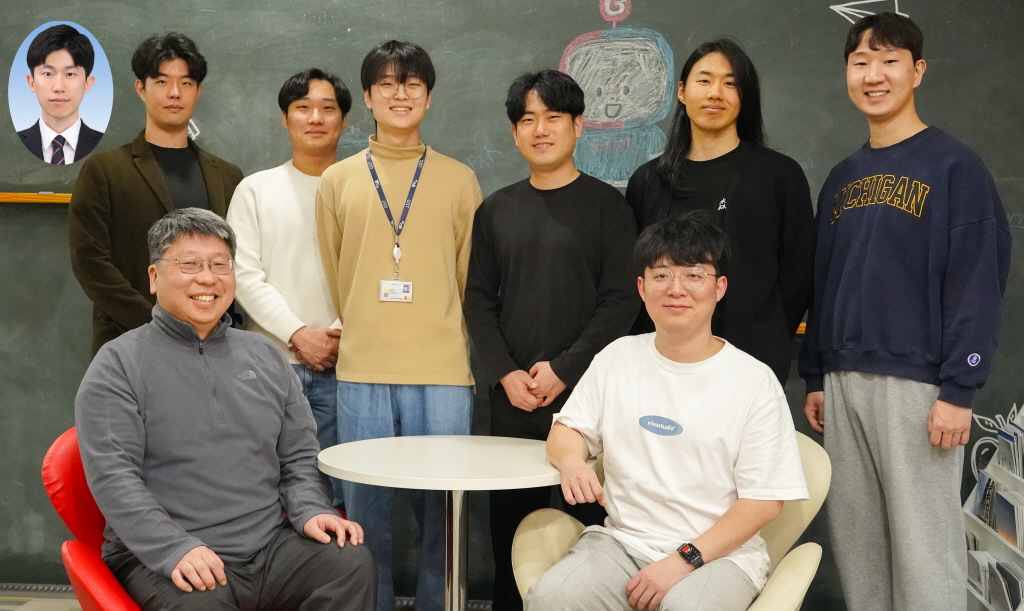
▲(From left in the front row) Professor Yong-gu Lee of GIST's Department of Mechanical Engineering, Dr. Seong-jae Lee of the Department of Mechanical Engineering, (from left in the back row) Researcher In-woo Hwang of LG Electronics, Master's student In-ho Park of the Department of Mechanical Engineering, Integrated Master's and Doctoral Program student Jae-ik Bae of the AI Graduate School, Master's student Geon-woo Shin of the AI Graduate School, Master's student Tae-hyung Gil of the AI Graduate School, Master's student Jin-hoon Cha of the Department of Mechanical Engineering, Master's student Dong-hyun Kim of the Department of Mechanical Engineering
A technology has been developed that can easily detect hit-and-run vehicles that hit a car in a parking lot and then run away using artificial intelligence (AI).
Gwangju Institute of Science and Technology (GIST, President Lim Ki-chul) announced on the 18th that Professor Yong-gu Lee's research team from the Department of Mechanical Engineering succeeded in detecting the point in time of hit-and-run accidents (parking accidents) from all CCTV footage using artificial intelligence (AI) technology.
In the event of a hit-and-run accident, the footage stored in the vehicle's black box must be checked, but if the footage is not stored, the perpetrator must be tracked through the surrounding CCTV. At this time, due to the nature of CCTV, a large amount of footage must be analyzed, and this type of video investigation method increases the workload of the investigator in charge.
In particular, it is not easy to prove intent in hit-and-run parking accidents, and even if intent is proven, a fine of up to 200,000 won is imposed. In comparison, it is difficult to find the time of accident occurrence and there are many difficulties in investigation, so technology development that takes into account the on-site situation is necessary.
The video shortening program currently used in the field is very expensive, with a license cost of approximately 15 million won. Above all, since it is a program developed primarily for crime prevention purposes and not specifically for water evasion, it cannot detect small shaking of objects and has compatibility issues, making it difficult to properly utilize it for water evasion investigations.
The research team collected the dataset using an RC car rather than an actual vehicle to reduce the cost of collecting the dataset and the possibility of an accident.
The appearance of real vehicles and RC cars are very similar, and when an object recognition model recognizes an RC car with weights learned from a real vehicle, similar accuracy was achieved, so it was thought that collecting data using an RC car would show similar performance to a real vehicle.
Because the latest black boxes have built-in collision detection sensors, the dataset was collected only from CCTV footage.
The research team developed a technology to detect the point of vehicle collision by analyzing 800 videos of hit-and-run accidents that they collected themselves and then teaching it to an artificial intelligence network.
In order to detect the point of collision, it is necessary to simultaneously analyze 'temporal information' to analyze the pattern of movement in consecutive frames and 'spatial information' to identify the structure and shape of the object, so the research team used a 3D-CNN that is capable of simultaneous analysis.
Due to the nature of hit-and-run accidents where the victim vehicle is specific, a preprocessing method was used to prevent unnecessary background information from being input into the network by leaving a certain distance around the victim vehicle.
Vehicle crash videos can be distinguished from non-crash movement patterns because the shaking during the crash appears as a repetitive movement.
The results of this study can significantly reduce work time compared to the previous case where investigators directly analyze video footage, as they can immediately confirm the movement of the object and the path it took before and after a suspected hit-and-run accident.
Furthermore, if this technology is applied to widely installed CCTVs, it can be utilized for crime prevention and analysis, which is very effective in strengthening community safety and preventing crime.
Professor Lee Yong-gu said, “The significance of this research result is that it greatly reduces the burden of analyzing massive CCTV footage using advanced artificial intelligence technology,” and “It is expected that through future commercialization, it will be possible to quickly identify and process accident situations, thereby further increasing social trust and safety.”
This study, led by Professor Lee Yong-gu and participated by Researcher Hwang In-woo, was conducted with the support of the Ministry of Trade, Industry and Energy, the Ministry of Science and ICT, the Defense Acquisition Program Administration, and the Science and Security Promotion Center, and the results of the research were published online in the renowned international academic journal 'JCDE (Journal of Computational Design and Engineering)' on February 19, 2024.
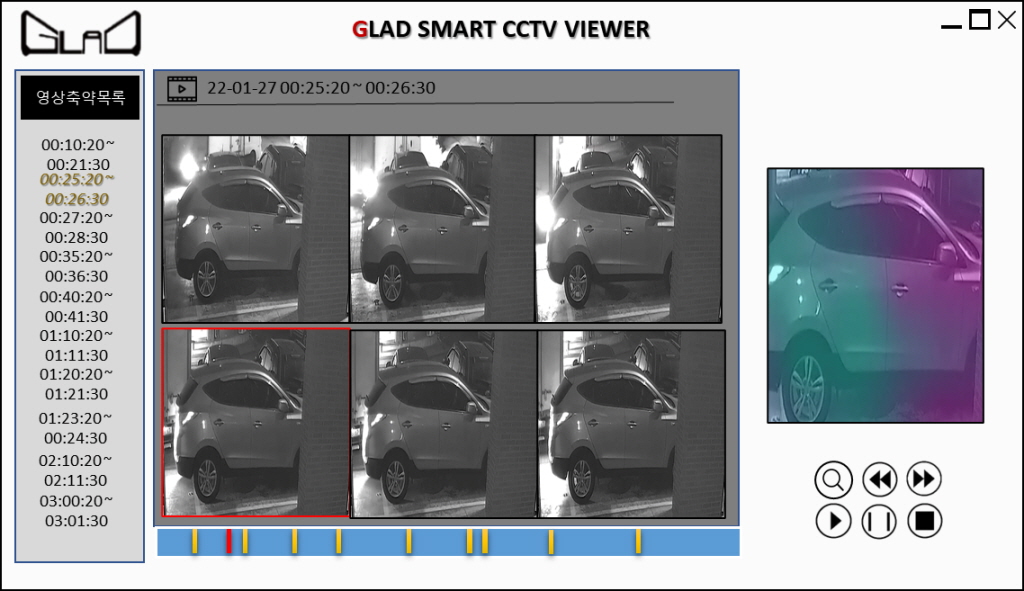
▲Example of user software: In the black box video, a 3-ton truck on the upper left of the vehicle is moving backwards and collides with an SUV. The user software marks that point in time on the timeline on the left.

Comments
Related news
Intelligent CCTV, “High Efficiency in Vehicle Number Recognition” VS “Actual Sites, Many Variables”
AI cameras at the edge are expected to expand their market presence primarily in the public sector and security market. While monitoring personnel have limitations in workforce and capabilities, AI can mechanically learn and infer predefined factors, and experts anticipate it will demonstrate effectiveness in real-world applications.
2023.03.30by 명세환 기자
Edge AI (1) - Vision recognition, actively adopted by infrastructure and service providers… "Low-spec optimization is key."
As artificial intelligence technology embedded in intelligent CCTV systems becomes more advanced, it is expected to alleviate the labor burden on social safety infrastructure. With active technology transfer to the private sector in areas such as facial recognition and human recognition, and expansion of related technology infrastructure and services accelerating, edge AI—which distributes computing power and enables artificial intelligence implementation even on low-spec devices—is gaining attention.
2023.04.11by 명세환 기자
SKT and Innodeb Launch AI Video Surveillance Solution
SKT is launching an AI-based next-generation intelligent video surveillance solution together with Innodep, a CCTV control platform specialist.
2023.07.18by 김예지 기자
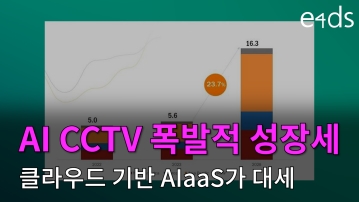
AI CCTV Market to Grow 20% Annually
The global AI-based CCTV market is projected to reach $16.3 billion (approximately 22 trillion won in Korean currency) by 2028, with an anticipated annual growth rate in the 20% range.
2023.08.16by 명세환 기자
ETRI Recognizes Research Results for "Visual Intelligence Deep View"
ETRI received the Minister of the Interior and Safety Award at the 2023 Republic of Korea Disaster and Safety Research and Development Awards ceremony for "Visual Intelligence DeepView," a technology for public safety demonstration and commercialization using public CCTV through core video understanding artificial intelligence technology.
2023.09.15by 배종인 기자











