



AMD Unveils Second-Generation Versal Adaptive SoC
 Published2024.04.09 18:15
.jpg)
▲AMD 2nd Generation Versal Adaptive SoC Series (Image: AMD)
Accelerating AI Inference in Embedded Systems
Recently, artificial intelligence is being applied to various embedded applications. Embedded environments must meet demanding operating conditions, including temperature ranges, limited specifications and form factors, and security and reliability. Therefore, single-chip embedded AI chips have been introduced to the market, enabling the introduction of AI capabilities into embedded systems and meeting broad market needs.
AMD unveiled its second-generation Versal Adaptive SoC series, an intelligent single-chip for embedded systems, in a pre-event media briefing.
The second-generation Versal adaptive SoC series, unveiled on the 9th, integrates three processors into a single chip. It is equipped with three chips: △programmable logic △vector processing △high-performance embedded CPU.
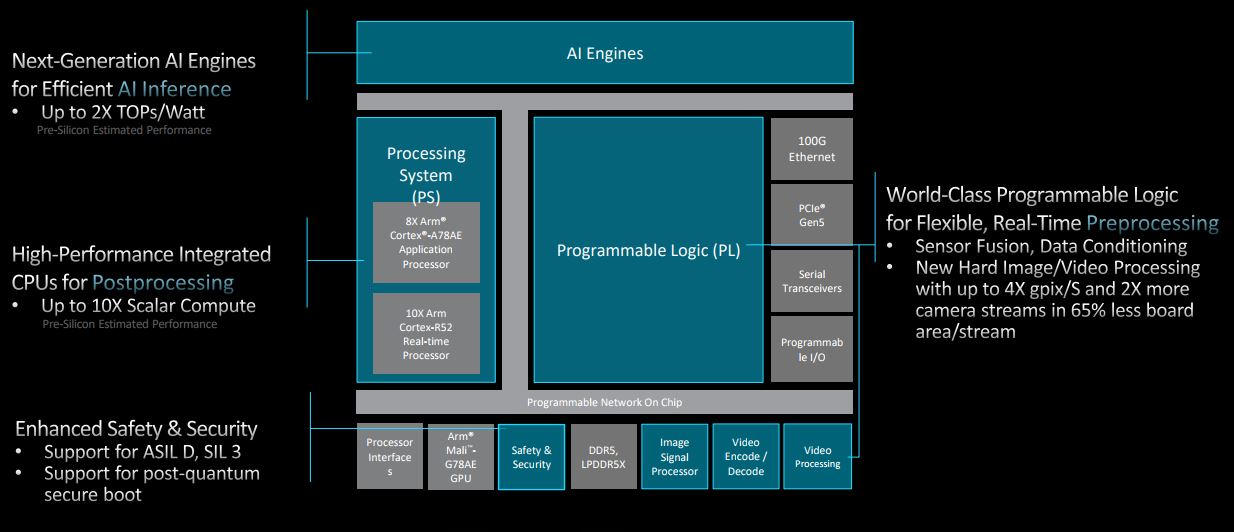
▲ AMD 2nd Generation Versal Adaptive SoC Series Block Diagram (Image: AMD)
Each is responsible for preprocessing (sensor processing and fusion, data conditioning), AI inference (cognition, analysis, situational awareness), and postprocessing (decision-making, control, feedback).
Challenges in multi-chip solutions include: △increased power requirements and delivery complexity; △increased board area and system size; △increased additional memory requirements; △increased latency in chip-to-chip communication; △increased safety vulnerabilities and failure factors due to increased chips; △difficulty in component life management; and △difficulty in board design.
AMD responded to market demands by unveiling two types of its 2nd generation Versal adaptive SoC series: △Versal AI Edge 2nd generation for AI-based embedded systems and △Versal Prime 2nd generation for classic embedded systems. The biggest difference between the two products is the presence or absence of an AI engine.
The second-generation Versal adaptive SoC specifications are described as providing four times higher performance in L2+·L3 ADAS compared to the previous generation, a 65% smaller board area for edge AI applications in smart cities, and twice faster video processing in video streaming.
In addition, it is introduced as being applicable to a wide range of markets, including automotive, robotics, industrial IoT, healthcare, machine vision, aerospace, and defense.
The second-generation Versal adaptive SoC series is currently in early access documentation. The roadmap is planned to begin with prototypes distributed in the first half of 2024, with production shipments starting in the second half.
Comments
Related news
AMD Accelerates Space Application Inference with Versal AI Edge
As advanced semiconductor demand in space applications such as low earth orbit satellites and space resource development is expected to surge as a next-generation advanced industry, AMD is strengthening its leadership in the radiation-hardened space-grade adaptive computing solutions sector.
2023.09.22by 명세환 기자
AMD Embedded+ Launch, “Background for Rapid Increase in Edge AI Chips and Sensor Data Analysis”
Growing supply of AI inference chipsets is expected at the edge. Machine vision and sensor data analytics are projected to drive edge AI-related shipments, while AI semiconductors for edge AI devices are emerging in SoC form factors.
2024.02.06by 명세환 기자

AMD Radeon RX 7900 GRE Graphics Card Worldwide Launch
AMD has unveiled a new graphics card equipped with an AI accelerator, designed for 4K resolution gaming and streaming.
2024.02.27by 명세환 기자

AMD Spartan UltraScale+ Unveiled
By 2028, IoT devices are expected to increase 2.3-fold, and FPGA demand is rising concurrently with the growth in connected devices. Meanwhile, the developer shortage is intensifying, with design engineer shortages expected to reach 30%. Currently, industrial and healthcare sector products require years of development, so companies need to extend the lifecycle of developed products to secure return on investment (ROI) relative to their capital expenditure.
2024.03.05by 명세환 기자

AMD CEO Lisa Su: "AI PCs will lead innovation in gaming and entertainment."
With AI PCs beginning to see widespread adoption, concrete examples are being presented demonstrating how to leverage them to enhance productivity.
2024.03.14by 권신혁 기자











