



Spectra to supply instrumentation cards for next-generation EPR spectrometers
 Published2024.04.17 10:44
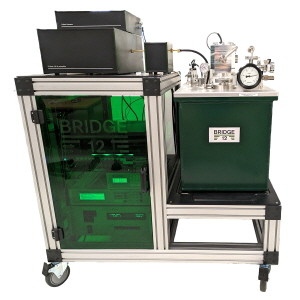 The instrumentation cards from Spectrum Instrumentation, a specialist in digitizers and generators, are used as key components in next-generation EPR spectrometers and have been recognized for their performance.
Spectrum announced on the 17th that its Arbitrary Waveform Generator (AWG) and digitizer have proven their capabilities as core components in the next-generation Electron Paramagnetic Resonance (EPR) spectrometer launched by U.S. startup Bridge12.
EPR, or electron spin resonance (ESR), spectroscopy is similar to nuclear magnetic resonance (NMR) spectroscopy, but studies the properties of unpaired electrons rather than nuclei such as protons.
It is used in the study of the electronic structure of metal complexes or organic radicals in the fields of chemistry, biology, materials science, and physics, but there was a problem that the EPR spectroscopy required a huge electromagnet weighing more than 1 ton, so the base had to be located in a basement.
Accordingly, a startup called 'Bridge12' located near Boston, USA, has released a next-generation EPR spectrometer that is 1/10th the size and weight, can be installed on any floor of a building, and is 50% cheaper than existing equipment.r />
The core components of this spectrometer include a spectrum measurement card consisting of an AWG that generates pulses and a digitizer that collects the return signal.
“As a startup, we were able to start from scratch and build a next-generation EPR spectrometer that is significantly more compact than existing products,” said Thorsten Maly, Vice President of Magnetic Resonance at Bridge12. “Many of our customers are university researchers who are introduced to EPR spectroscopy through collaborations, and the availability of an affordable, state-of-the-art instrument will make this methodology more accessible. Another goal is to make EPR spectroscopy accessible to more scientists by making it easier to use than existing instruments that require a separate operator.” “Bridge12’s control software is intuitive with automated features. It’s easy to set up, and you can immediately see if your experiment is working correctly, so even if you’re not an EPR spectroscopy expert, you can get the results you want.”

Comments
Related news
Launch of 8.3GHz 'FSW Signal Analyzer' to Lead Next-Generation Technology
Rohde & Schwarz has announced a new option for the R&S FSW-B8001. This option extends the internal analysis bandwidth of the FSW high-performance signal and spectrum analyzer to 8.3GHz. The R&S FSW, supporting a maximum measurement frequency range of 85GHz, boasts superior measurement dynamic range and sensitivity, accuracy, and EVM performance. Additionally, it provides extended analysis bandwidth and dedicated measurements, meeting the test and measurement requirements for ultra-wideband (UWB) signal analysis and next-generation technologies.
2020.10.07by 김동우 기자
SE Motor Protection Relay Applied to Samsung Heavy Industries Smart Ship Solution
Samsung Heavy Industries is currently conducting verification on Schneider Electric Korea's IoT-based smart motor protection relay spectrum version product (EOCR-iSEMMETS). The new product is applied to the construction of the Smartship solution and is utilized for remote motor diagnostics.
2021.03.31by 이수민 기자

TI Unveils Industrial and Automotive Power Solutions Featuring Active EMI Filters
As the proportion of electronic components increases in industrial and automotive applications, reducing electromagnetic interference (EMI) has become increasingly important. Texas Instruments' LM25149-Q1 and LM25149 synchronous DC/DC buck controllers integrate active EMI filtering (AEF) and dual random spread spectrum (DRSS) technology to reduce the board area occupied by external EMI filters and lower conducted EMI in power solutions across the entire frequency band of CISPR 25 Class 5.
2021.04.08by 이수민 기자

Keysight Receives Industry-First Sub-Terahertz 6G Development License
▲Keysight has acquired an FCC Spectrum Horizon license for developing the industry's first sub-terahertz 6G technology.
2022.04.29by 김예지 기자
Spectrum Instruments Implements DDC Function Using External GPU
Spectrum Instrumentation, a specialist company in digitizers and generators, announced on the 19th that it will implement digital down conversion (DDC) functionality in its PCIe digitizer product line.
2023.04.19by 명세환 기자











