


Electric vehicle durability has been dramatically improved.
 Published2024.05.09 16:57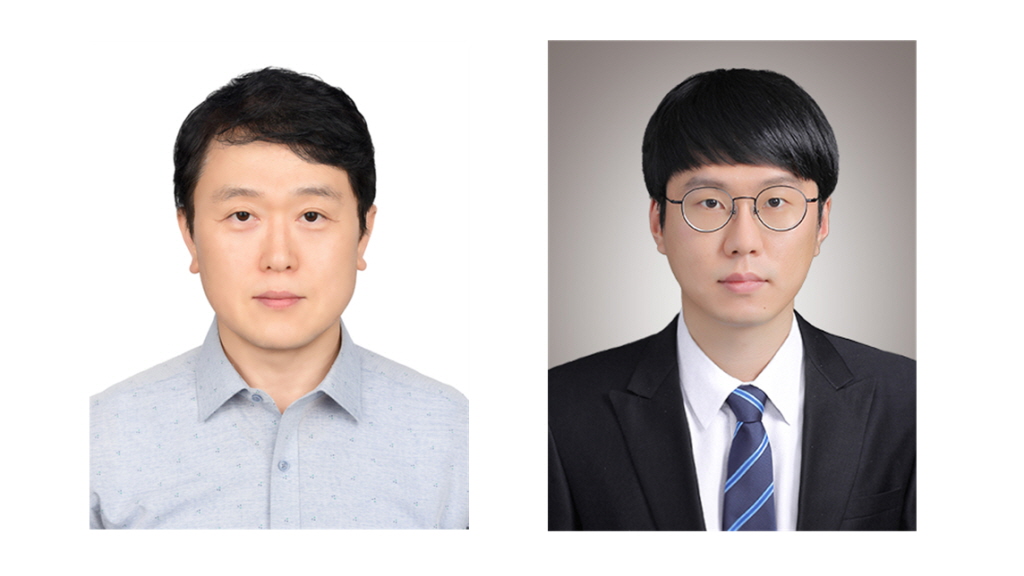
▲Dr. Eo Gwang-jun and Dr. Son Hyeon-woo (from left) of the Korea Institute of Materials Science, who led this research.
An aluminum alloy material for electric vehicles with dramatically improved thermal durability has been developed, and it is expected to contribute significantly to reducing the risk of electric vehicle accidents in the future.
The Korea Institute of Materials Science (KIMS, President Choi Cheol-jin) announced on the 9th that the research team led by Dr. Eo Gwang-jun and Dr. Son Hyeon-woo of the Aluminum Research Lab of the Metal Materials Research Division succeeded in developing an aluminum alloy for electric vehicles with dramatically improved durability.
The research team discovered a new mechanism by which nanostructures within aluminum alloys operate, and confirmed that the alloy developed through this improved thermal durability by up to 140% compared to materials from advanced foreign companies.
The existing aluminum battery outer material has a problem in that it continuously deteriorates due to the heat emitted by the battery, which critically increases the risk of accidents as the electric vehicle ages. The newly developed aluminum alloy adds various trace elements to the existing 6000 series aluminum alloy to increase thermal durability and delay the deterioration of exterior materials due to heat generation.
The research team built a new database by adding dozens of trace elements and analyzing nanostructures through a cutting-edge nanostructure precision analysis process using transmission electron microscopy and 3D atomic force microscopy.
Based on this, we were able to confirm that several elements can improve thermal stability.
Aluminum alloys with thermal durability enhancement technology can exhibit excellent properties in parts that are used for long periods of time in high-temperature environments, such as electric vehicle battery exteriors and supersonic aircraft structural materials.
Existing thermal durability enhancement technologies have limitations in that they utilize a database of elements that have long been used in aluminum alloys.
This study is significant in that it diversifies the database of thermal durability enhancement technologies and suggests new directions for alloy design.
The electric vehicle battery casing market is expected to grow at a CAGR of 8.4% from USD 464.9 million in 2020 to USD 863.3 million in 2029.
Although we are currently lagging behind advanced overseas companies in terms of technological competitiveness, it is expected that localization through this technology will not only have an import substitution effect but also enable exports.
Dr. Son Hyun-woo of the Korea Institute of Materials Science and Engineering, who led the research, said, “If the technology developed this time is commercialized, it will be an opportunity to raise awareness of the need for the development of high value-added aluminum alloys, which are currently lagging behind advanced foreign companies, and to encourage domestic companies to enter the research and development market more actively.”
This research was conducted through the Korea Institute of Materials Science's basic project and National Research Laboratory (N-Lab.) project with support from the Ministry of Science and ICT. Furthermore, the research results have been published in three SCI-level papers and two related patents have been filed. The research team has completed basic research on manufacturing technology for aluminum alloys with excellent thermal stability and is currently conducting follow-up research with the goal of achieving technological maturity through applied research and transferring the technology to domestic aluminum battery casing manufacturers.

Comments
Related news
Dr. Yoo Ji-seong of Materials Research Institute, selected as ‘Material Innovation Researcher of the Month’ by the Korean Institute of Metals and Materials
Dr. Yu Ji-seong, researcher at the Hydrogen Materials Evaluation Laboratory under the Extreme Materials Research Institute at the Korea Institute of Materials Science (KIMS, Director Lee Jung-hwan), a government-funded research institute under the Ministry of Science and ICT, has been selected as the "Innovative Materials Researcher of the Month" announced by the Korean Institute of Metals and Materials (KIM, President Joo Se-don).
2024.03.07by 배종인 기자
Materials Research, “Higher and wider electromagnetic wave absorption”
A research team led by Dr. Lee Hee-jung at the Functional Composite Materials Research Center, Composite Materials Division of the Korea Institute of Materials Science (KIMS, Director Lee Jung-hwan) has successfully developed a Metal-Organic Framework (MOF) that maximizes dielectric loss and magnetic loss in the gigahertz (GHz) high-frequency band by utilizing Metal-Organic Frameworks (MOF), and achieved final development of high-performance and broadband absorption material through compositing.
2024.04.01by 배종인 기자
Choi Cheol-jin, 7th President of Korea Institute of Materials Science, “I will make all citizens aware of and sympathize with the importance of materials”
Dr. Choi Chul-jin has been appointed as the seventh president of the Korea Institute of Materials Science (KIMS), a government-funded research institute under the Ministry of Science and ICT. President Choi Chul-jin held his inauguration ceremony on April 22 at the auditorium of the main building of the Korea Institute of Materials Science and commenced his official duties for a three-year term.
2024.04.22by 배종인 기자
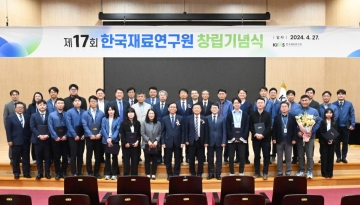
Materials Research Institute, 17th Anniversary of Materials Globalization Pioneer
The Korea Institute of Materials Science (KIMS, Director Chul-jin Choi) marked its 17th anniversary by emphasizing the globalization of Korean materials and revealing the Institute's progress toward realizing a materials powerhouse.
2024.04.23by 배종인 기자
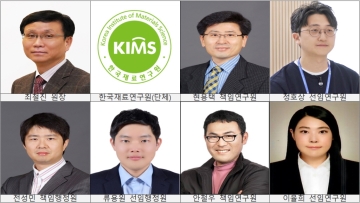
Materials Research Institute, President Choi Cheol-jin received 8 government awards for science and technology, including the Order of Merit
Korea Institute of Materials Science (KIMS, Director Choi Chul-jin) received a total of 8 government commendations for contributions to science and technology promotion on the occasion of the 57th Science Day, including 1 Science and Technology Order of Merit, 1 Prime Minister's Commendation, and 6 Minister of Science and ICT Commendations.
2024.04.25by 배종인 기자











