



Volvo Trucks Korea Establishes Korea's First Dedicated Charging Facility for Large Electric Trucks
 Published2024.05.27 11:58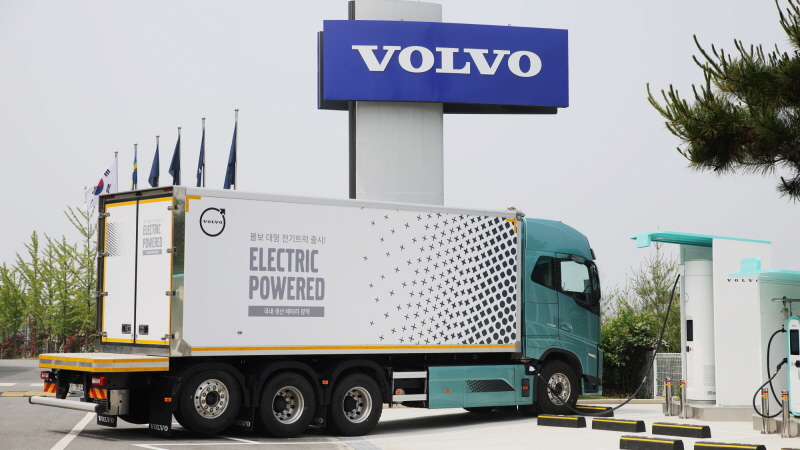
▲ Volvo Trucks Korea's first dedicated charging facility for large electric trucks in Korea (Photo courtesy of Volvo Trucks Korea)
26 Charging Stations Dedicated to Large Electric Trucks Completed at Directly Managed Service Centers in Dongtan, Incheon, and Gimhae
Reach 80% battery SOC for FH electric models within 1.5 hours using a 350kW ultra-fast charger
Volvo Trucks Korea announced on the 27th that it has completed the construction of the first charging facilities dedicated to large electric trucks in Korea at three directly managed service centers in Dongtan, Incheon, and Gimhae.
Volvo Trucks Korea’s directly operated charging stations are the first step in the charging network construction roadmap established by Volvo Trucks for the domestic introduction and commercialization of heavy electric trucks, with 26 fast chargers installed at the Dongtan, Incheon, and Gimhae service centers.
The 350kW ultra-fast charger installed at Volvo Trucks' company-operated charging stations can charge the FH Electric's battery SOC (state of charge) to 80% within 1.5 hours.
This is because the Volvo FH Electric consistently delivers 250kW per hour up to 80% battery charge.
Volvo Trucks domestic charging infrastructure to accelerate the transition to electric trucksStep-by-step goals related to the construction of the system have also been established.
We have completed the construction of a dedicated charging facility for electric trucks at a company-operated service center. For the next phase, we are preparing to install charging infrastructure at 31 Volvo Trucks in-house service networks nationwide, with construction scheduled to begin in the second half of the year.
In the third stage, discussions are underway to establish commercial vehicle charging facilities at existing dedicated car chargers, focusing on truck-dense areas such as major port facilities and logistics hubs, by forming strategic alliances with charging service providers.
Finally, we plan to expand charging infrastructure dedicated to commercial vehicles through active consultation with the government and public institutions.
Volvo Trucks was the first in the commercial vehicle industry to introduce large electric trucks into mass production in 2019 and currently sells a total of six electric truck models, possessing the widest product range in the industry.
As of the end of 2023, it held a 49% share of the European market for heavy electric trucks weighing over 16 tons, and the heavy electric truck 'FH Electric' was selected as the 'International Truck of the Year 2024 (IToY 2024)', proving its excellent performance.
Volvo Trucks Korea introduced the FH Electric, a heavy electric truck, in March 2023, becoming the first in the domestic commercial vehicle industry to do so. It is also currently preparing to deliver the Volvo FH Electric truck to customers in the domestic commercial vehicle market by the third quarter of 2025.
Park Kang-seok, CEO of Volvo Trucks Korea, stated, “Volvo Trucks Korea is continuing its efforts to alleviate concerns regarding charging facilities, which are one of the biggest worries for customers when purchasing electric trucks, and to accelerate the domestic adoption of heavy-duty electric trucks,” adding that “charging infrastructure "We look forward to continuously collaborating with more partner companies to build this," he said.
Meanwhile, as part of its efforts to achieve Volvo Group’s sustainability goals, Volvo Trucks Korea invested approximately 6 billion won to install solar power generation facilities at three directly managed service centers in Dongtan, Incheon, and Gimhae, thereby converting the electricity used domestically to 100% green energy.
Under the group-wide vision of sustainability, Volvo Trucks has established a goal to replace 50% of the trucks sold with electric trucks or zero-carbon products by 2030, and to replace and sell all products sold with zero-carbon products by 2040.
In addition, Volvo Trucks is striving for sustainability and carbon neutrality, which are the Volvo Group's visions, including achieving net zero in all related processes by 2050.
Comments
Related news
EU CRMA Final Approval… Long-term Plans for Supply Chain Diversification, Raw Material Information Collection, etc. Must Be Prepared
The European Critical Raw Materials Act (CRMA), which received final approval in March, does not explicitly stipulate discriminatory provisions against products of foreign origin; however, a report published by the Korea Automotive Research Institute (hereinafter KARI) states that industries and companies expected to face indirect impacts need to establish long-term plans for supply chain diversification and the collection and management of raw material information.
2024.05.17by 성유창 기자
.jpg)
ST, Space saving and integration of automotive electrical components to improve convenience
STMicroelectronics (hereinafter ST), a global semiconductor company supporting diverse electronic applications and customers, has launched a new step-down synchronous DC/DC converter that supports light load, low noise, and thermal insulation applications and has obtained automotive quality certification. The converter reduces space in applications such as automotive body electronics, audio systems, and inverter gate drivers, while improving the convenience of cross-application integration.
2024.05.22by 배종인 기자
“Infrastructure-based autonomous driving is more effective than car-centered autonomous driving”
Infrastructure-based autonomous driving demonstrates superior performance to vehicle self-intelligence in complex traffic environments such as intersections, and opinions have been raised that Korea, which possesses world-class technology in key sectors including automobiles and telecommunications, will have sufficient capability to realize infrastructure-based autonomous driving.
2024.05.23by 성유창 기자
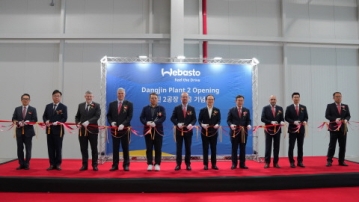
Webasto expands state-of-the-art automotive battery pack production plant in Dangjin, South Chungcheong Province.
Global mobility company Webasto of Germany has secured additional annual battery production capacity of 100,000 units with the completion of a new factory featuring over 15,000 m² of production and storage space.
2024.05.23by 성유창 기자

[EMI/EMC Expert Talk②] Professor Jin-Guk Kim, “Passive EMI Filters Face Limits, Active EMI Filter Semiconductor Mass Production Preparations in Progress”
[Editor's Note] Electromagnetic noise generated during IT product design causes critical defects such as product performance degradation and malfunction. Recently, electromagnetic noise in the environment has been increasing due to vehicle electrification, miniaturization of various IT devices, and paradigm shifts toward 5G and 6G communications, leading to malfunctions in various devices and systems. In response, through the planned series 'EMI/EMC Expert Dialogue,' we aim to shed light on the importance of EMI and EMC design for the development of safe and highly reliable advanced IT products, and have arranged opportunities to meet with EMI/EMC specialists active across various sectors and hear their latest insights.
2024.05.24by 권신혁 기자











