


On-device AI: Chip Optimization Key to Cost Efficiency
 Published2024.06.03 16:33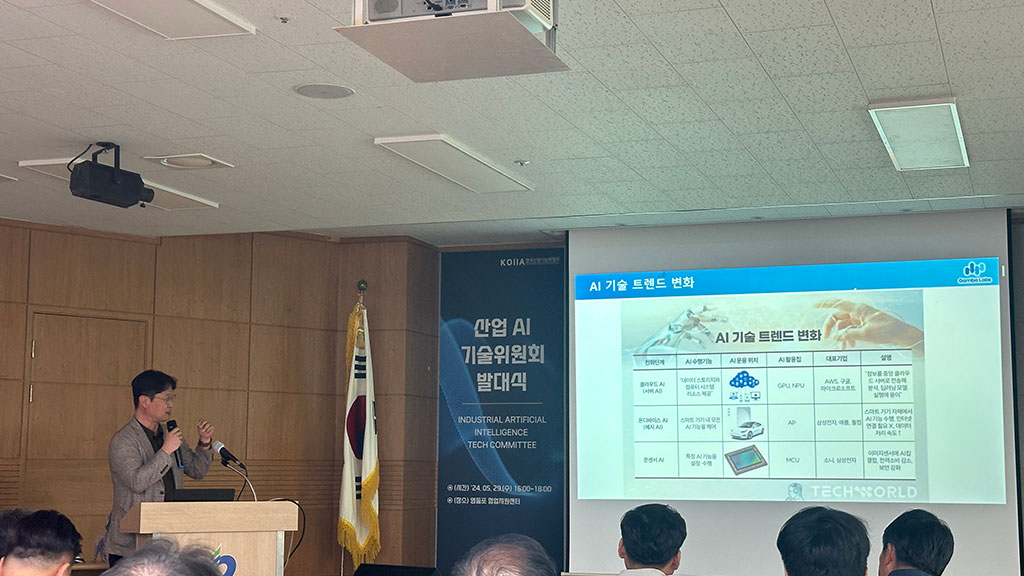
The Korea Industrial Intelligence Association Launches its Industrial AI Technology Committee.
Embedded systems require miniaturized hardware-based performance optimization.
As the recent AI development trend shifts from using large-scale resources to efficiently utilizing small devices, MCU-based design solutions that support AI application development in industrial settings are attracting attention.
The launch ceremony for the "Industrial AI Technology Committee," launched by the Korea Industrial Intelligence Association on the 29th, provided a forum for sharing industrial AI-related technologies and industry trends. Gachon University Chairperson Cho Young-im introduced the committee and highlighted trends in international AI standardization. Speakers emphasized the use of industrial data for AI applications.
Hardware optimization is a key focus for the domestic AI industry. As computing performance grows and becomes more important, various types of semiconductor chips are being utilized. The CPUs and GPUs adopted by major global big tech companies generate annual demand of 200 to 400 million units, while the APs and GPUs used in mobile devices generate annual demand of 1.2 to 2 billion units. Recently, the demand for NPU (Neural Processing Unit) specialized in AI processing is increasing.
Recently, the trend has shifted from large-scale AI learning and inference based on the cloud (server) to on-device AI or edge AI, which improves data processing speed by incorporating AI functions into smart devices themselves.
In this trend, the "MCU (Microcontroller Unit)" is considered a cost-effective strategy for integrating AI chips into image sensors in embedded systems, reducing power consumption and enhancing the security of personalized devices. Recently, NPUs have also been incorporated into MCUs.
An MCU is a core component of an embedded system, a computer system designed to perform specific tasks. It can be viewed as a miniature computer that integrates a microprocessor unit (MPU), memory, and input/output interfaces on a single chip. MCUs perform basic calculations, input/output control, and data processing, ensuring low power consumption and security, making them primarily used in fields such as industrial automation, smart homes, and smart cities. Major MCU manufacturers include STMicroelectronics, NXP, and Microchip.
Gamba Labs CEO Park Se-jin emphasized the importance of cost reduction and development environment as key keywords for edge AI, saying, “The key is how small we can make it and how much we can optimize it.”
“Rather than uploading sensor data from industrial sites to the cloud and running large-scale models, we can achieve cost efficiency by focusing on specialized areas,” said CEO Park. “Major MCU companies already provide libraries for AI application development, supporting easy AI development.”
Research is already underway overseas, and development in Korea is still in its early stages. For example, NXP's new MCX A series MCUs are optimized for power architecture and software compatibility, making them suitable for a wide range of embedded applications, including industrial sensors, motor controllers, batteries, portable power system controllers, and IoT devices.
STMicroelectronics also supports a variety of AI solutions that accelerate the implementation and development of edge AI processing based on STM32 MCUs and MPUs. These solutions enable AI processing directly on STM32 MCUs and MPU devices, without cloud connectivity. STMicroelectronics also provides automated autoML programs, such as the STM32Cube.AI platform and NanoEdge.AI Studio.
Gamba Labs, a Korean startup, is collaborating with smart home device manufacturers, robots, and automotive parts companies and is currently in the validation stage for its voice speaker recognition solution. Gamba Labs provides hardware modules for testing and developing its TinyML models. It supports voice and motion recognition model testing based on ESP32S3 MCU and provides VIOLA automation framework.
“The future challenges in the on-device AI market are miniaturizing hardware, maximizing energy efficiency, securing price competitiveness, making models lightweight and optimized, automating the development environment, and enabling integration with NPUs,” said CEO Park. “This can be seen as an opportunity for domestic startups like Gamba Labs.”
Comments
Related news
.jpg)
Supermicro Expands Edge AI Server Solutions
Supermicro's application-optimized servers are equipped with NVIDIA GPUs and are expected to facilitate fine-tuning of pre-trained models, while deploying AI inference solutions at the edge where data is generated to improve response time and decision-making.
2024.02.23by 명세환 기자

Intel Unveils Edge Platform, Simplifying On-Device AI Development
Competition among companies is intensifying to expand AI at the edge device layer that interfaces with consumers and end users. In this context, Intel has newly introduced an open software platform that facilitates the development, deployment, and execution of edge AI solutions for developers, operators, and enterprises.
2024.02.27by 명세환 기자
.jpg)
ST, “Contains all the industry know-how in ‘Edge AI Solution’”
ST Microelectronics (hereinafter ST) introduced software packages supporting ST's products and edge AI (on-device AI) solutions based on ST MCU and MPU.
2024.03.19by 성유창 기자
.jpg)
NXP Expands Edge Portfolio with MCX W Wireless MCU Series
NXP Semiconductor announced on the 11th that it is adding extensive connectivity to its MCX portfolio through the latest devices in the MCX W series, building on the success of recently launched MCX A and MCX N series devices.
2024.04.11by 명세환 기자

Keysight and AMD Collaborate on Cloud and Edge Infrastructure Performance Benchmarking
Keysight Technologies announced on the 9th that it will leverage AMD's 4th generation AMD EPYC™ CPU to develop the industry's first benchmarking methodology that redefines the system performance evaluation field for high-speed digital designers, network equipment manufacturers, and data center operators.
2024.05.09by 김예지 기자











