



Korea Mechanical Engineering Transfers CO2 Reduction Technology to the US
 Published2024.07.01 13:58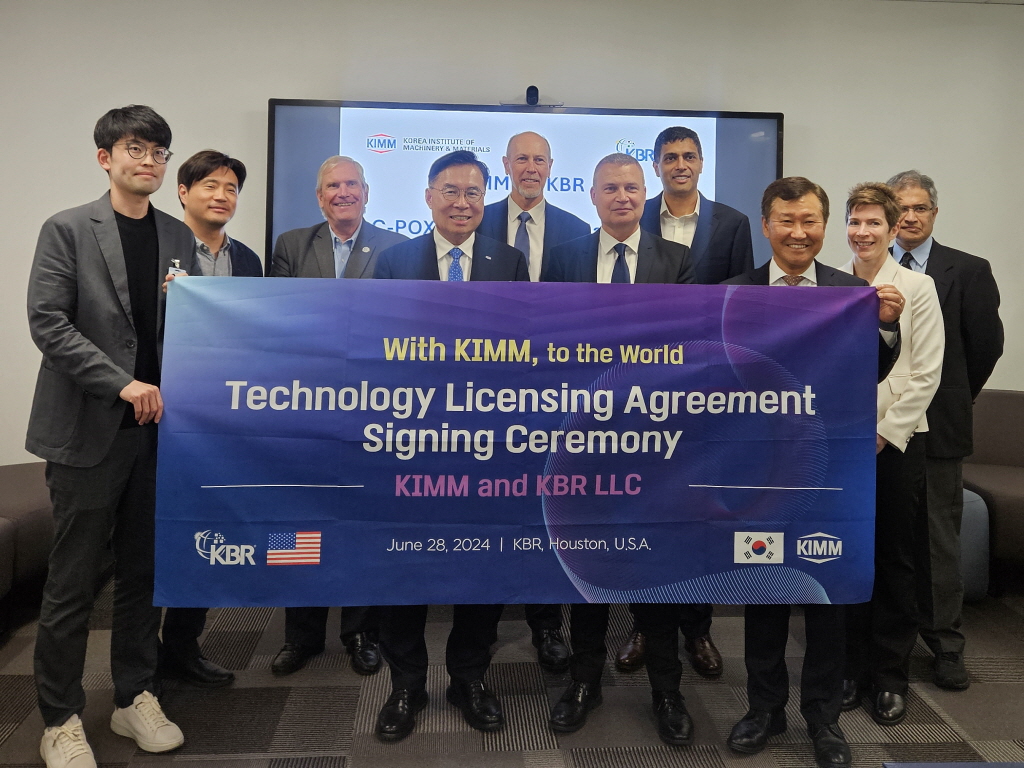
▲(4th from the left) Director Ryu Seok-hyeon of the Korea Institute of Machinery and Materials, KBR executives and staff are taking a commemorative photo after signing the contract.
The Korea Institute of Machinery and Materials (President Ryu Seok-hyun), under the Ministry of Science and ICT, has achieved the feat of transferring its unique carbon reduction technology, created through convergence research between research institutes, to the largest global engineering company in North America. With this technology transfer achievement, the excellence of our country's chemical process technology has been proven worldwide, and it is expected to become a cornerstone for the future leap forward of 'K-Machine' into the global industry.
Korea Machinery & Materials announced on the 1st that it signed a CPOx® technology transfer agreement with global engineering company KBR (Kellogg Brown & Root) on June 28th (local time).
KBR (Kellogg Brown & Root) is a global company in the fields of engineering, procurement, construction (EPC) and services for the chemical/energy industries, established in 1998 through the merger of MW Kellogg and Halliburton's construction subsidiary, Brown & Root.
CPOx (Catalytic Partial Oxidation)® technology is a catalytic partial oxidation technology that reduces CO2 by diversifying the catalyst regenerator fuel of the catalytic NCC process.
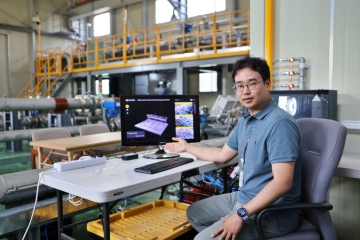
CPOx® technology, first developed by the research team led by Senior Researcher Daehoon Lee and Senior Researcher Seongkwon Cho of the Semiconductor Equipment Research Center of the Autonomous Manufacturing Research Institute of the Korea Institute of Machinery and Materials, is a technology that reduces CO2 emissions by supplying methane generated during the process as a heat source instead of fuel oil to the catalyst regenerator of the catalytic NCC process.
In order to reduce CO2 and secure economic feasibility, the need to replace fuel oil with methane as the heat source required for the catalyst regenerator in the catalytic NCC process has arisen. However, KBR's catalytic NCC process, the 'K-COT process', has a chronic abnormal combustion (after-burn) problem when supplying methane, a by-product gas of the process, as a heat source, making it impossible to use methane.
The CPOx® technology developed by Korea Institute of Machinery and Materials is a technology that decomposes methane into carbon monoxide (CO) and hydrogen (H2) by reacting it with a catalyst in the 'K-COT process' and supplies it to a catalyst regenerator. This technology can solve the problem of abnormal combustion, thereby securing carbon emissions and reducing the unit cost of olefin production.
“This achievement was made by setting goals based on field demands from the beginning of the research, and by pursuing problem discovery, solution development, and securing process applicability,” said Lee Dae-hoon, a senior researcher at the Korea Institute of Machinery and Materials. “Starting with the CPOx® process technology, we will develop a variety of world-class process technologies and contribute to enhancing the nation’s technological competitiveness.”
Ryu Seok-hyun, the president of KIMM, said, “At a time when carbon emissions, such as the carbon border tax, are threatening corporate competitiveness, it is very meaningful that we have achieved technology transfer related to reducing carbon emissions using our independent technology to a global company like KBR.” He added, “We will continue to expand our network of practical international cooperation so that KIMM’s excellent future-leading technologies can produce visible results in the global industrial market.”
The CPOx® technology research, for which a technology transfer agreement has been signed, was conducted with the support of the National Research Council of Science and Technology of the Ministry of Science and ICT's 'Large-scale Convergence Plant Technology for Securing Energy and Chemical Raw Materials (Organized by: Korea Research Institute of Chemical Technology, Future-leading Convergence Research Group, Director Yong-gi Park)' project.
Meanwhile, KIMM is operating its own global cooperation program called 'With KIMM, to the World.' Prior to the technology transfer agreement ceremony with KBR, Director Ryu Seok-hyun and his research team visited Harvard Medical School in Boston, Massachusetts General Hospital (MGH), Massachusetts Institute of Technology (MIT), and the National Institute of Standards and Technology (NIST) in Maryland, USA from June 24 to 26.
The research team discussed close international joint research cooperation plans through projects such as the Global Industrial Technology Cooperation Center (GITCC) and the National Cooperation Center for Industrial Technology (NCC) of the Ministry of Trade, Industry and Energy in areas such as △on-site immune diagnosis, △next-generation high-resolution Micro-LED display, △quantum technology standardization and nano. Then, on June 27, they attended the '3rd Korea-US Advanced Industrial Technology Cooperation Forum' hosted and organized by the Ministry of Trade, Industry and Energy and the Korea Institute for the Advancement of Technology and held a joint forum with MIT, etc.

Comments
Related news
Korea Machinery & Materials Institute to Select Large Number of CNC Systems for Participation in SIMTOS 2024
The Korea Institute of Machinery and Materials (KIMM, Director Ryu Seok-hyun), under the Ministry of Science and ICT, is participating in 'SIMTOS 2024' held at KINTEX in Ilsan with its largest-ever scale, showcasing a wide range of CNC systems for machine tools developed domestically.
2024.04.01by 배종인 기자
.jpg)
No Problems with Autonomous Driving on Dirt Roads… Korea Institute of Machinery and Materials Develops Core Technology for Off-Road Autonomous Driving
Off-road environment recognition technology capable of recognizing foreign substances such as dust, mud, snow, and rain during autonomous driving of construction and agricultural machinery, national defense unmanned ground vehicles (UGV), and other off-road vehicles, and removing them in real-time, has been developed domestically for the first time.
2024.04.17by 성유창 기자
KIMM Accelerates Atmospheric Environment Improvement in Mongolia
Dr. Ryu Seok-hyun, President of the Korea Institute of Machinery and Materials (KIMM) under the Ministry of Science and ICT, and his research team visited Abrams Co., Ltd. (CEO: Son Chang-ho), a subsidiary research institute company, as well as Mongolia's Ministry of Economic Development, Ministry of Road and Transportation Development, Ministry of Finance, the Development Corporation under Ulaanbaatar City Hall, and the Policy Analysis Research Institute from April 29 to 30. They discussed follow-up measures for the emission reduction project targeting aging vehicles in urban areas and plans to expand technical cooperation on improving air pollution and resolving odor issues.
2024.04.30by 배종인 기자
E-Fuel Production Realizing Clean Fuel
The Korea Institute of Machinery and Materials (President Ryu Seok-hyun, hereafter KIMM), Heat Pump Research Center of the Carbon-Neutral Machinery Research Institute, led by Principal Research Scientist Kim Young, has developed a high-efficiency microchannel reactor that reduces the amount of catalyst required for e-fuel production by 30% and achieves 30 times greater capacity compared to conventional systems. This reactor is safe at high temperature and high pressure with easy heat dissipation, enabling flexible temperature control, making it advantageous for e-fuel production.
2024.05.27by 배종인 기자
Plant Major Accident Detected by 'Sound' Even from a Distance
A research team led by Senior Researcher Woo Jung-han at the Korea Institute of Machinery and Materials (KIMM, Director Ryu Seok-hyun) under the Ministry of Science and ICT has developed technology for the first time in Korea that enables real-time detection of pipe leakage accident locations from a distance using acoustic sensors.
2024.05.29by 배종인 기자











