


Ministry of Science and ICT to Promote Korea's AI Regulatory Sandbox and Secure Semiconductor Power
 Published2024.07.02 10:49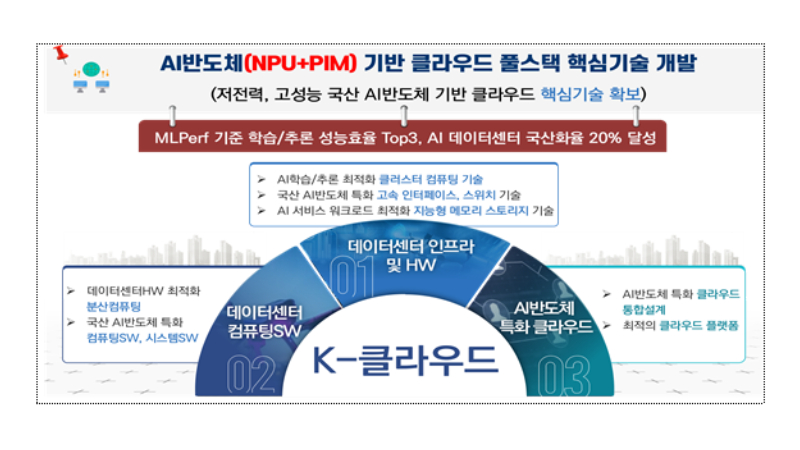
Creating an AI computing ecosystem based on domestic AI semiconductors
The Ministry of Science and ICT is continuing its efforts to contribute to the development of the AI industry. It has designated regulatory exceptions for 23 new technologies and services, and the K-Cloud technology development project based on domestic AI semiconductors has completed the preliminary feasibility study.
The Ministry of Science and ICT announced that the 'K-Cloud Technology Development Project Using AI Semiconductors' (hereinafter referred to as the K-Cloud Technology Development Project), planned in collaboration with the National IT Industry Promotion Agency, has passed the preliminary feasibility study. The results of this preliminary feasibility study were confirmed through the deliberation and resolution of the 5th National Research and Development Project Evaluation General Committee for 2024 held on Wednesday, the 26th.
In addition, the Ministry of Science and ICT announced that it held the 36th New Technology and Service Deliberation Committee on the 28th, announced a plan for system improvement, and designated regulatory exceptions for a total of 23 new technologies and services.
■ 23 New Technology and Service Regulatory Sandbox Promotion
The Ministry of Science and ICT announced a plan to improve the ICT regulatory sandbox system and focus its capabilities on discovering and planning regulatory sandbox tasks in the AI field. The Ministry of Science and ICT stated, “Compared to the recent increase in demand for regulatory innovation in the AI field, regulatory reorganization such as revising related laws takes a long time, so the regulatory sandbox is intended to preemptively discover innovative AI services so that they can be launched into the market,” and “Through this, we plan to support opening the floodgates to innovation in the AI field.”
As an example in the AI field, the 'Traffic Safety Smartphone Solution Soft V2X (LG Electronics)' was actively interpreted to be serviceable. In addition, a special case for verification was designated for the 'National Strategic Technology Specialized Research Institute Data Platform', a medical data platform built by Seoul National University Hospital for the purpose of advanced bio research. During the verification period, all researchers will conduct joint research on medical AI and big data through the platform.
In the private sector, when carrying out urban development such as reconstruction and redevelopment, consent from landowners in development areas can be obtained electronically (electronic signature, electronic document) instead of in writing, and a service that allows the general meeting of the relevant association to be held online has been designated as a demonstration special case (Ready Post). In addition, five cases of 'mobile virtual reality (VR) experience services' and six cases of 'platform-based temporary taxi driver qualification operation', including urban smart storage convenience services, were converted to temporary permits.
Minister of Science and ICT Lee Jong-ho said, “As discussed with the international community at the recent AI Seoul Summit, the new era of AI requires a balance of safety, inclusion, and innovation, and among these, the regulatory sandbox plays a very important role in AI innovation.” He added, “The Ministry of Science and ICT will spare no support so that AI innovative services can be launched and developed in the market through the regulatory sandbox.”
■ K-Cloud Technology Development Project, Strengthening AI Infrastructure
The government will invest a total of KRW 403.1 billion (KRW 342.6 billion from the national budget) in the K-Cloud technology development project over six years from 2025 to 2030. We plan to promote 28 detailed tasks in three strategic areas: △Infrastructure and HW, △Data Center Computing SW, and △Cloud Technology Specialized in AI Semiconductors, based on domestically produced AI semiconductors.
Through this, by 2030, when the project ends, the domestic AI semiconductor-based AI computing learning/inference performance efficiency will be strengthened to the global TOP 3 level, and the domestic production rate of AI data centers will be raised to 20%.
Furthermore, the Ministry of Science and ICT said, “The K-Cloud Technology Development Project is expected to contribute to the industrial activation of the entire AI-semiconductor value chain, including AI semiconductor companies, system SW companies, cloud companies, and AI companies,” and added, “Based on this technological innovation and industrial activation, the government will be able to contribute to the implementation of a sustainable AI ecosystem.”
Minister of Science and ICT Lee Jong-ho said, “The K-Cloud Technology Development Project is an essential project to complete AI data centers, which are the core infrastructure of the AI era, with our own technology, and it will also contribute to digital carbon neutrality.” He added, “We will do our best to successfully promote the project, create a sustainable AI ecosystem, and achieve technological innovation in AI and AI semiconductors, thereby successfully realizing the ‘AI-Semiconductor Initiative.’”
Comments
Related news
.jpg)
“Leaping forward to become the No. 1 country in the AI coexistence era”… AI Strategy High-Level Council launched
The Ministry of Science and Technology is launching the AI Strategy Supreme Council as the importance of securing AI technology industry competitiveness grows amid the spread of generative AI, and will make full efforts to integrate AI into daily life across the national, industrial, and public sectors while securing AI competitiveness.
2024.04.05by 김예지 기자
.jpg)
Ministry of Science and ICT to Promote Zero Trust Security Pilot Project with 4.5 Billion Won
The Ministry of Science and ICT and the Korea Internet & Security Agency (KISA) announced on the 8th that they will begin full-scale support for the adoption of zero-trust new security systems at government, public institutions, and private companies across a total of 2 fields (government/public and private sectors) and 4 projects (1 for government/public and 3 for private sector).
2024.04.09by 김예지 기자
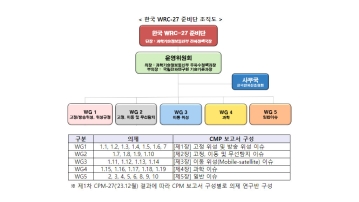
Ministry of Science and ICT launches WRC-27 preparatory team… ‘First step in securing 6G frequency’
The Ministry of Science and ICT established the Korean World Radiocommunication Conference Preparatory Group on the 19th to systematically respond to the World Radiocommunication Conference scheduled to be held in 2027 (2027 World Radiocommunication Conference, WRC-27).
2024.04.23by 김예지 기자
.jpg)
Ministry of Science and ICT to Cancel StageX's Qualification as 4th Mobile Carrier Candidate
StageX, which is preparing to launch as the fourth mobile carrier, is initiating a hearing procedure to make a final determination on whether to cancel its candidate status. The reason for cancellation is that it paid only an amount falling short of the capital specified in the allocation application, as evidenced by the capital contribution certificate.
2024.06.14by 김예지 기자
.jpg)
StageX, the 4th mobile carrier in danger of bankruptcy, what about the refunds already paid?
On the 14th, Choi Byung-taek, director of the Radio Policy Bureau, claimed, "The 205 billion won submitted by the business operator is stated as capital in the frequency allocation application and the applicant corporation details, with no other explanation provided." In response, StageX clarified on the 19th that there was an error in the Ministry of Science and ICT's explanation that it violated Article 3 (stock sale prohibition) and Article 4 (faithful implementation of capital procurement plan) of the commitment letter.
2024.06.21by 김예지 기자











