


Low-cost green hydrogen production using platinum-free catalysts
 Published2024.07.24 11:28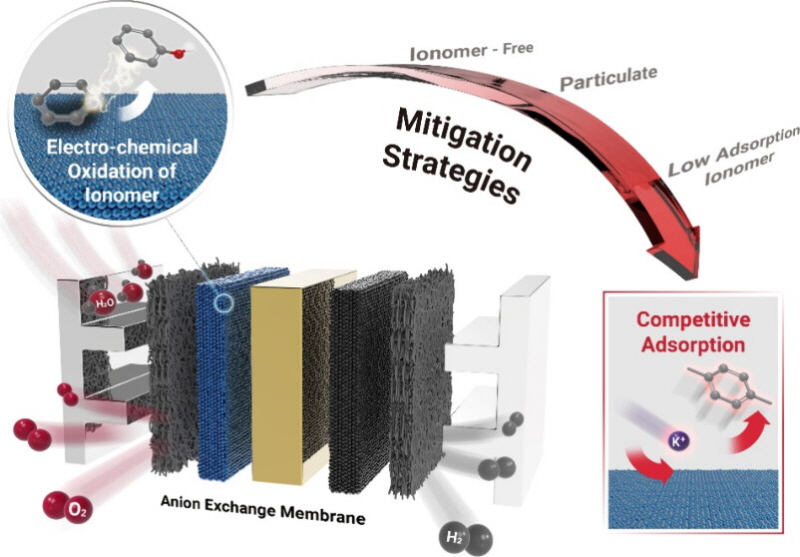
▲Schematic diagram of the overall strategy for preventing electrochemical oxidation of ionomers
A technology has been developed to improve the performance and durability of hydrogen production devices using inexpensive catalysts that do not require platinum, which is expected to help produce low-cost green hydrogen in the future.
Professor Seung-Geol Lee's research team from the Department of Materials Science and Engineering at UNIST (President Jong-Rae Park) has presented a new anion exchange membrane electrolysis technology using a low-cost non-platinum metal catalyst.
This reduces the direct contact between the potassium and the ionomer by allowing it to adhere to the catalyst surface. Preventing the ionomer from oxidizing can reduce the cost of hydrogen production.
In general hydrogen production devices, the properties of the ionomer that transfers ions change over time and become weak. This leads to a decrease in hydrogen production efficiency and a shortened lifespan of the device.
The research team utilized the fact that the adsorption energy of potassium is three times greater than that of organic compounds. They discovered that substances such as potassium hydroxide and sodium hydroxide can improve the performance and stability of anion exchange membrane electrolysis systems.
Cationic substances were adsorbed on the catalyst surface, reducing direct contact between the ionomer and the catalyst. Ultimately, it was proven through density functional theory (DFT), which calculates the electronic structure of the material, that the hydrogen production performance can be maintained by preventing oxidation of the ionomer.
There have been attempts to improve performance using strong alkaline potassium hydroxide and sodium hydroxide aqueous solutions in the past, but the specific principles have not been elucidated. However, the competitive adsorption strategy identified in this study is expected to greatly increase the possibility of commercializing low-cost catalysts.
“The competitive adsorption strategy is effective in reducing the electrochemical oxidation of ionomer materials that occurs at the contact surface with the catalyst,” emphasized first author Researcher Lim Ji-hoon.
Professor Seung-Geol Lee said, “This study will provide directions for improving the performance and stability of various energy devices, including high-performance alkaline anion exchange membrane electrolysis systems.”
The research results were published online on June 2 in ACS Energy Letters, a world-renowned energy academic journal. The research was conducted jointly by Dr. Yu Seung Kim’s research team at Los Alamos National Laboratory in the United States and Professor Shannon Boettcher of Berkeley University and Berkeley Lab in the United States, and was supported by the U.S. Department of Energy and the National Research Foundation of Korea.

Comments
Related news
AI technology that maintains existing knowledge, innovates autonomous driving and security systems
Professor Baik Seung-ryeol's team at the Graduate School of Artificial Intelligence at UNIST (President Yong-hun Lee) has developed 'SDDGR (Stability Diffusion-based Deep Generative Replay)' technology that enables AI to learn new information while maintaining existing knowledge.
2024.06.20by 배종인 기자
Jeans dye Prussian blue, next-generation battery material, on the rise
A research team led by Professor Lee Hyun-wook from the Department of Energy and Chemical Engineering at UNIST (President Lee Yong-hun) has developed a low-cost lithium secondary battery system that significantly enhances battery performance by utilizing Prussian blue as a cathode material.
2024.06.24by 배종인 기자
Solvent-free thick electrode lithium battery performance enhancement
A research team led by Professor Jung Kyung-min from the Department of Energy and Chemical Engineering at UNIST (Ulsan National Institute of Science and Technology) announced on the 25th that they have newly developed a dry electrode unit process and semi-finished product evaluation method for lithium-ion batteries. This dry process, which does not use harmful solvents, improves battery performance while also contributing to environmental protection.
2024.06.25by 배종인 기자
Nature-mimicking metal-bonded catalyst removes hazardous hydrocarbons
A research team at UNIST has developed a bio-inspired catalyst that decomposes harmful hydrocarbons. By oxidizing carbon-hydrogen bonds, it is expected to reduce energy consumption and contribute to preventing environmental pollution.
2024.07.10by 배종인 기자
Biosensor that rapidly detects minute amounts of protein using light
A joint research team led by Professor Lee Jong-won from the Department of Electrical and Electronic Engineering at UNIST (President Park Jong-rae) and Dr. Jung Joo-yeon from the Nanolithography Research Center at Korea Institute of Machinery and Materials (Director Ryu Seok-hyun) has developed a novel biosensor that dramatically improves protein detection sensitivity.
2024.07.11by 배종인 기자











