



Achieving carbon neutrality with eco-friendly refrigerants that are 100 times cheaper
 Published2024.07.26 13:37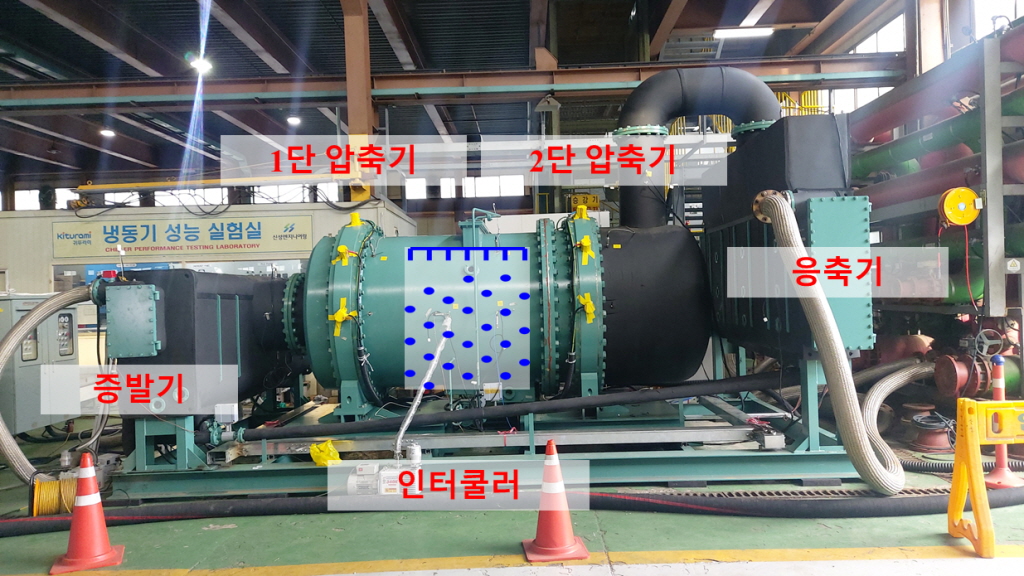
As international refrigerant regulations are strengthened to achieve carbon neutrality, a cooling technology using water with an environmental pollution index of zero as a refrigerant has been developed for the first time in Korea. This technology is economical as it is cheaper than existing chemical refrigerants, and it is expected to contribute to the realization of carbon neutrality as it can be applied as an eco-friendly refrigerant to air conditioners and industrial cooling units in the future.
Kim Jeong-cheol, a senior researcher at the Heat Pump Research Center of the Korea Institute of Machinery and Materials (President Ryu Seok-hyeon) under the Ministry of Science and ICT, announced on the 25th that he had developed the first core technology for an eco-friendly water refrigerant cooling system that can cool or transfer heat using water as a refrigerant.
The system developed this time uses water as a refrigerant instead of the existing chemical refrigerants, and is expected to be eco-friendly and inexpensive, significantly reducing refrigerant costs and increasing efficiency in maintenance and operating costs.
This technology was developed only in advanced countries such as Germany and Japan, but this time, we have developed the original technology for the first time in Korea, which has enabled us to secure national competitiveness.
Unlike existing compressors that use synthetic refrigerants, the Korea Mechanical and Electrical Engineering Research Institute has developed centrifugal compressors, evaporators, and condensers that can use water as a refrigerant.
When using water as a refrigerant, the inside of the evaporator must be maintained at 7℃ or lower, the inside of the condenser must be maintained at 35℃ or higher, and the inside of the cooling system must be in a vacuum state.
Additionally, because the surface tension of water is large, the heat transfer tubes are selected and arranged differently from those in synthetic refrigerant systems to suit the structure of the evaporator and condenser.
This system is designed to accommodate the compressible properties of water, maximizing the benefits of water in the cooling process while maintaining existing system functionality.
Environmentally friendly refrigerants such as ammonia and propane are often flammable or toxic, so if they must be used, separate safety facilities must be installed in the cooling device in accordance with the High Pressure Gas Safety Management Act.
On the other hand, water is non-toxic and non-flammable, so there is no need for separate safety facilities. There are advantages.
Due to tightening environmental regulations, refrigerants currently in use on the market will either be phased out entirely or their use reduced by up to 80% by 2045, depending on the refrigerant type. Furthermore, eco-friendly synthetic refrigerants currently being sold for development are expensive, and the companies that produce them monopolize the market. Therefore, alternatives are needed.
The newly developed cooling system utilizes water as a refrigerant, which is up to 100 times cheaper than conventional refrigerants, thereby reducing cooling system maintenance costs. Furthermore, using water as a refrigerant allows it to efficiently absorb and release heat, achieving the same cooling effect as conventional refrigerants while reducing energy consumption, potentially leading to lower electricity bills.
Kim Jeong-cheol, a senior researcher at the Korea Institute of Machinery and Materials, said, “This is the first case of developing an industrial chiller and heat pump system that uses water as a refrigerant in Korea, which was developed mainly in some advanced countries.” He added, “In line with the international trend of continuously demanding the development of eco-friendly chiller and heat pump technologies related to new refrigerant regulations, we will work to systematically develop related technologies in Korea and achieve commercialization.”
This research was conducted with the support of the Ministry of Trade, Industry and Energy's 'Development of 350kW-class natural refrigerant (R-718) application compression refrigeration technology' project.

Comments
Related news
E-Fuel Production Realizing Clean Fuel
The Korea Institute of Machinery and Materials (President Ryu Seok-hyun, hereafter KIMM), Heat Pump Research Center of the Carbon-Neutral Machinery Research Institute, led by Principal Research Scientist Kim Young, has developed a high-efficiency microchannel reactor that reduces the amount of catalyst required for e-fuel production by 30% and achieves 30 times greater capacity compared to conventional systems. This reactor is safe at high temperature and high pressure with easy heat dissipation, enabling flexible temperature control, making it advantageous for e-fuel production.
2024.05.27by 배종인 기자
Plant Major Accident Detected by 'Sound' Even from a Distance
A research team led by Senior Researcher Woo Jung-han at the Korea Institute of Machinery and Materials (KIMM, Director Ryu Seok-hyun) under the Ministry of Science and ICT has developed technology for the first time in Korea that enables real-time detection of pipe leakage accident locations from a distance using acoustic sensors.
2024.05.29by 배종인 기자
“Anyone can easily develop products in virtual reality”
The Korea Institute of Machinery and Materials (President Ryu Seok-hyun) has launched an initiative to promote the adoption of its independently developed 'Virtual Engineering Platform' to accelerate digital transformation for small and medium-sized enterprises that have been in a blind spot regarding virtual engineering technology.
2024.05.30by 배종인 기자
Ammonia engine operation reduces CO2 emissions by 50%
A research team led by Park Chul-woong, Principal Research Scientist at the Korea Institute of Machinery and Materials (Director Ryu Seok-hyeon) under the Ministry of Science and ICT, is successfully conducting demonstration of combustion technology for an LNG-ammonia dual-fuel engine for ships using ammonia as fuel in joint research with Korean Register of Shipping, HD Hyundai Heavy Industries, HD Korea Shipbuilding & Offshore Engineering, the Korea Research Institute of Ships and Ocean Engineering, and Kunsan National University at the Korea Register of Shipping Green Ship Equipment Test and Certification Center in Gunsan, Jeollabuk-do.
2024.06.10by 배종인 기자
Korea Mechanical Engineering Transfers CO2 Reduction Technology to the US
The Korea Institute of Machinery and Materials (KIMM), under the Ministry of Science and ICT, headed by Director Ryu Seok-hyun, has achieved a successful technology transfer of its proprietary carbon reduction technology, developed through collaborative research among government-funded research institutes, to KBR (Kellogg Brown & Root), North America's largest global engineering company. This technology transfer achievement has demonstrated the excellence of Korea's chemical process technology on the world stage, and is expected to serve as a cornerstone for the future leap of 'K-Machine' into the global industrial sector.
2024.07.01by 배종인 기자











