



Discarded by-product gas transformed into high-value-added aldehyde.
 Published2024.08.23 08:47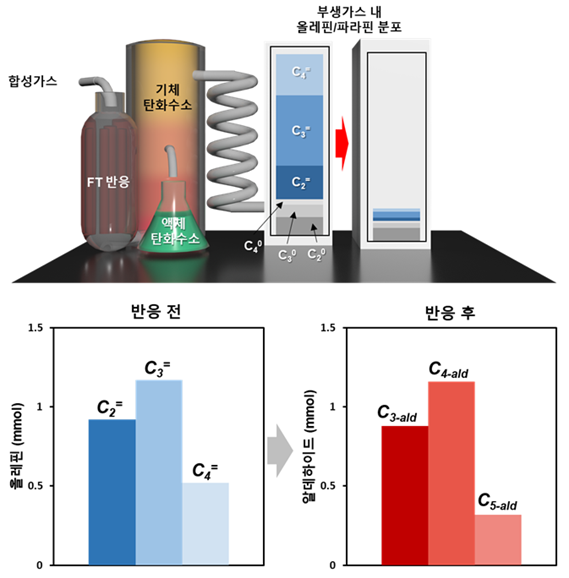
▲(Top) Schematic diagram of the hydroformyl reaction for upgrading by-product gas during the LAO production process. (Bottom) Changes in olefin content in the by-product gas before and after the hydroformyl reaction.
A UNIST research team has developed a technology to produce high-value-added aldehydes using byproduct gases. This technology is expected to play a key role in achieving self-sufficiency in the domestic chemical industry, reducing dependence on foreign chemical materials and enabling a stable response to supply chain crises.
UNIST (President Jong-Rae Park) announced on the 23rd that the team led by Professor Kwang-Jin Ahn of the Department of Energy and Chemical Engineering and Professor Jeong-Woo Han of Seoul National University, in collaboration with the Korea Institute of Energy Research, developed a high-performance rhodium-based catalyst.
This catalyst efficiently converts olefins contained in byproduct gas into high-value aldehydes. Olefins are unsaturated hydrocarbon compounds with double bonds and, along with paraffins, are important raw materials in the chemical industry.
The research team has developed a new method for recycling waste byproduct gas. They also developed technology to convert the byproduct gas generated during the process of combining carbon dioxide with hydrogen to create fuel into high-value-added products.
To improve the performance of the rhodium catalyst, cerium oxide was introduced to improve the chemical properties of the catalyst. The research team successfully converted olefins contained in the by-product gas into high value-added chemicals called aldehydes using a heterogeneous catalyst with high reaction performance comparable to existing technologies.
Byproduct gas, a byproduct of the chemical reaction that converts synthesis gas to liquid, has previously received little attention. The rhodium catalyst developed by the research team significantly improves performance while reducing its size and increasing its dispersibility, making it reusable. This has enabled a new appreciation of the industrial value of byproduct gas.
Professor Ahn Gwang-jin explained, “This technology will play a significant role in increasing the value of chemical reaction byproducts,” and “It can also be applied to technology that protects the environment by converting carbon dioxide into fuel.”
Professor Han Jeong-woo of Seoul National University evaluated that “the catalyst developed through this research maximized the efficiency and stability of rhodium.”
The research was conducted with support from the Ministry of Trade, Industry and Energy and the Ministry of Science and ICT, and the results were published in the international academic journal 'Chemical Engineering Journal'.

Comments
Related news
S-OIL to double supply of by-product gas for carbon dioxide production
S-OIL will supply 200,000 tons annually of by-product gas used as a raw material for carbonate production to Donggwang Chemical (CEO Choi Nam-ho), an industrial gas manufacturer, increasing the supply by twofold from the previous level starting from mid-this month.
2023.06.14by 배종인 기자
Materials Research Institute Develops Ultra-thin Coating Water Electrolysis Catalyst Technology
The Korea Institute of Materials Science has simultaneously resolved the performance and durability trade-off problem in water electrolysis catalysts by applying ultra-thin surface coating technology. Achieving 1.9 times higher performance compared to conventional catalysts while demonstrating 1,000-hour long-term stability, the institute has developed technology scalable to industrial water electrolysis systems through a simple process.
2026.10.07by 배종인 기자
Gigaphoton Develops Neon Gas Recycling System for ArF Excimer Lasers...Achieves 50% Recycling Rate
Gigaphoton announced that it has developed a gas recycling system for ArF excimer lasers and achieved a 50% neon gas recycling rate.
2026.10.02by 배종인 기자
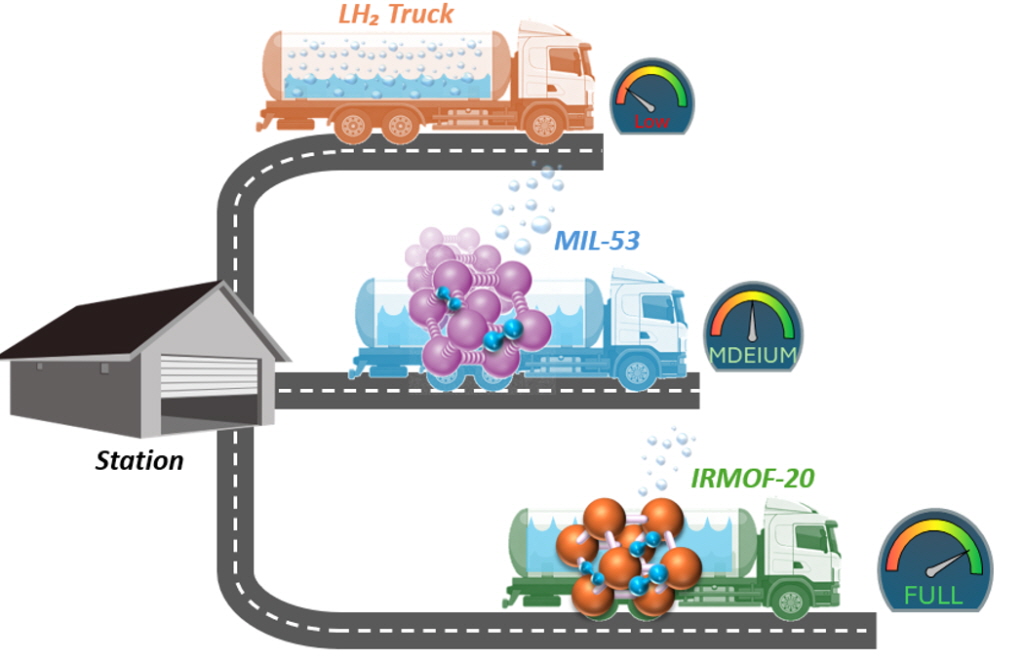
UNIST suppresses vaporization losses while maintaining 97% of liquefied hydrogen storage capacity
A research team led by Professor Oh Hyun-cheol from the Department of Chemistry at UNIST, in collaboration with Professor Moon Hoe-ri from Ewha Womans University and researchers from the Technical University of Munich in Germany, has verified technology that reduces boil-off loss occurring during liquefied hydrogen transportation and storage by utilizing metal-organic frameworks (MOF).
2026.09.30by 배종인 기자
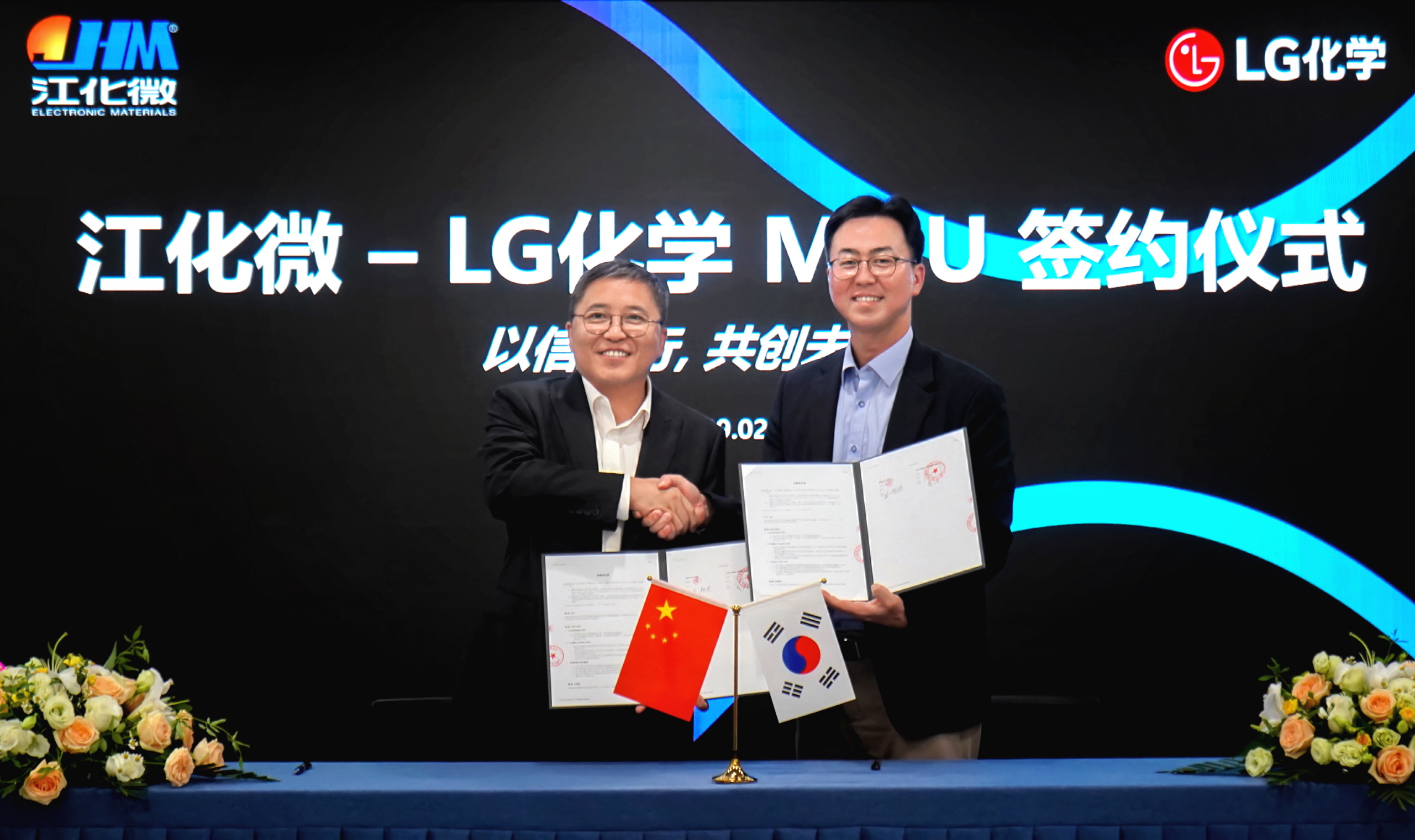
LG Chem Expands Semiconductor Cleaning Materials Business…Collaborates with China's Jianghua Wei on Ultra-high Purity IPA
LG Chem is moving to expand its ultra-high purity IPA (isopropyl alcohol) business, a core material for semiconductor processes. The company is building a local supply system in collaboration with a Chinese precision chemical company and strengthening its market strategy for AI semiconductors and advanced memory.
2026.09.14by 배종인 기자











