



KETI Prevents Electric Vehicle Fires with All-Solid-State Battery Protection Layer Technology
 Published2024.09.10 11:02
.jpg)
▲Schematic diagram of a lithium metal all-solid-state battery and battery performance evaluation results.
The Korea Electronics Technology Institute (KETI, President Shin Hee-dong) has developed a technology that increases the energy density of all-solid-state batteries while ensuring safety, which is expected to significantly contribute to reducing the risk of electric vehicle fires in the future.
KETI announced on the 5th that it had successfully developed a lithium metal protective layer technology that increases the energy density and stability of all-solid-state batteries together with the team of Professor Yoo Dong-ju of Korea University and the team of Professor Yoon Won-seop of Sungkyunkwan University.
All-solid-state batteries, unlike conventional lithium secondary batteries, are composed of solid electrolytes, so they are safe and have the advantage of high energy density, eliminating the risk of explosion. Therefore, there is currently fierce national R&D competition for commercialization of the technology.
Among them, lithium metal anodes are the optimal material with higher energy density than existing graphite anodes, but they have problems such as side reactions occurring between the electrolyte and lithium metal, and dendrites forming on the surface of the anode during charging, which increases the risk of fire such as battery explosion and reduces the battery lifespan.
KETI's Next-Generation Battery Research Center (Director: Ji-Sang Yoo) developed a lithium metal protective layer with high ionic conductivity using nanoparticle silicon powder, ultimately improving the output performance of lithium metal all-solid-state batteries.
According to Researcher Lee Geung-jong and Dr. Choi Seung-ho (senior researcher) who led the technology development, nano-sized silicon powder It was confirmed that the composed protective layer can effectively suppress dendrite growth on the cathode surface by forming lithium metal and a silicon-lithium alloy.
Furthermore, the alloy protective layer technology developed through this study was applied to the manufacturing process to ensure safety in high-output environments, and the commercial viability of the technology was proven through pouch-type cell verification.
The research results were published in the latest issue* (published in August) of ACS Energy Letters (IF=19.3), a renowned international academic journal in the field of energy chemistry.
KETI Next Generation Battery Research Center Director Yoo Ji-sang (corresponding author) said, “In order to increase the energy density of all-solid-state batteries, the application of lithium metal anodes is essential, but the lithium dendrite phenomenon has been a major obstacle to battery development.” He added, “The lithium metal protective layer technology developed by KETI researchers is expected to become a key technology for improving the performance of all-solid-state batteries as it can be applied to large areas in the future.”
Meanwhile, this research result was developed through the Automotive Industry Technology Development Project supported by the Ministry of Trade, Industry and Energy and the Korea Institute of Industrial Technology Planning and Evaluation, and the STEAM Research Project promoted by the Ministry of Science and ICT and the National Research Foundation of Korea.

Comments
Related news
KETI, KEIT, and Solid Power Join Hands to Preempt Next-Generation Battery
The Korea Electronics Technology Institute (KETI, Director Shin Hee-dong) has signed a trilateral memorandum of understanding with the Korea Institute of Industrial Technology Evaluation and Planning (KEIT, Director Jeon Yun-jong) and U.S. solid-state battery company Solid Power Inc. (CEO John Van Scoter) to strengthen global R&D cooperation in the next-generation battery sector.
2023.11.20by 배종인 기자

Korea-US Solid Power Discusses Next-Generation Battery Cooperation Plan
The Ministry of Trade, Industry and Energy (hereinafter referred to as the Ministry) discussed battery sector cooperation plans with Solid Power, a U.S. company that possesses leading technologies in the all-solid-state battery field, which is referred to as the "dream battery," and shared the status of cooperation initiatives with Korea.
2024.01.18by 성유창 기자

Ministry of Trade, Industry and Energy to Invest 117.2 Billion Won in Development of Promising Batteries, Including All-Solid-State Batteries
The government plans to invest a total of 117.2 billion won by 2028 to develop three promising battery technologies including all-solid-state, lithium-metal, and lithium-sulfur batteries, and it is expected that all three major battery manufacturers will participate.
2024.03.12by 성유창 기자
Electrochemical Research Institute, “All-Solid-State Battery Solid Electrolyte Cost Halved, Quality Doubled”
The Korea Electrotechnology Research Institute (KERI) has made groundbreaking research achievements in advancing the commercialization of all-solid-state batteries free from explosion and fire hazards, with results published in a prestigious international academic journal. Dr. Park Jun-woo and researcher Seong Jung-hwan (student researcher at UST KERI Campus), both belonging to KERI's Next-Generation Battery Research Center, have developed a "solid electrolyte (sulfide-based) particle size control and wet synthesis process" technology that reduces process steps and costs to less than half while improving product quality by more than twofold.
2024.03.18by 배종인 기자
“Achieving high performance and high energy density in all-solid-state batteries”
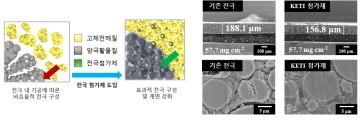
The Korea Electronics Technology Institute (KETI, Director Shin Hee-dong) has developed additive technology for dry electrodes that improves the energy and output characteristics of all-solid-state batteries, and the research results have been published in an internationally renowned academic journal.
2024.04.17by 배종인 기자











