



Heat pumps must become a key industry
 Published2024.09.13 08:55
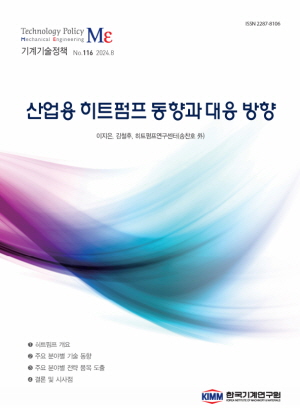 Amid growing concerns about the global climate crisis and the urgency to achieve carbon neutrality, support for the heat pump sector has been suggested as crucial.
The Korea Institute of Machinery and Materials (President Ryu Seok-hyun), under the Ministry of Science and ICT, published Machinery Technology Policy No. 116, “Industrial Heat Pump Trends and Response Directions,” which contains trends in the heat pump market and policies, as well as strategic items by major sector.
Heat pumps are eco-friendly devices that absorb heat from low-temperature sources and transfer it to high-temperature ones. They offer significant growth potential in terms of reducing fossil fuel dependence, improving energy efficiency, and achieving sustainability. They are attracting attention as a key device for achieving carbon neutrality. They convert unused energy sources like air, rivers, wastewater, and waste heat, as well as renewable energy sources like geothermal heat and solar heat, into advanced energy sources.
Considering the role of the research institute and the synergy with the industry, the research team selected four key technology fields for heat pumps: △industrial heat pumps, △Carnot batteries, △unused energy heat pumps, and △thermal energy networks. They analyzed technology trends and issues in each field to derive strategic items.
An industrial heat pump is a device that produces and supplies high-temperature steam of 100℃ or higher required for industrial processes using waste heat or unused heat sources. As strategic items, we have identified small and medium-sized industrial steam heat pumps using screw compressors and large-capacity turbo heat pumps using MVR (Mechanical Vapor Recompression).
Carnot batteries store large amounts of surplus electricity as high-temperature thermal energy (over 300°C), converting it into electricity when needed to act as a buffer between high-temperature heat supply and demand. Strategic products include high-temperature heat pump systems utilizing natural refrigerants, high-temperature solid-state heat storage technology, and long-cycle Carnot battery ESS (Energy Storage System) technology.
The unused energy heat pump, with its added heat recovery system, supplies heat based on the characteristics of the heat source and the temperature range of the demand location. A renewable heat source hybrid low-GWP (Global Warming Potential) refrigerant heat pump and a natural refrigerant cooling device-based water- and geothermal hybrid data center cooling system were presented as strategic technologies.
Thermal energy networks are a technology that aims to improve energy efficiency by addressing the imbalance between thermal energy production and demand. They can extend beyond simple thermal energy source sharing to encompass energy trading. The development of thermal energy trading technology utilizing industrial waste heat and the demonstration of a thermal energy network are key strategies.
Heat pumps are attracting attention as a high-efficiency, eco-friendly energy conversion technology that can replace existing heat supply systems. The research team emphasized the need for domestic development of promising heat pump technologies and the leading development of core technologies to prepare for future markets. He also added that it is necessary to strengthen the ecosystem through heat pump demonstrations in cooperation between industry, academia, and research institutes based on technological strengths in core heat pump components such as heat exchangers and compressors.
In particular, Lee Ji-eun, a senior researcher at the Korea Institute of Machinery and Materials' Machinery Policy Center, said, "We need to make preemptive efforts to secure the Asian market, where the market is expected to expand from heating and cooling to non-residential heat pumps, and the European market, where growth is high due to the transition from small boilers to heat pumps."
Meanwhile, the Korea Institute of Machinery and Materials' Heat Pump Research Center, under the slogan "The Heat Pump Research Center that Moves All the Heat in the World," aims to provide total heat energy solutions. It is comprised of four working groups (system research, core equipment technology, heat pump application and innovation, and heat energy conversion) and two operating groups (heat pump roadmap, external cooperation and public relations). The center plans to establish a "Heat Pump Technology Development Roadmap" that outlines short-, mid-, and long-term strategic action plans for each item by 2040.
The Korea Institute of Machinery and Materials publishes "Machine Technology Policy," a specialized journal that analyzes trends in the machinery industry and proposes policies, at least three times a year. Subscriptions and downloads can be made on the KIMM website.
.jpg)

Comments
Related news
Biosensor that rapidly detects minute amounts of protein using light
A joint research team led by Professor Lee Jong-won from the Department of Electrical and Electronic Engineering at UNIST (President Park Jong-rae) and Dr. Jung Joo-yeon from the Nanolithography Research Center at Korea Institute of Machinery and Materials (Director Ryu Seok-hyun) has developed a novel biosensor that dramatically improves protein detection sensitivity.
2024.07.11by 배종인 기자
Achieving carbon neutrality with eco-friendly refrigerants that are 100 times cheaper
A senior researcher Kim Jung-chul at the Heat Pump Research Center of the Korea Institute of Machinery and Materials (Director Ryu Seok-hyun), under the Ministry of Science and ICT, has domestically developed for the first time the foundational technology of an eco-friendly water refrigerant cooling system capable of cooling or transferring heat using water as a refrigerant.
2024.07.26by 배종인 기자
.jpg)
Materials Research Institute and Mechanical Research Institute Pour Warm Water for Research Cooperation
The Korea Institute of Materials Science (KIMS, Director Choi Chul-jin) and Korea Institute of Machinery and Materials (KIMM, Director Ryu Seok-hyun) held the "2024 First Machinery-Materials Research Collaboration Exchange Meeting," a communication forum for the smooth implementation of their "Collaboration Priming Project" for research cooperation.
2024.07.29by 배종인 기자
.jpg)
Machinery and Materials Research Institute, Nano-Chemical Research Institute, Join Hands for 300mm Semiconductor Packaging Infrastructure
The Korea Institute of Machinery and Materials (President Ryu Seok-hyun) and the National Nano Fabrication Center (President Park Heung-su) have joined forces to establish advanced packaging infrastructure for 300mm semiconductors and develop related technologies.
2024.08.01by 배종인 기자
Korea Machinery Research Institute, expanding domestic gear train base
The Korea Institute of Machinery and Materials (KIMM) under the Ministry of Science and ICT, headed by Director Ryu Seok-hyun, jointly hosted the "2024 KIMM Gear Train Conference" with the Gear Train Research Group of the Korean Society of Mechanical Engineers on August 13-14.
2024.08.19by 배종인 기자











