



“Trump 2nd term US trade policy monitoring strengthened 'necessary to prepare for high prices, high interest rates, strong dollar'”
 Published2025.01.21 10:40
.jpg)
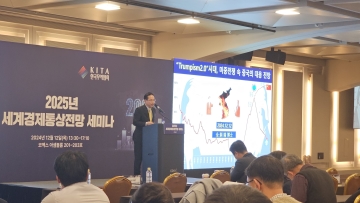
▲Lee Si-wook, director of the Korea Institute for International Economic Policy, is presenting the world economic outlook for 2025.
Semiconductors Need New Growth Engines as Short-Term Reflection Profits and Mid- to Long-Term Difficulties
Short-term impact on automobiles inevitable, Korea benefits from increased demand for ships, nuclear power plants, and bio in the US
“As there is a risk of rising prices and heightened instability in the financial system in the U.S. due to Trump’s second-term economic stimulus package and tariff hikes, our country should actively respond by strengthening monitoring of the new U.S. administration’s trade policies and establishing response plans for each scenario.”
The Korea Industrial Technology Promotion Association held a seminar on ‘2025 Trade Conditions and World Economic Outlook’ at the E-Tower on January 16.
Lee Si-wook, president of the Korea Institute for International Economic Policy, who made the announcement that day, predicted that the world economic growth rate in 2025 will be 3.0, which is almost the same as 3.1 in 2024.
With the US leading the global economy with modest growth, India and ASEAN are expected to recover to pre-COVID levels.
The U.S. is expected to have a generally stable year, with a healthy job market, consumer spending still strong, and government fiscal spending and investment plans in place.
On the other hand, the EU is expected to grow by 1.3% in 2024 due to the base effect, which is higher than Germany's Due to the economy, Germany is expected to have a growth rate in the 0% range as exports are sluggish and its dependence on foreign energy sources is growing.
China is expected to see a large decline due to a decline in domestic demand caused by sluggish consumption.
Interest rates were expected to decline gradually amid increased volatility due to high uncertainty, and the exchange rate was expected to see a easing of dollar strength amid pressure from a strong dollar and a U.S. rate cut.
Oil prices are expected to show increased volatility due to Middle East risks, but a mild downward trend is expected.
2025 is the year that Donald Trump takes office, and Trump's second-term trade policy is expected to have a major impact on the global economy.
The Trump administration's economic policies focus on revitalizing manufacturing, creating jobs, and stabilizing prices through comprehensive tax cuts, deregulation, protectionism, increased energy independence, and cracking down on illegal immigration.
Director Lee Si-wook said that there will definitely be trade measures after President Trump takes office, but the substance of these measures has not yet been clearly revealed. He mentioned that there is talk of raising an additional 25% tariff on Canada and Mexico, and imposing the same 25% tariff on China, but it is uncertain whether these will be implemented.
In particular, with regard to why tariffs among numerous trade measures, comprehensive audits, energy, and border measures require congressional approval, while tariffs can be implemented with just an executive order, and it is analyzed that this is advantageous in terms of securing the votes of voters with anti-globalization sentiment, resolving trade imbalances, correcting unfair trade practices of other countries, restoring manufacturing jobs, and securing fiscal revenue.
However, considering the concerns raised in the U.S. that tariff increases will put upward pressure on prices, the administration will focus all its efforts on core policies such as tax cuts and deregulation in the early days of its term, and will use universal tariffs as a means of pressuring trade for the time being, and then decide whether to implement them after a certain period of time, taking into account macroeconomic conditions such as prices.It was expected that a decision would be made.
In relation to this, it is estimated that the total export amount of Korea will decrease by up to 44.8 billion dollars due to the impact of Trump's tariff policy on the Korean economy.
In response, Director Lee Si-wook requested that Korea be excluded by emphasizing that Korea is a country that will sign an FTA agreement, and suggested that Korea should invest heavily in various cooperative demands from the United States and pursue policies to avoid tariffs while diluting European issues.
In particular, looking at the ranking of trade surplus with the United States, there is a positive outlook that it may be able to avoid damage primarily because it is ranked after Mexico, Vietnam, Canada, Japan, and Taiwan.
Looking at the impact on our country's major industries, semiconductors may see a short-term windfall from the US's export controls, but in the medium to long term, Chinese semiconductors are likely to quickly replace our country's products, so it appears necessary to focus on investing in the AI chip and high-performance memory markets to secure new growth engines.
Automobiles are expected to take a hit in the short term, but growth is expected in the long term due to infrastructure expansion and falling battery production costs.
Shipbuilding and maintenance/repair fields are very promising, but the revision of the Jones Act in 1920 is important, and as nuclear power plants are inevitably developing due to the surge in demand for electricity, joint development and export cooperation of SMRs using American design technology and Korean manufacturing technology are expected to be promising.
Bio is expected to benefit CDMO companies in Korea due to the enactment of the Biosecurity Act, and the bio-replicant sector is also expected to be promising due to the drug price reduction policy.
Director Lee Si-wook said, “Considering the low external dependence of the United States, if the solid growth continues through tax cuts and infrastructure investment and prices stabilize, it is likely that aggressive trade policies such as imposing universal tariffs will continue for a certain period of time.“There is a possibility that a second Trump term will fan inflation in the U.S. with stimulus measures and tariff hikes, worsen the national debt problem, and heighten the instability of the financial system. This could also act as a downside risk that would weaken the growth of the U.S. and global economies by reproducing the situation of ‘high prices, high interest rates, and a strong dollar,’” he said.
Accordingly, it is expected that our country will have to strengthen monitoring of the new U.S. administration's trade policy and establish response measures for each scenario to respond.
He also argued that “our major corporations that have led the global market for the past several decades are now in a situation called the ‘innovator’s dilemma’ where they are failing to achieve sufficient competitiveness or innovation and their market dominance is being eroded by the technologies of latecomers such as Chinese companies,” and that “systematic policy design and implementation are needed to capture new industrial and technological opportunities and strengthen industrial competitiveness through close communication and cooperation between the public and private sectors from a mid- to long-term perspective.”

Comments
Related news
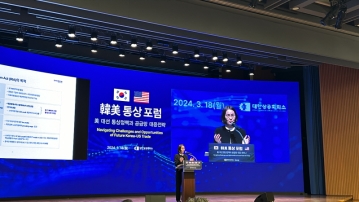
“Even Trump can’t immediately abolish the IRA”
Even if former President Trump wins the upcoming U.S. presidential election, the likelihood of the IRA being immediately repealed is very low, though experts have raised a consensus view that the electric vehicle transition trend could be somewhat delayed.
2024.03.21by 성유창 기자
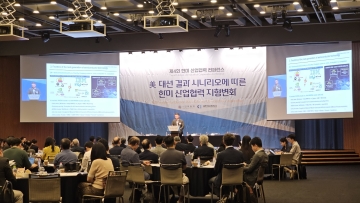
Harris vs. Trump, Semiconductor Industry Watches Election Results
With the semiconductor industry emerging as a core national competitive advantage in the race for AI-era hegemony, the industry is closely monitoring the direction of the U.S. presidential election in November. Industry officials gathered together as venues were established to anticipate scenarios based on the election outcome and discuss countermeasures.
2024.09.24by 권신혁 기자
[Contribution] Professor Kim Pil-su of Daerim University, “Trump’s Re-election Strengthens Protectionism, and the Automobile Industry Must Prepare”
President Donald Trump's election as the 47th President of the United States has prompted Kim Pil-su, professor at Daelim University, to share his perspective on the potential impact on Korea's automotive industry.
2024.11.07by 명세환 기자
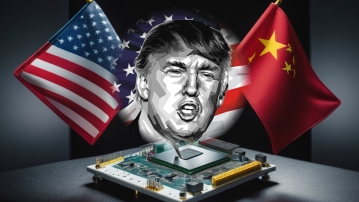
Trump 2nd term, electric car and battery blue
Donald Trump, the vanguard of America First, has won the 2024 U.S. Presidential election for his second term as the 47th President, making a "Trump 2.0" era increasingly likely. In the U.S. Congressional elections, as of 7 a.m. Korean Standard Time on the 7th, Republicans have successfully secured a majority in the Senate, and the Republicans are expected to hold a majority in the House as well. With the Trump administration controlling both Congress and the executive branch, significant transformations in trade relations are anticipated in the △semiconductor △automotive △energy industry sectors going forward.
2024.11.07by 권신혁 기자
US-China Trade War Season 2, “Korea, Raw Material Risk Far Higher than Exports”
As the Trump second term approaches, the prelude to another U.S.-China trade war is taking shape. While major domestic manufacturing industries such as semiconductors, batteries, and electric vehicles are expected to be affected, industry experts have gathered to provide key insights into the upcoming 2025 trade environment.
2024.12.13by 권신혁 기자











