



We will make a battery that lasts 1,000 km without explosions
 Published2025.03.18 09:00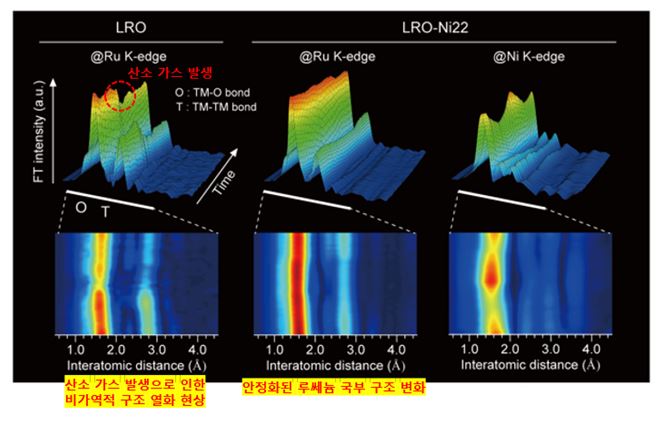
▲ Analysis of real-time local structural changes during charge and discharge of nickel-substituted cathode materials
A technology has been developed that suppresses oxygen gas generation in lithium-rich cathode materials, enabling the creation of a battery capable of driving 1,000 km without fear of explosion, and it is expected that the development of long-range driving batteries will become a reality in the future.
UNIST announced on the 18th that a team led by Professor Hyun-Wook Lee of the Department of Energy and Chemical Engineering has identified the cause of oxygen generation in lithium-ion materials, a new cathode material for batteries, and proposed material design principles to solve this problem.
Lithium-rich materials are theoretically capable of storing 30% to 70% more energy in batteries than conventional materials through high-voltage charging of 4.5V or higher.
In terms of electric vehicle driving range, it means it can travel up to 1,000 km on a single charge.
On the other hand, this material has a problem in that the risk of explosion increases as oxygen (O-2) trapped inside the material is oxidized and released in gaseous form (O2) during the actual high-pressure charging process.
The research team analyzed that oxygen gas is released as partial structural deformation occurs as oxygen is oxidized around 4.25V, and proposed an electrode material design method that fundamentally prevents this oxidation of oxygen.
Some of the transition metals in lithium-ion materials are electrons with lower electronegativityIt is a strategy of substituting with a metal element.
Due to the difference in electronegativity between the two metal elements, electrons accumulate around the element with higher electronegativity, increasing the number of available electrons in the transition metal and preventing oxygen from being oxidized.
On the other hand, in situations where the number of available electrons for transition metals is insufficient, oxygen gives up its electrons and is oxidized, being released in gaseous form.
First author Dr. Minho Kim of UNIST (currently a postdoctoral researcher at UCLA, USA) explained, “While previous research focused on stabilizing oxidized oxygen to prevent it from being released in gaseous form, this study is distinguished by its focus on preventing the oxidation of oxygen itself.”
In addition, such changes in electron density can increase the charging voltage through an inductive effect, thereby achieving high energy density.
Since energy density is proportional to the number of available electrons and the charging voltage, a strategy of substituting transition metals enables the storage of more energy per unit weight of the battery.
It is a principle similar to how more energy is stored in a dam the more water it has and the greater the drop in elevation.
The research team experimentally confirmed the oxygen oxidation inhibitory effect of the transition metal substitution strategy.
Accelerator-based X-ray analysis results showed that oxygen gas generation was significantly reduced when a portion of the ruthenium was replaced with nickel. In addition, it was theoretically proven that charge redistribution occurs through density functional calculations (DFT).
This research was conducted jointly by Professor Donghwa Seo of KAIST, Chung-Ang University, Pohang Accelerator Laboratory, Professor Yuzhang Li of UCLA, UC Berkeley, and Lawrence Berkeley National Laboratory.
Accelerator-based X-ray analysis was conducted by Professor Haeseong Jang of Chung-Ang University (co-first author), and the theoretical DFT calculations were led by Dr. Eunryul Lee of Lawrence Berkeley National Laboratory (co-first author).
Professor Lee Hyun-wook stated, “By creating a technology library through various experiments and theoretical analyses, we have presented a direction for material development to cathode material researchers,” adding, “This will be helpful in developing explosion-free, long-range battery materials with increased energy density.”
This research was conducted with the support of the National Research Foundation of Korea's International Cooperation Development Project for Original Technology, and the results were published online on February 19 in 'Science Advances,' a sister journal of 'Science,' a world-renowned journal published by the American Association for the Advancement of Science (AAAS).
Comments
Related news
.jpg)
Nordic significantly extends primary cell-based Bluetooth battery life
Nordic Semiconductor has launched a new power management IC (PMIC) model, the nPM2100. This product is equipped with an ultra-high efficiency boost regulator and various energy-saving features, enabling significantly extended battery life for primary battery-based Bluetooth Low Energy devices.
2025.02.05by 배종인 기자
Performance of 4 Korean Battery Companies Surges... Red Light for Deficit in 2024
The 2024 performance of Korea's leading battery companies is becoming clear. Operating profit declined 70-80% year-over-year and some companies posted losses, vividly demonstrating the downturn in the electric vehicle and battery markets. #LGEnergySolution #Geumyang #Battery #ElectricVehicle #EV #SamsungSDI
2025.02.24by 권신혁 기자
L&F, 'High-Nickel Composite Cathode Active Material' Wins Interbattery Awards
Global secondary battery materials company L&F received the honor of an award in the materials and components category at the InterBattery Awards 2025 held at COEX on the 24th for its high-nickel composite cathode active material.
2025.02.25by 명세환 기자
LNF Participates in 'Interbattery 2025'… Proves Leadership in LFP Cathode Material Technology
L&F will participate in 'InterBattery 2025' held at COEX from March 5-7 and showcase next-generation battery material technology and global production systems.
2025.02.27by 배종인 기자
.jpg)
Interbattery 2025, the largest ever… Trumpism and Chasm Breakthrough in One Voice
The electric vehicle and battery-related industries have experienced a downturn, resulting in poor performance from the country's top three battery makers last year. However, Korean companies are steadfastly preparing for the future of electrification ahead. At Inter Battery, Korea's largest battery exhibition, market-leading companies showcasing cutting-edge technological capabilities gathered in one place, filling the entire COEX venue.
2025.03.05by 권신혁 기자











