



“Digital transformation in manufacturing requires cloud-based edge computing”
 Published2025.03.18 12:31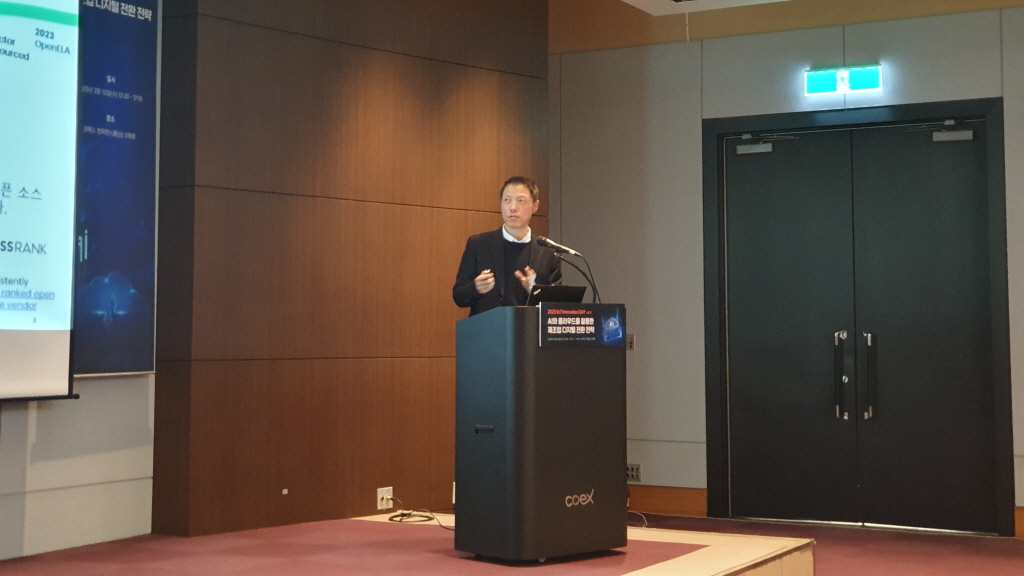
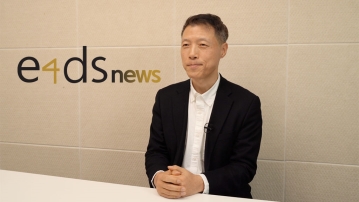
▲Recently, Hong Su-se Korea CEO is giving a presentation at the '2025 e4ds IIoT Innovation Day_Part2' event.
Factory-unit distributed data center environment, solving latency issues
“The digital transformation of manufacturing cannot be achieved simply with centralized cloud technology. To realize the digital transformation of manufacturing, a technological foundation that can process and control data in real time at the closest location to the site is essential. SUSE is supporting the manufacturing industry’s realistic digital transformation strategy with solutions that meet these technical needs.”
Choi Geun-hong, CEO of Suseo Korea, gave a presentation on the topic of 'Cloud-native based edge solutions for smart manufacturing industry in the AI era' at the '2025 e4ds IIoT Innovation Day_Part2' event held at COEX in Samseong-dong, Seoul on the 12th.
CEO Hong Geun-hye said that while the introduction of AI and cloud technologies is rapidly driving the digital transformation of the manufacturing industry, an appropriate application strategy is essential for these technologies to actually be effective in manufacturing sites.
He continued by saying that the digital transformation of the manufacturing field is mainly manifested in two areas: predictive AI and generative AI. Predictive AI helps increase the efficiency of the production process and reduce the defect rate by analyzing data collected in the field, while generative AI goes beyond improving existing processes and enables entirely new ways of designing and producing products, accelerating innovation in the manufacturing industry.
In order for these AI technologies to be effectively utilized, 'edge computing' technology that can process data immediately at the closest location to the site is essential, he argued, and in an edge computing environment, fast data processing speed and stable operation are key, and limited computing resources must be managed efficiently.
In this regard, companies that have applied SUSE's edge computing solutions were cited as examples.
Global automaker BMW has been experiencing production efficiency issues due to latency issues that occur when logistics robots transport parts within its factories.
Previously, commands were given from the central cloud of the headquarters.The robot was operated in a way that caused problems such as robot collisions or departure due to network delays.
To address this, SUSE has built a distributed data center environment based on cloud native technology on a factory-by-factory basis.
By deploying containerized applications on edge computing resources within each factory, real-time control and data processing of robots became possible, which ultimately solved the delay problem and ensured production stability.
Continental, another global auto parts manufacturer, was experiencing management complexity and increased costs as developers spread across the world developed software in different environments.
Since adopting SUSE's cloud-native container technology, we have significantly improved the efficiency of our development environment, reducing software upgrade and deployment times by more than 80% compared to before.
In the case of industrial equipment manufacturer Krone, the company has adopted an approach in which the system software for processing data is embedded in the production equipment it supplies to factories.
The company has enabled predictive maintenance by collecting, storing and analyzing data from its production facilities in real time on-site through SUSE's edge solutions.
This has resulted in reduced facility maintenance costs and improved the operating rate and quality of production facilities.
These cases show that appropriate use of edge computing technology is essential for the successful application of AI and cloud technologies in manufacturing sites.
In particular, the edge computing environment required in manufacturing sites faces various challenges, such as data processing speed (latency), limited computing resources, and management of various hardware and software, unlike the general cloud environment.
The SUSE solution is automated and tailored to each site. It has the advantage of being easy to deploy and manage, and guaranteeing high performance and stability even in environments with limited computing resources.
Another distinguishing strength is that it can consistently manage thousands of computing resources through a central management system even in large-scale distributed environments.
Founded in 1992 in Nuremberg, Germany, SUSE provides solutions optimized for cloud native environments based on 33 years of accumulated technology in the Linux and open source fields.
Recently, it has expanded its scope to include technologies that support not only Linux OS but also Kubernetes containers and edge computing environments.
Choi Jin-hong, CEO of Suse Korea, said, “Suse’s cloud native-based edge computing technology is contributing to the digital transformation of manufacturing sites by providing an automated distribution and management system for software, including OS and Kubernetes container technology.”
Comments
Related news

SUSE Strengthens Enterprise Security with Open-Source Cloud-Native Solutions
SUSE has announced open-source cloud-native solutions and is moving forward with strengthening enterprise security.
2022.06.09by 배종인 기자
SUSE Launches Carrier-Optimized Edge Computing Platform
SUSE®, a global leader in innovative, open, and secure enterprise-grade solutions, launches an edge computing platform optimized for building future infrastructure such as 5G and open frameworks, supporting telecommunications carriers' future network environments.
2023.02.09by 배종인 기자
SUSE, Kubernetes Platform Rancher 2.7.2 Update
SUSEⓇ, a global leader in innovative, reliable and secure enterprise-grade open source solutions, is updating the latest version of Rancher, a Kubernetes management platform, and is moving forward to promote ecosystem adoption with enhanced scalability and improved security posture.
2023.04.19by 배종인 기자
SUSE, “SUSE Linux with Trust Will Double in 3 Years”
Joseph Garcia, President of SUSE Asia/Pacific, visited Korea to support existing Korean customers and announced plans to achieve more than double growth over the next three years in Korea.
2023.11.17by 배종인 기자
Choi Jin-hong, CEO of SuSe Korea - “Complex hybrid cloud ‘SuSe’ solves it all at once”
We met with Choi Jin-hong, the recent branch manager of SUSE Korea, to discuss cloud management solutions in manufacturing environments and SUSE's domestic market strategy.
2024.03.19by 김예지 기자











