


Semiconductor safety standard 'SEMI S2' published in Korean, with experts from Samsung and SK Hynix participating to accelerate field implementation.
 Published2025.07.03 09:34
The latest Korean translation of 'SEMI S2,' a core safety standard for the global semiconductor industry, has been released, and it is expected that the latest safety standards will be immediately applicable to the field in all areas of semiconductor manufacturing equipment design and safety evaluation.
The Semiconductor Equipment and Materials International (SEMI) announced on the 2nd that it will translate and distribute the revised version of SEMI S2-0724 so that domestic practitioners can easily and accurately understand and apply it.
The high barrier to entry for semiconductor equipment manufacturers and small and medium-sized partners, which had previously been provided only in English, has been resolved.
SEMI S2 is an international standard applicable to all areas of design and safety evaluation of semiconductor and display manufacturing equipment. It details safety requirements for mechanical, electrical, and gas systems to reduce the risk of fire, electric shock, and explosion, as well as emergency stop and interlock functions.
It is being used as an essential guideline in large fabs and research institutes at home and abroad.
A total of 26 experts in the equipment, testing, and certification fields participated in this translation project, including five EHS (safety, health, and environment) experts from Samsung Electronics and SK Hynix, as well as Applied Materials, ASM, ASML, ICR, KTR, PCA, Safe World Engineering, Salus Engineering International, Tokyo Electron, and Wonik IPS.
The working group organized by SEMI Korea will hold regular meetings for four months starting in March of this year. We conducted a review of terminology unification and accuracy of expression, as well as field tests.
The translation faithfully reflects the major revisions to SEMI S2-0724.
The detailed requirements for eight areas, including High Pressure Systems, Equipment Decommissioning, Fire Protection, Flammable Substances, SEMI S30 (Energetic Materials), Lifting Equipment and Hinged Loads, and Safety Labels, are clearly explained in Korean terms.
Practitioners can intuitively understand the obligations and application cases for each provision.
“This translation corrects existing errors and is designed to immediately reflect the latest safety standards in the field,” said Nam Seung-kyung, senior project leader at ASM. “It will significantly reduce the confusion in interpretation that practitioners experience during the design and evaluation process.”
PCA Manager Park Hyeon-jun also emphasized, “We will support small and medium-sized partner companies to easily understand SEMI S2, shorten the certification and evaluation period, and reduce costs.”
SEMI has established a total of 30 safety standards for the semiconductor and display industries over the past 50 years, and S2 is recognized as a core document among them.
Since 2013, SEMI has published six standard Korean translations, including S6, S10, S14, S21, S23, and S29, and has released a total of seven documents, including this translation.
The Korean translation is available free of charge on the SEMI official website (www.semi.org) and through the SEMIViews subscription service.Ram can be downloaded.
It will also be distributed through the official channels of SEMI Korea and the Korea Semiconductor Industry Association (KSIA), and will be used as a key reference material when establishing future national standards (KS).
A SEMI official said, “With the release of the Korean translation, the level of domestic semiconductor equipment safety management will be significantly improved and the efficiency of the certification and evaluation process will be greatly enhanced.”

Comments
Related news
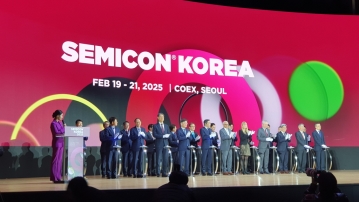
SEMICON Korea 2025 Opens, Previewing the Changes and Opportunities Ahead of AI-Reshaping the Semiconductor Industry
Semicon Korea 2025 will be held for three days from February 19 to 21 at Seoul COEX. As the global semiconductor supply chain faces enormous changes due to AI's rapid advancement, the semiconductor festival has opened its doors as a venue where industry trends and new opportunities can be identified. This year, the event will be held at its largest scale ever, utilizing not only COEX's A, B, C, D, and E halls, but also additionally the Grand Ballroom and Platz.
2025.02.19by 명세환 기자
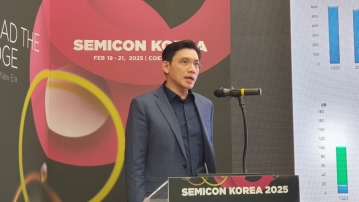
“Korean semiconductors to continue growth with increased investment in AI and HPC”
Clark Tseng, director at SEMI, forecast at a press briefing for Semicon Korea 2025 held on February 19th that Korea's semiconductor industry will continue to grow driven by AI and HPC demand.
2025.02.24by 배종인 기자
.jpg)
Global Silicon Wafer Sales to Reach $11.5 Billion in 2024… 7% Down YoY
SEMI, an industry association representing the global electronics industry supply chain, announced on the 26th that global silicon wafer shipments in 2024 recorded 12.266 billion square inches, down 2.7% year-over-year, and revenue totaled $11.5 billion, a decrease of 6.5%.
2025.02.26by 권신혁 기자
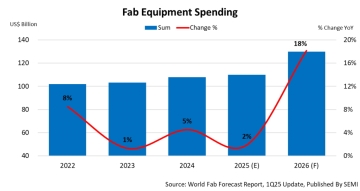
“Global semiconductor equipment investment to exceed $110 billion by 2025”
According to the latest 'World Fab Forecast' report from SEMI (Semiconductor Equipment and Materials International), a representative organization of the semiconductor industry supply chain, front-end semiconductor manufacturing equipment spending is expected to reach $110 billion in 2025, representing a 2% increase compared to the previous year.
2025.03.27by 권신혁 기자
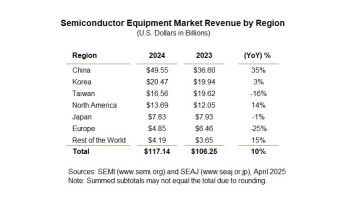
Semiconductor equipment investment in 2024 to reach $117.1 billion, up 10% from the previous year
According to SEMI, an industry association representing the global electronics industry supply chain, semiconductor manufacturing equipment investment reached $117.1 billion in 2024, representing a 10% increase compared to the previous year. The global semiconductor equipment market in 2024 achieved a record high due to various factors including increased demand for AI and high-performance computing and changes in investment policies by country.
2025.05.27by 명세환 기자











