


Arm Leads Open AI Data Center Standards, Joins OCP Board, Accelerates Chiplet Design and Integration
 Published2025.10.21 12:41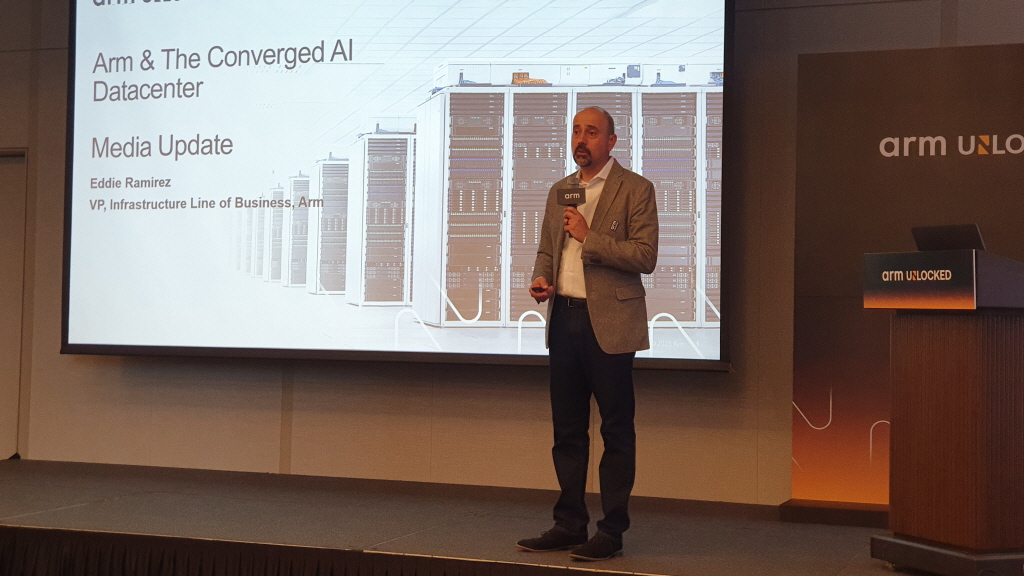
▲Eddie Ramirez, Vice President of Market Entry Strategy for Arm Infrastructure Business Unit, is giving a presentation.
Optimizing Meta Collaborative AI Workloads, Major Cloud Companies, Including AWS, Adopt ARM-Based Servers
ARM is simultaneously promoting the standardization of chiplet system architecture specifications and expanding the ecosystem, enabling diverse companies to dramatically reduce development time and costs within their respective areas of expertise and accelerate custom silicon development through an open chiplet ecosystem.
Eddie Ramirez, Vice President of Market Entry Strategy for Arm Infrastructure Business Unit, shared key trends in the AI era and ARM's strategy at the 'Arm Unlocked Seoul 2025 Media Briefing' on the 21st, suggesting the direction of the industry.
Vice President Eddie Ramirez first introduced six key trends driving AI innovation.
First, the rapid evolution of models. Following the Google Brain team's Transformer paper in 2017, ChatGPT1 emerged as a model with 100 million parameters. In just seven years, ChatGPT5 has grown by over 1,000 times, boasting 600 billion parameters. Adding to this the expansion of context windows, the computational effort required for a single query is increasing exponentially.
Second, there is an explosive demand for AI applications. There are 100 to 300 million AI app downloads every month, and ChatGPT5 recorded 52 million downloads in its first month alone.
Third, the rise of "agentic AI." AI agents are being utilized in diverse fields, including customer support, supply chain management, and content creation, at speeds surpassing human requests. To achieve this, various specialized models are operating in parallel.
These changes are also having a major impact on silicon design.
Moving away from the traditional PPA (power, performance, area)-centric design, new criteria such as latency, memory size, and input/output throughput are required.
Especially in a reality where a single AI rack consumes the same amount of electricity as 100 households, power efficiency is no longer an option but a necessity.
The changes to the data center are also noteworthy. Meta replaced the traditional reinforced concrete construction with a massive tent-style data center, shortening the construction period from three years to six months. This is a case that symbolizes the speed competition in the AI era.
ARM is strengthening its ecosystem-centric strategy in line with this trend.
Through strategic collaboration with Meta, we are driving AI workload optimization, and ARM's position is further solidified as major cloud companies, including AWS, adopt ARM-based servers.
More than half of the servers currently deployed on AWS are ARM-based, making ARM instances the least expensive cloud option.
ARM is also accelerating the development of chiplet-based custom silicon through its 'Total Design' program.
Chiplets are a method of combining modules designed by various companies based on their respective areas of expertise, which can drastically reduce development time and costs.
ARM recently joined the board of directors of the Open Compute Project (OCP), along with AMD and NVIDIA.
This is a strategic move by Arm to drive open standards for AI data centers, and it will collaborate with Meta, Google, Intel, and Microsoft on designing next-generation infrastructure.
Arm defines the integrated AI data center as the next-generation infrastructure, aiming to maximize AI computing efficiency per unit area to reduce power consumption and costs.
To this end, we are pursuing joint design across computing, accelerators, memory, storage, and networks.
Arm® Neoverse™ is a core technology across all layers of the AI stack, enabling a wide range of optimizations from data tokenization to AI model execution, and applications in scientific, medical, and commercial sectors.
In particular, Arm is also accelerating the expansion of its chiplet-based AI silicon supply chain.
On this day, Arm announced that it is contributing the vendor-neutral and open Foundation Chiplet System Architecture (FCSA) specification to OCP.
This accelerates chiplet design and integration without being tied to a specific CPU architecture, and serves as the foundation for large-scale reuse and interoperability.
FCSA is based on Arm's Chiplet System Architecture (CSA), and since its launch in 2023, the Arm Total Design ecosystem has more than tripled in size.
Korean companies are also making notable progress. Samsung Foundry, AD Technology, and Rebellion are accelerating the development of AI inference chips through the "Leapfrog Project," and ARM Total Design currently has six Korean partners.
"We can move faster," said Vice President Eddie Ramirez. "The Korean ecosystem already has a strong foundation, and we anticipate even more innovation in the future."
Meanwhile, Arm held 'Arm Unlocked Seoul 2025' on the 21st. This event, a new global event series replacing the existing 'Cancer Tech Symposia', was held for the second time in Seoul following the successful inaugural event in Shanghai last month.
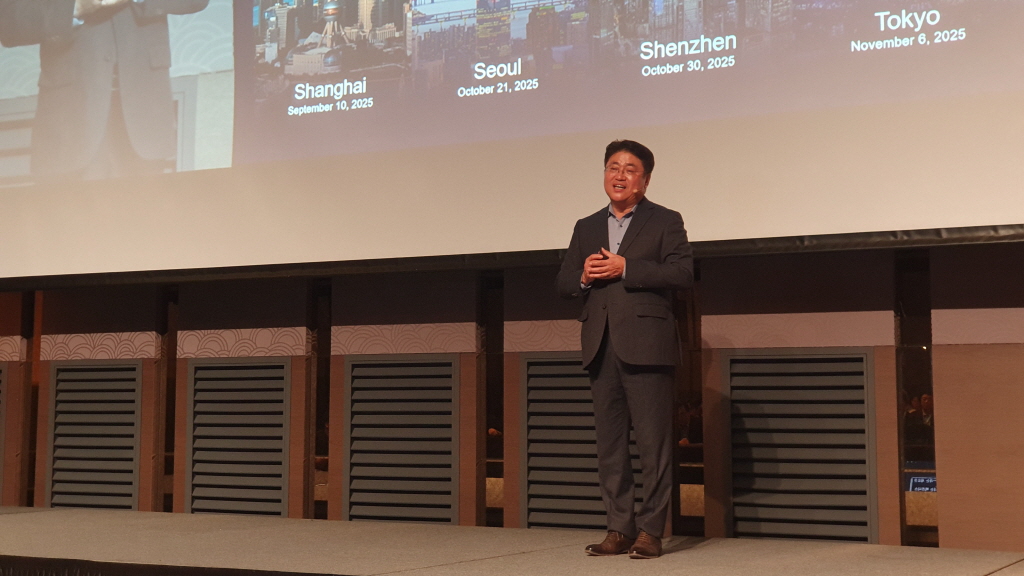
▲Arm CEO Hwang Seon-wook is giving a speech at 'Arm Unlocked Seoul 2025.'
“It is an honor to host this event in Korea, which aims to become one of the top three AI powerhouses,” said Hwang Sun-wook, President of Arm. “We are delighted to share Arm’s latest technologies and insights in the 2025 trend where AI will transform the entire technology industry.”
The event showcased key technological achievements in cancer.
Last February, the world's first 'Arm V9 architecture-based G-AI platform' was announced, which features efficient implementation of on-device intelligence through the combination of CPU and MPU.
In June, the company unveiled its AI-based vehicle computing platform through 'Automotive CSS', and in August, it unveiled 'Neural Technology', which added neural application capabilities to GPUs.
In September, the company announced its 'Lumex CSS' platform for next-generation mobile and computing devices, which it said would provide up to five times improved AI performance.
Cancer is focusing not only on technological innovation but also on strengthening partnerships.
In June, 'Arm Total Design Service&' was launched in Korea.Arm held a conference to discuss the future direction of "Arm® Neoverse™ CSS" with domestic and international design partners. In September, Arm joined the "Max Alliance," a government-led project to strengthen the AI semiconductor ecosystem. Through this initiative, Arm plans to collaborate with the Korean government and major companies to support Korea's leap forward as an AI powerhouse.

Comments
Related news
.jpg)
Arm Announces Chiplet System Architecture Public Specification
Arm, which is leading the standardization of chiplets, has announced the first public specification of CSA. The industry expects this will significantly reduce fragmentation and further accelerate the development and deployment of customized silicon solutions.
2025.02.03by 명세환 기자
Arm Unveils Cortex-A320 for Edge AI… ML Performance↑, Power Consumption↓
The IoT market is expanding consumer touchpoints as a key pillar of edge AI. In response, Arm has unveiled a new next-generation edge AI portfolio, demonstrating its technological leadership in edge AI within the IoT market.
2025.02.27by 권신혁 기자

Arm Kleidi Enters Automotive Market… Accelerating AI-Based App Performance
Today, 94% of global automobile manufacturers are using Arm technology in their latest vehicle models. As Arm platforms become increasingly prevalent across the automotive industry, implementations for major in-vehicle AI applications such as AWS, BigOne, and Sonatus have been introduced.
2025.03.13by 권신혁 기자
.jpg)
IAR Announces Commercial Support for Zephyr RTOS, A New Turning Point for Safety-Centric Embedded Development
IAR, a global leader in embedded software solutions, has recently garnered industry attention by announcing comprehensive commercial-level support for Zephyr RTOS, an open-source real-time operating system, alongside the release of version 9.70 of its toolchain for Arm.
2025.07.24by 명세환 기자
.jpg)
ARM Unveils Lumex CSS Platform, A Paradigm Shift in On-Device AI SoC Design
ARM announced its next-generation Lumex CSS (Compute Subsystem) platform, declaring a transition from a mere IP supplier to an SoC co-design partner. The platform, which offers integrated provision of CPU, GPU, system IP, and software, is evaluated as a key strategy to accelerate the on-device AI era.
2025.09.11by 명세환 기자











