


ADI Unveils Power Studio, a Complete Power System Design Suite
 Published2025.10.24 15:14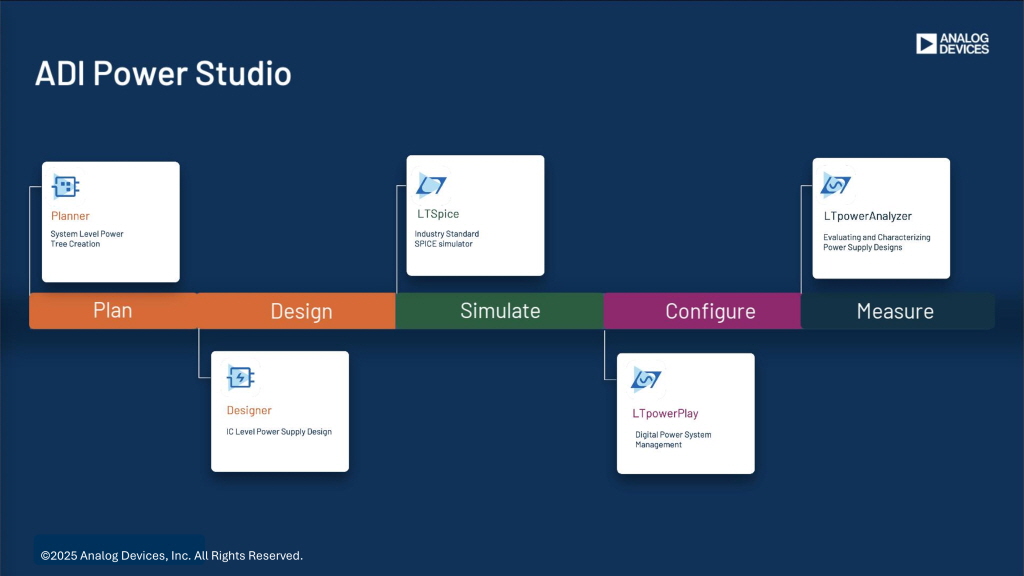
▲ADI Power Studio configuration diagram
Simulation results are provided within 1 second, and are integrated with LTspice and SIMPLIS.
“Our goal is to have the first design working when developing a power system, and that’s the end of development.”
Analog Devices, Inc. (ADI) announced at a press conference on the 24th the launch of 'ADI Power Studio,' a comprehensive power design solution that provides advanced modeling, component recommendations, and efficiency analysis capabilities based on simulation.
In addition, ADI also unveiled early versions of ADI Power Studio Planner and ADI Power Studio Designer, new web-based tools that provide an enhanced user experience under the Power Studio brand.
Bob Reay, Vice President of ADI's Multimarket Power Group, who was in charge of the presentation that day, emphasized the need and function of an integrated workflow that supports customers to efficiently perform the entire process from initial design to simulation and measurement.
Bob Ray, Vice President, said, “Power Studio is a platform that integrates existing Linear Technology (LTC) and Maxim design tools into one.“It was developed to address the challenges faced by modern power systems, including diverse power rails, complex voltage domains, and demanding load requirements,” the company said.
He continued, “Through this, ADI helps customers proceed with a single flow from component selection and design, simulation, and performance measurement.”
The platform is largely divided into five stages.
The first is the 'planning' stage, which is a high-level design process that designs the system architecture and constructs a block diagram. You can compare various voltage domains and architectures to establish the optimal design direction.
The second is the 'design' stage, which is the process of selecting individual parts and reflecting them in the design.
The third is the 'simulation' stage, where detailed circuit simulation is performed using LTspice or SIMPLIS tools.
The fourth is the 'configuration' stage, which sets up the components to be mounted on the board and configures the software for digital control.
The final step is the 'measurement' stage, where actual hardware performance is evaluated using the LT Power Analyzer.
In particular, ADI has equipped this platform with an AI-based 'Wizard' function, which automatically recommends optimal components and design plans based on design requirements entered by the user.
This allows engineers with limited design experience to easily start their first design and helps them reach a final design with the initial design without repeated redesign.
Additionally, Power Studio is web-based, enabling real-time collaboration and data sharing.
It can also be useful in team-based development environments, as multiple engineers can work on projects or review designs simultaneously.
In addition to wizard functions, ADI cited powerful LTspice-based simulation, portable and cost-effective hardware measurement tools, and performance comparison analysis functions as its strengths that differentiate it from its competitors.
These features are described as elements that major competitors do not offer.
The symposium also presented actual design examples.
Users can choose from a variety of options including input voltage, output voltage, current, board size, and cost.By setting a single parameter, the designer tool can recommend optimal components and simulate efficiency, power loss, dynamic response, and more at the system level.
Simulation results are provided quickly, within about 1 second, and once satisfactory performance is confirmed, detailed simulations can be continued with LTspice or SIMPLIS.
“ADI’s goal with Power Studio is to help customers quickly discover the value of their components and confidently move from the earliest stages of design to the next,” said Vice President Bob Ray. “In the future, we plan to expand beyond the planning and design stages to include simulation and measurement, making it web-based, and we will continue to strengthen our AI capabilities.”

Comments
Related news
[Technical contribution] ADI Adam Huff and George Chian, Measuring loop response when upper feedback resistor is not accessible
Adam Huff and George Chian of Analog Devices (ADI) discuss methods for measuring loop response when the top feedback resistor is inaccessible.
2025.06.02by 명세환 기자
ADI, “Securing stable oscillator oscillation conditions using ADALM2000 is key”
Antoniu Miclaus, Systems Applications Engineer at Analog Devices, Inc., discusses hands-on practice with a Colpitts oscillator using the ADALM2000 educational kit.
2025.07.18by 배종인 기자
.jpg)
[2025 e4ds Tech Day] ADI Director Seongho Son: "'GMSL' Emerging as a Key Interface in the SDV Era"
GMSL (Gigabit Multimedia Serial Link), a high-speed, high-reliability, low-latency multimedia transmission technology, is gaining significant attention as it is well-suited for sensor, display, and camera networks in Software Defined Vehicle (SDV) development. In particular, in SDV projects based on Zonal architecture, GMSL simplifies communication between ECUs and sensors and achieves wiring optimization through PoC functionality. The combination of GMSL, Automotive Ethernet, and TSN optimizes communication between sensors, controllers, and HPCs, and through role-sharing of each technology, it delivers optimal performance in securing real-time performance and stability. In this context, Analog Devices (ADI) plans to present "High-Speed Data Transmission Technology for SDV - ADI GMSL" at the "2025 e4ds Tech Day" scheduled for September 9th, focusing on the core of GMSL technology and its application cases within SDV trends. We met with Son Sung-ho, Director at ADI, who is leading the presentation, to discuss ADI's GMSL technology.
2025.08.27by 배종인 기자
[Technical Contribution] ADI's Frederik Dostal: "Buck-boost voltage conversion topology combined with ADI's Silent Switcher technology achieves exceptional EMI/EMC performance."
We spoke with Frederik Dostal of Analog Devices, Inc. about buck-boost voltage conversion technology with excellent EMI/EMC performance.
2025.09.11by 배종인 기자

[2025 e4ds Tech Day] "ADI GMSL Solutions: A Core Infrastructure for the SDV Era"
ADI (Analog Devices Inc.) Executive Director Son Sung-ho presented on "High-Speed Data Transmission Technology for SDV - ADI GMSL" at the '2025 e4ds Tech Day,' providing detailed information on SDV architecture and how ADI's GMSL (Gigabit Multimedia Serial Link) solution is applied within it. Executive Director Son Sung-ho stated, "The automotive industry is undergoing rapid paradigm shifts. There is accelerating transition away from traditional hardware-centric vehicle design toward software-centric 'Software Defined Vehicle (SDV)'" and added, "Within this trend, ADI is leading core technologies in future mobility through high-speed interface solutions optimized for the SDV era."
2025.09.19by 배종인 기자











