


[Serial Feature] Physical AI: Redefining the Future of Industry ②, "The 'Physical AI Market' Will Become a $1 Trillion Ecosystem by 2030."
 Published2025.10.27 16:43
Nvidia, OpenAI, and others are leading the physical AI ecosystem, and competition among countries is intensifying.
[Editor's Note] While conventional AI focuses on inference and generation within digital data, Physical AI directly acts and reacts in the real world through sensors, edge computing, robots, and control systems. The implementation of Physical AI can significantly advance industrial innovation and automation because it directly acts and solves problems in the real world, and it directly interacts with the real world. Accordingly, global companies such as Nvidia, Tesla, and Google are making massive investments in Physical AI, and the related market is expected to grow explosively. To implement this Physical AI, recognition technologies such as sensors, as well as edge computing and embedded systems for real-time data processing, local computing, robotics, and control technologies are essential. Accordingly, e4ds News has prepared a series of articles to examine the core technologies and implementation strategies of physical AI, including the concept, market outlook, related technologies, and actual cases.
.jpg)
▲Automobile production facility using physical AI (Photo: Shutterstock)
According to some experts, 'Physical AI' will be the greatest revolution in human history, surpassing the Industrial Revolution.
Although it has a significant social, cultural, and economic impact, we cannot predict the full extent of it. Therefore, from an economic perspective, according to forecasts by global market research firms, physical AI is expected to become a key driving force that will shake up the industrial structure to the point where it will reach a market worth approximately $1 trillion by 2030.
First, according to Statista, the robotics market is projected to grow from approximately $50.3 billion in 2025 to $65 billion in 2030, representing an average annual growth rate of 5.2%.
Industrial robots are at the heart of manufacturing automation, while service robots and collaborative robots are rapidly expanding in logistics and healthcare.
The autonomous vehicle market is expected to experience explosive growth. According to Statista and Grand View Research, the market, which was worth $42.8 billion in 2025, is projected to reach $214.3 billion by 2030. With an average annual growth rate of nearly 20%, this sector represents a complex ecosystem combining diverse technologies, including sensors, AI chips, and vehicle operating systems.
The smart manufacturing market is also noteworthy. According to Market Research Future, the market is expected to grow from $500 billion in 2025 to $800 billion in 2030, at a compound annual growth rate of 9%. Technologies such as digital twins, AI-based quality control, and predictive maintenance are maximizing process efficiency.
AI semiconductors serve as the brain of physical AI. According to Statista, the market size is projected to more than triple, from $92.7 billion in 2025 to $332.7 billion in 2030. The 29.1% compound annual growth rate represents the steepest growth rate in the physical AI ecosystem.
The embedded systems market, another foundational technology, is projected to expand from $186.7 billion in 2025 to $283.9 billion in 2034, according to Precedence Research. While the growth rate is relatively stable at 4.8%, it remains an essential core technology in diverse fields, including IoT devices, vehicles, and medical devices.
Physical AI isn't a single market. Sensors collect data, embedded systems process it, AI models make decisions, and robots and vehicles translate that information into action. Throughout this process, semiconductors serve as the engine that powers all of this technology.
In other words, the growth of autonomous vehicles will dramatically increase demand for AI chips, which in turn will lead to the proliferation of embedded systems and smart manufacturing. Rather than each market operating independently, these two markets are intertwined and growing into a convergent ecosystem.
Accordingly, investments from related companies and countries are also proceeding rapidly.
NVIDIA, a dominant player in the GPU and AI chip markets, is expanding its physical AI ecosystem with its autonomous driving platform Drive and robotics platform Isaac. Recently, there has been a move to dominate the simulation infrastructure across industries by incorporating Omniverse-based digital twin technology into smart manufacturing and robot development.
While OpenAI doesn't directly build robots, it contributes to research on robot control and autonomous systems through reinforcement learning and multimodal models. Through its collaboration with Microsoft, it provides cloud and edge computing infrastructure, strengthening the role of physical AI as the brain.
Amazon continues to invest heavily in logistics automation and robotics. Amazon Robotics already operates tens of thousands of warehouse robots, and AWS provides an AI learning platform for autonomous driving and robotics, supporting the expansion of the ecosystem.
Google (Alphabet) is leading the global autonomous driving market through its autonomous driving subsidiary Waymo. DeepMind is leading research in reinforcement learning-based robot control, and Google Cloud provides AI-based smart factory solutions to manufacturing and logistics companies.
By country, the United States is characterized by large-scale private-sector investment. Companies like Tesla, Nvidia, Google, and Amazon are leading the way in autonomous driving, robotics, and semiconductors, and the defense and space sectors are also actively utilizing physical AI technology.
China is investing heavily in smart manufacturing and robotics through its state-led "Made in China 2025" strategy. Companies like Baidu, Alibaba, and Huawei are spearheading autonomous driving, AI chip, and smart city projects, while government subsidies and deregulation are accelerating the expansion of the ecosystem.
In Korea, companies such as Samsung Electronics, Hyundai Motor Company, and LG Electronics are expanding their investments in semiconductors, autonomous driving, and robotics, respectively. The government is supporting the ecosystem through its K-Smart Manufacturing strategy and AI semiconductor development policy, while Hyundai Motor Group is simultaneously strengthening robotics and autonomous driving through its acquisition of Boston Dynamics.
Experts say that physical AI will change the global industrial landscape over the next 10 years, and advise that Korea, with its strengths in semiconductors and smart manufacturing, must take the lead in the physical AI era by connecting with the global ecosystem.
The next part will cover 'sensors', a core technology of physical AI.

Comments
Related news
“Korea’s Key Technology Self-Reliance through Large-Scale Investment in Physical AI Is Essential”
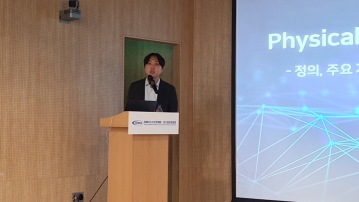
Lee Hae-su, Senior Researcher at the AI Policy Research Division of the Software Policy Research Institute, presented on "Physical AI Development Trends and Related Policy Implications" at the '2025 Embedded AI Trend Forum' held on the 16th at the Grand Hall of Korea Conference Center, hosted by the Embedded Software and System Industry Association (Chairman Lee Chang-yeol, hereinafter KESSIA). He stated that Physical AI is a next-generation technology that will determine industrial competitiveness and national security, and that proactive measures are urgently needed.
2025.07.21by 명세환 기자
“On-device AI requires a lightweight AI model, system software stack, and AI hardware.”
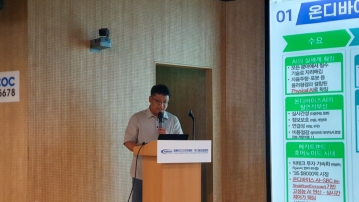
Kwon Jin-se, a researcher at the On-Device AI Research Division of the Electronics and Telecommunications Research Institute (ETRI), presented "On-Device AI Optimization Technology as Seen Through the Case of Quadruped Robot Guide Dog" at the "2025 Embedded AI Trend Forum" held on the 16th at the Korea Conference Center Grand Hall, hosted by the Embedded Software and System Industry Association (Chairman Lee Chang-yeol, hereinafter KESSIA), and discussed practical cases of Physical AI technology that fuses robotics with on-device AI technology.
2025.07.21by 배종인 기자
[2025 e4ds Tech Day] "The Era of Physical AI: New Opportunities for the Semiconductor Industry"
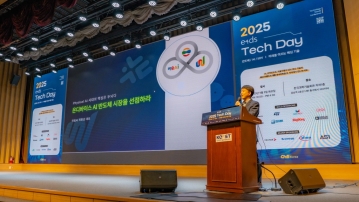
"Physical AI and on-device AI have now become essential technologies rather than optional ones, and semiconductor development for these will determine competitiveness across the entire industry." Choi Hong-seob, CEO of Maum AI, presented on 'On-Device AI Technologies and Strategies in the Physical AI Era' at the '2025 e4ds Tech Day' event held on September 9th, delivering an in-depth presentation on the definition and market outlook of Physical AI as well as the importance of on-device AI semiconductors.
2025.10.20by 배종인 기자
[Serial Project] Physical AI: Redefining the Future of Industry ①, "The Success of Physical AI Depends on the Design of Interactions Between Humans and Intelligent Machines."
While conventional AI has focused on inference and generation within digital data, Physical AI acts and responds directly in the real world through sensors, edge computing, robots, and control systems. The implementation of Physical AI can significantly advance industrial innovation and automation since AI directly acts and solves problems in the real world, interacting directly with the physical environment. Accordingly, global companies including NVIDIA, Tesla, and Google are making massive investments in Physical AI, and the related market is expected to grow explosively. To implement such Physical AI, perception technologies including sensors, edge computing and embedded systems for local computing to process real-time data, as well as robotics and control technologies are essential. In response, e4ds news has prepared a series of articles to examine core technologies and implementation strategies ranging from the concept of Physical AI to market outlook, related technologies, and practical cases.
2025.10.20by 배종인 기자
.jpg)
AMD Platforms: A Perfect Fit for Physical AI
Robotec.ai will unveil a fully autonomous warehouse robot powered exclusively by AMD Ryzen™ AI processors at ROSCon 2025 held in Singapore, in collaboration with AMD and Liquid AI. The robot is equipped with agentic AI technology that performs tasks through real-time inference and natural language understanding, moving away from traditional hardcoded command methods.
2025.10.27by 배종인 기자











