


Mouser's Carolyn Mathers: "Ultra-thin OLED Night Vision Revolution"
 Published2025.11.04 10:52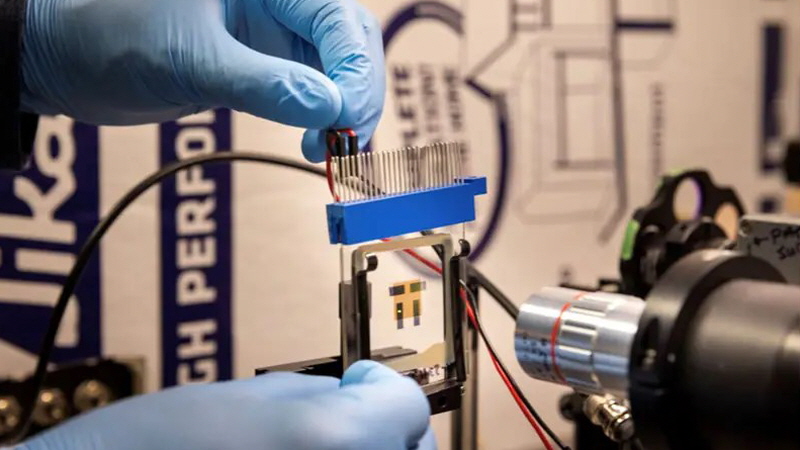
▲Source: Marcin Szczepanski, Michigan Engineering
Expanding its scope of application from military to smart cities and autonomous driving, offering a wide range of benefits.
Night vision goggles first appeared in the 1930s as military technology advanced.
It began to be widely used during World War II. Although technology has advanced over the years, these devices are still bulky, expensive, and heavy.
Night vision systems work by converting near-infrared light into electrons, which then pass through a vacuum and reach a screen, where they are converted into visible light.
Because the light is amplified approximately 10,000 times, users can see clearly even in the dark.
However, this process is very power-consuming, which poses significant design constraints and ultimately increases size and cost.
Organic light-emitting diodes (OLEDs) can also convert infrared light into visible light in a 1:1 ratio.
However, a recently developed new OLED changes this ratio by producing multiple output photons for each input photon.
According to researchers at the University of Michigan, applying this new OLED technology to small, lightweight eyewear could lead to low-cost, long-lasting night vision devices.
■ Operating Principle
This new OLED solution converts near-infrared light into visible light and amplifies it, delivering amplification of more than 100 times without using conventional high-voltage components.
Amazingly, this light amplification takes place within an ultra-thin film stack less than 1 micron (0.001 mm) thick, much thinner than the width of a human hair (about 50 microns).
This device operates at much lower voltages than conventional image intensifiers, reducing power consumption and extending battery life.
By combining a photon-absorbing layer with a five-layer OLED stack, the new OLED converts infrared light into electrons, which are then converted back into visible-light photons.
Unlike the conventional 1:1 ratio, this OLED has a Each time an electron passes through the stacked structure, five photons are generated. As a result, more output light can be obtained with the same amount of input light.
Previously, OLEDs could be used to convert near-infrared light into visible light, but without pure photonic gain.
A research team led by Professor Chris Giebink at the University of Michigan has achieved high photon gain for the first time in a thin-film device, and their results were published in the journal Nature Photonics. Postdoctoral researcher Raju Lampande also participated in the research.
The research team increased cost efficiency and scalability by utilizing commercially available materials and existing OLED manufacturing technology. This achievement opens the way to important advancements in display technology, upconversion imaging, and neuromorphic optoelectronics.
■ Memory components
What's unique about this approach is that there is a 'memory effect' within the OLED.
This opens up the possibility for computer vision systems to detect and interpret incoming light signals or images.
This phenomenon is commonly called 'hysteresis', which means that the current state of the system depends to some extent on past inputs.
For OLEDs, hysteresis means that the light output at a given moment is affected by the intensity and duration of light received in the past, allowing the device to 'remember' previous illumination and improve its current performance based on that history.
Professor Gibbing explained the hysteresis phenomenon as follows:
“When you shine light on an upconverted OLED, it starts to glow, and when you turn off the light, it stops glowing.”
However, the new device developed this time can remain 'on' over time and remember past lighting.
These unique memory properties enable it to process images much like the human visual system.
This property is similar to how neurons in the human brain remember past signals and process information, and helps OLEDs analyze and classify images more effectively.
These OLEDs, which can retain previous inputs, can implement a neuron-like connection structure, allowing them to directly interpret and analyze input images without a separate computational unit.It provides an ideal foundation for .
■ Beyond Military and Defense
Traditionally, we associate night vision technology with the military and defense industries, but the potential applications of these ultra-light OLEDs extend far beyond that.
In smart cities, this technology could enhance urban safety by providing small, portable night vision devices for police officers and emergency responders.
Additionally, OLED night vision can be linked to IoT networks and applied to smart monitoring in dark spaces.
Cities like New York and Singapore are already exploring next-generation urban programs that could benefit from these technologies.
In the autonomous vehicle field, OLED night vision sensors can improve object recognition in night environments and increase energy efficiency.
This makes it a suitable option for both electric and autonomous vehicles. This technology could be extended to a variety of fields, including augmented reality (AR), wearable devices, industrial settings, and even wildlife observation.
For example, AR glasses could display real-time maps of wildlife locations for hikers and photographers, while construction workers could use these OLEDs to improve work safety.
Conservation researchers could also use miniature devices incorporating this technology to observe nocturnal wildlife activity in remote areas.
These diverse application examples demonstrate the wide range of benefits OLED-based night vision technology can provide.
■ The Future of Night Vision
Night vision with OLED technology promises to be the next leap forward in how we interact with the night world.
Researchers at the University of Michigan have overcome the limitations of existing systems—bulk size, high power consumption, and reliance on complex, high-voltage components—by achieving high photonic gain in a compact, thin-film device.
The ability to amplify light with extremely low power means the technology has wide-ranging applications in a variety of fields, including military and surveillance applications, as well as wearable devices and self-driving cars.
This innovation was developed in collaboration between OLEDWorks, a leading provider of OLED lighting solutions, and RTX, an aerospace and defense innovator, and is supported by research funding from DARPA.
※ About the author
; padding-right: 20px;" />Carolyn Mathas is a freelance writer and site editor for United Business Media's EDN, EE Times, IHS 360, and AspenCore, and has collaborated with numerous companies. She previously served as Director of Marketing for Securealink and Micrium, Inc., and has provided public relations, marketing, and content creation services to companies including Philips, Altera, Boulder Creek Engineering, and Lucent Technologies. She holds an MBA from the New York Institute of Technology and a bachelor's degree in marketing from the University of Phoenix.

Comments
Related news
.jpg)
Bill Schweiber Mouser Electronics, “Linear Motors Are an Attractive Choice for a Variety of Industrial and Specialty Applications”
We spoke with Bill Schweber from Mouser Electronics about linear motors.
2025.03.11by 명세환 기자
Mouser Marcel Conce, “Digital Insulation Plays a Crucial Role in Preventing Electrocution Accidents and EMI”
Marcel Consee from Mouser Electronics talks about digital isolation.
2025.06.17by 명세환 기자

Mouser: "Container Technology Makes Embedded Software Development More Efficient and Flexible"
We spoke with Adam Taylor of Mouser Electronics about container technology that is transforming embedded software development.
2025.08.14by 배종인 기자
Mouser: "For Efficient Operation of Single-Phase AC Motors, Selection and Management of Starter and Run Capacitors Are Essential"
I spoke with Bill Schweber from Mouser Electronics about the importance of starting and running capacitors in single-phase AC motors.
2025.09.18by 배종인 기자
.jpg)
48V power systems for AI data centers are on the rise.
According to "Optimizing Efficiency as Data Centers Shift to 48V Power" recently published by Mouser Electronics, high-efficiency power management solutions centered on 48V architecture and polymer capacitors are emerging as key technologies for simultaneously securing both stability and profitability in data centers.
2025.10.14by 배종인 기자











