


Creaform Accelerates Targeting of Reverse Engineering Market with 'HandySCAN 3D|PRO Series'
 Published2025.11.06 09:02
Portable 3D scanners offer a solution to the demand for digital restoration in the automotive and aerospace industries.
Creaform, a business unit of AMETEK Inc. and a global specialist in portable 3D measurement solutions, is accelerating its push into the reverse engineering market by adding the 'PRO Series' to its flagship product line, HandySCAN 3D™.
The newly unveiled PRO series is an integrated solution combining high-precision, high-speed hardware with intuitive Scan-to-CAD Pro software, which optimizes the entire product development process by dramatically reducing the time required from data collection to 3D model creation.
Creaform led the industry 20 years ago by introducing the first portable self-positioning 3D laser scanner, and the new PRO series builds upon that technological legacy while further enhancing accessibility and productivity.
Recently, the demand for reverse engineering has been rapidly increasing in various manufacturing sites, including the automotive, aerospace, and defense industries. In particular, the importance of high-precision scanning technology is growing in the process of restoring older vehicles or discontinued parts, or analyzing the structures of competitor products.
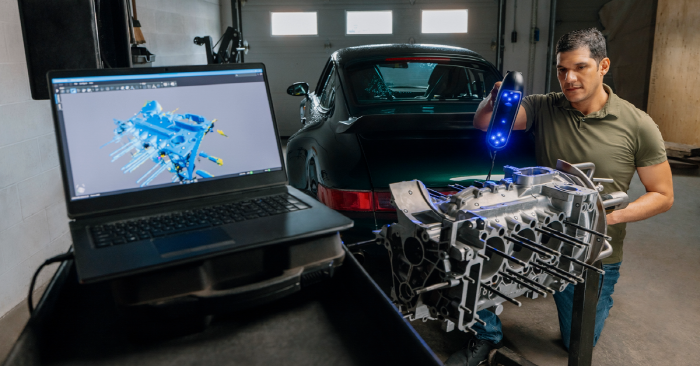
For example, some automakers use 3D scanners to digitize the shape of parts and convert them into CAD models to restore mold data of classic cars, and then rework them into modern designs. At aircraft manufacturing sites, maintenance accuracy is enhanced by scanning aging fuselages or wing structures to obtain precise models and comparing even minute deformations in real time.
Amidst this trend, the technological capabilities of the HandySCAN 3D PRO series, which measures millions of points per second and achieves precision of 0.03 mm, are becoming an attractive alternative for manufacturing companies seeking to increase development efficiency.
The new product uses a total of 23 blue laser lines to quickly capture complex shapes without distortion, and the integrated Scan-to-CAD Pro module automatically meshes scan data and supports sketching and modeling tasks.
Through this process, designers can immediately continue modifying and designing within the CAD environment as soon as they read the physical shape via the scanner. Since separate file conversion or intermediate editing is not required, the entire cycle from design to verification to release is shortened, resulting in faster market response times. The user interface, equipped with an LCD touchscreen and vibration feedback, enhances usability for field engineers, and the system is designed at a reasonable price point that is applicable to everyone from SMEs to large enterprise R&D organizations.
Such integrated solutions are also aligned with the 'digital twin' trend that is rapidly spreading across industries. Converting actual product shape data into high-precision 3D models serves as the foundation for simulation in virtual environments, additive manufacturing (3D printing), and maintenance automation.
In particular, these scanning-modeling solutions are becoming essential tools in industries that require the reinterpretation of physical objects as data, such as the lightweight design of automotive parts, aerodynamic analysis of fighter jets or drones, and durability reinforcement of ships and heavy equipment. The global reverse engineering market is projected to grow from $3.3 billion in 2023 to $9 billion in the early 2030s, with high-precision 3D measurement technology at its core.
Pierre-Luc Delagrave, Product Manager at Creaform, stated, “The PRO series is the optimal tool for quickly realizing ideas and producing perfect results from the start,” adding, “Based on reasonable pricing and high precision, it will accelerate the future of industrial measurement technology.”
In fact, there is a growing number of cases where designers in the automotive and aerospace sectors, as well as in the defense, energy, and robotics sectors, are seeking to redesign or improve the performance of older parts through reverse engineering, and this demand is expected to expand further with the development of high-speed and high-precision scanners.
Ultimately, the launch of the PRO series signifies more than just the arrival of a new scanner. This is because it marks the starting point for ushering in an era of 'real-time engineering,' which compresses product development cycles and enables the immediate acquisition and modification of design data on-site. Reverse engineering is evolving from a technology for restoring the past into the first step in designing future products.

Comments
Related news
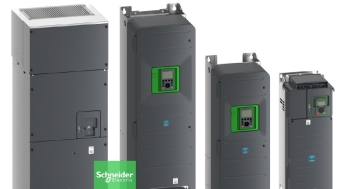
Schneider Aims for Building Energy Savings and Operational Stability with Next-Generation HVAC Drives
Schneider Electric has unveiled its next-generation HVAC drive product line 'Altivar HVAC'. The new product line's key features center on enhanced energy savings, system operational stability, and building management system integration. The products are divided into 'ATH200' for OEM and small equipment applications, and 'ATH600' for environments requiring continuous operation and advanced control. The company plans to expand the application scope from commercial buildings to facilities where HVAC system stability is critical, such as hospitals, airports, and data centers. The announcement includes over 30% energy savings, operation from -10°C to +60°C, Modbus and BACnet support, and compatibility with low global warming potential refrigerants.
2026.03.26by 명세환 기자
Ecolab Expands AI Data Center Cooling Business Through Acquisition of CoolIT
Ecolab has agreed to acquire CoolIT Systems, a liquid cooling company for AI data centers, for approximately $4.75 billion. The transaction is expected to close by Q3 2026, subject to regulatory approvals. CoolIT has been supplying direct-to-chip cooling-based coolant distribution units, cold plates, and manifolds, serving hyperscale data centers and colocation operators as customers. This acquisition is a measure to address the high-heat and high-density server environments created by AI proliferation. Ecolab plans to combine its water management and digital monitoring capabilities with CoolIT's hardware technology to expand its data center cooling business.
2026.03.26by 명세환 기자

AI Semiconductor Era, Key is 'Materials Technology'… KIEC Holds Seminar on High-Performance Semiconductor Materials
With rapid growth in the global semiconductor market driven by expanded AI data center investments and increased demand for high-bandwidth memory (HBM), a specialized seminar examining next-generation semiconductor materials and packaging technologies will be held. The Korea Chemical Industry Institute will host a "High-Performance Semiconductor Materials Technology Seminar" on April 24 at the FKI Tower of the Korea Economic Association in Yeouido, Seoul. Applications to participate in the seminar are being accepted on a first-come, first-served basis through the Korea Chemical Industry Institute's official website, with early bird discounts available until March 27 and advance registration open until April 22.
2026.03.25by 배종인 기자
.jpg)
KIMS Shares Techniques for Industrial Application of Casting Technology
The Korea Institute of Materials Science held a casting technology seminar at its headquarters in Changwon, South Gyeongsang Province, and introduced core process technologies utilized in industrial applications. The seminar covered fundamental principles of casting processes and defect control methods, lightweight-oriented die-casting technology, and trends in aluminum casting alloys for mobility applications. At the conclusion of the event, consultations on industrial technical challenges were also conducted, providing an opportunity to expand the interface between research institutions and industry.
2026.03.25by 명세환 기자
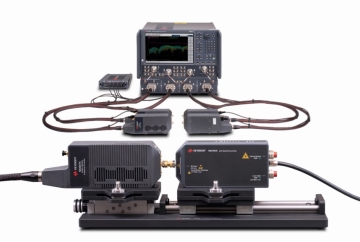
Keysight Launches 220GHz Optical Component Analyzer… Aims at Verifying Next-Generation Optical Transceivers
Keysight Technologies has introduced the N4378A optical wave component analyzer, which can measure the characteristics of opto-electronic conversion components up to 220GHz. This equipment is targeted at the rapidly advancing data center optical interconnection market driven by AI and cloud expansion, and supports single-sweep broadband measurements at 1310nm and 1550nm wavelengths. The device focuses on enhancing measurement accuracy and design verification efficiency in the development process of next-generation 1.6T and 3.2T class optical transceivers through optical modulator and photodetector verification, differential measurements for dual-drive optical modulators, and 0.5mm coaxial connector protection structures. Keysight demonstrated this equipment for the first time at OFC 2026.
2026.03.25by 명세환 기자











